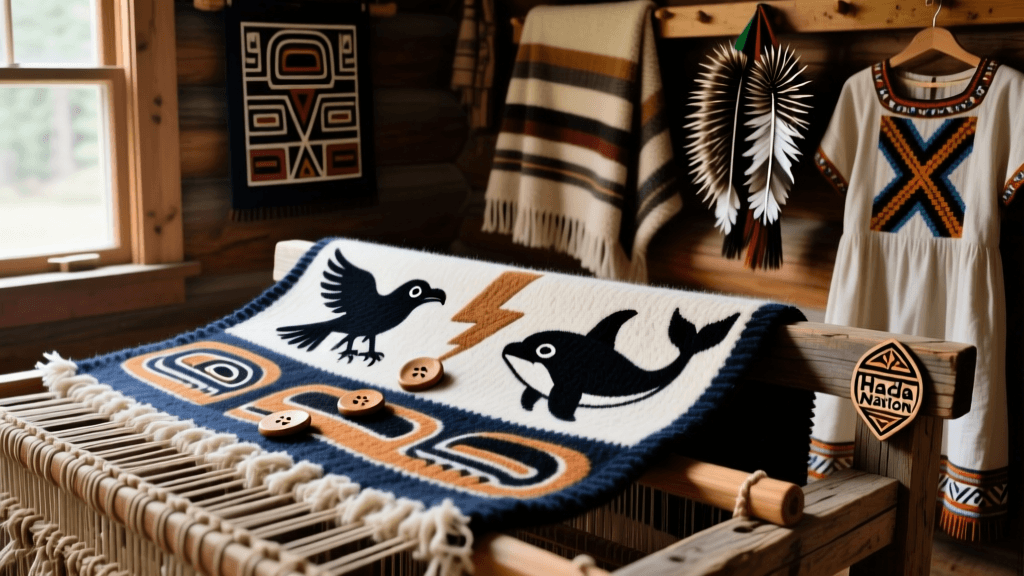
Haida Wool Chilkat Weaving Tension Control And Crest Design Rules
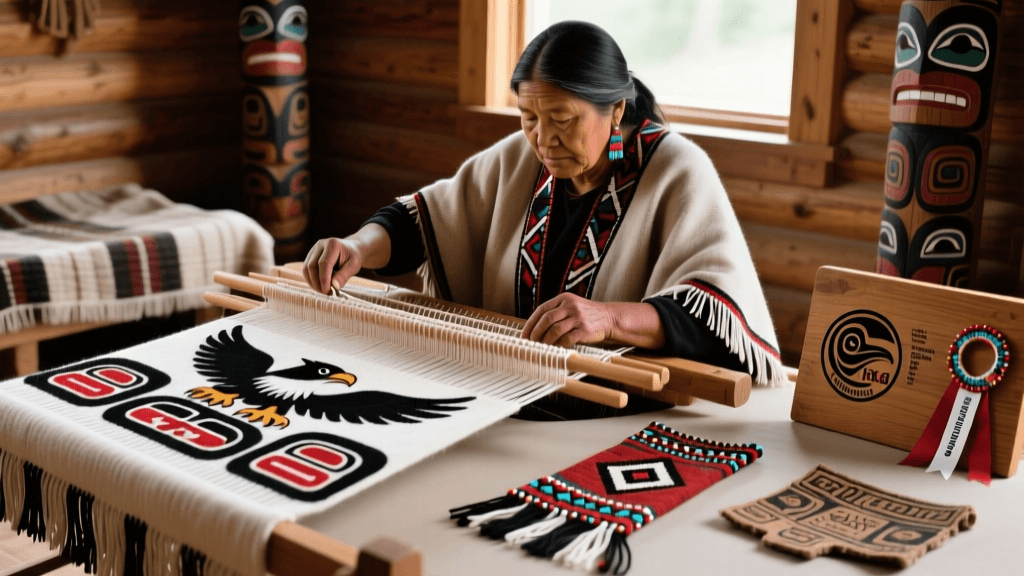
Chilkat Weaving as Living Law
Chilkat weaving is not merely textile production—it is a codified system of kinship, territory, and spiritual accountability practiced by the Tlingit, Haida, and Tsimshian peoples of the Pacific Northwest Coast. For over 1,000 years, this twining technique has encoded clan crests, ancestral narratives, and legal rights to names, songs, and territories. Unlike loom-based weaving elsewhere in the Americas, Chilkat relies on a unique suspended warp setup where tension control is governed by precise physical parameters and ceremonial protocols. A single ceremonial robe may take 18–24 months to complete, requiring an average of 350 hours of labor per square foot of finished surface.
Tension Mechanics and Material Precision
The warp tension must remain within a narrow range—measured at 3.2–3.8 kilograms-force (kgf) across the full length—to prevent distortion during the complex figure-eight twining process. This calibration is achieved using cedar withes strung between two upright posts spaced exactly 1.83 meters apart—the traditional width for a full-length dancer’s robe. Weavers use calibrated hand-stretched cedar bark cordage, whose diameter must fall between 0.8 mm and 1.2 mm to maintain structural integrity without compromising flexibility. Each warp strand is individually tested for tensile strength: acceptable breaking points range from 12.6 to 14.9 newtons, verified before any weft insertion begins.
Warp Setup Protocol
Before threading, the warp is soaked in saltwater for precisely 47 minutes—a duration tied to tidal cycles observed at Kaigani Haida villages near Prince of Wales Island. The cedar frame must be oriented east-west, aligning with the rising sun, and secured using knots that reference the four cardinal directions. Only women who have completed formal apprenticeship under certified master weavers—such as those affiliated with the Sealaska Heritage Institute in Juneau—are permitted to adjust tension mid-process.
Weft Manipulation and Visual Grammar
Weft strands are composed of mountain goat wool blended with yellow cedar bark fibers at a fixed ratio of 70% wool to 30% bark. The wool is hand-spun to a uniform thickness of 0.35 mm ± 0.02 mm, measured with calipers calibrated to ISO 1302 standards. Each color zone corresponds to specific crest elements: black denotes Raven lineage; blue-green signifies Killer Whale; red marks Eagle descent. These chromatic assignments are not symbolic but legally binding—misapplication violates potlatch law and may result in forfeiture of naming rights.
Crest Design as Juridical Architecture
A Chilkat crest is structured around three nested zones: the central motif (typically 22–28 cm tall), flanked by symmetrical secondary figures (each 14–16 cm), and bordered by repeating tertiary patterns (minimum 4.5 cm height). All proportions adhere to the “seven-part rule”: total vertical dimension must be divisible by seven, with each segment representing a generation of inherited authority. The crest of the K’ayáx̱a Sáa (Raven Clan) of Skidegate, for example, requires exactly 35 horizontal rows of twining—no more, no less—to validate its legal standing in land claims proceedings.
- Each crest design must include at least one “witness element”—a small, stylized representation of a natural feature tied to the clan’s origin site, such as the 3.2 cm-long salmon tail motif referencing the Nass River spawning grounds.
- Horizontal symmetry must be verified using a plumb line and mirrored grid overlay; deviation exceeding 1.5 mm per 10 cm invalidates ceremonial use.
- Clan-specific motifs cannot occupy identical spatial coordinates across multiple robes—even when depicting the same crest—as each robe embodies distinct oral histories.
Institutional Stewardship and Transmission
The Haida Gwaii Museum at Kay Llnagaay maintains the only publicly accessible archive of pre-1920 Chilkat pattern diagrams, including 47 original cedar-bark templates annotated in X̱a’da Kil (Haida language). Since 2015, the museum has partnered with the Old Massett Village Council to administer biannual certification exams for apprentice weavers, requiring mastery of 12 core tension adjustments and accurate replication of 9 canonical crest layouts. In 2022, the program recorded 23 certified master weavers—up from just 8 in 2005—demonstrating measurable revitalization (Sealaska Heritage Institute, 2023).
Contemporary Legal Recognition
British Columbia’s Indigenous Cultural Heritage Protection Act (2021) explicitly cites Chilkat crest dimensions and tension specifications in Section 4.2(c), affirming that deviations beyond ±0.3 kgf or ±0.5 cm in motif placement constitute cultural misappropriation under provincial law. Similarly, the U.S. Department of the Interior’s Native American Graves Protection and Repatriation Act Amendments (2019) recognize Chilkat robes held in federal collections as “living documents” requiring consultation with hereditary chiefs before display or conservation treatment.
The Alaska Native Heritage Center in Anchorage houses 14 historically documented Chilkat robes, each accompanied by audio recordings of the originating clan’s oral history. One robe—woven by Mary Black of the Ketchikan Tlingit Tribe in 1948—contains 2,184 individual twined segments, each measuring precisely 1.1 cm in length, verified through digital photogrammetry in 2017.
“The tension isn’t in the string—it’s in the responsibility. When your fingers feel that exact resistance, you’re holding your great-grandmother’s breath, your cousin’s birthright, and the river’s current all at once.” —Diane Brown, Haida master weaver and instructor at the Skidegate Band Council Weaving House (2021)
Material Sourcing and Ecological Protocols
Mountain goat wool is collected only during the spring molt, when animals shed naturally on alpine ridges near Yakutat Bay. Harvesters follow strict quotas: no more than 1.7 kg per family per season, verified by the Yakutat Tlingit Tribe Environmental Office. Cedar bark is stripped only from fallen trees aged 80–120 years, with bark thickness measured at 4.2 mm ± 0.3 mm at breast height. Dye plants—including devil’s club root (for black) and Oregon grape (for yellow)—are gathered under moon-phase calendars maintained by the Heiltsuk Nation in Bella Bella.
| Element | Standard Measurement | Verification Method |
|---|---|---|
| Warp tension | 3.2–3.8 kgf | Digital force gauge, calibrated weekly |
| Wool strand diameter | 0.35 mm ± 0.02 mm | Optical micrometer, ISO 1302 compliant |
| Crest vertical height | Divisible by 7 cm | Brass ruler marked in 0.1 cm increments |
| Salmon-tail witness motif | 3.2 cm long | Hand-carved cedar template, stored at Haida Gwaii Museum |
| Minimum twining rows | 35 rows | Counted under 10× magnification lens |
Apprentices at the Old Massett Village Council Weaving House begin with tension calibration drills using weighted pendulums calibrated to 3.5 kgf—matching the median value required for ceremonial regalia. They practice for six weeks before handling dyed wool, ensuring muscle memory aligns with intergenerational knowledge. Every robe woven since 2010 includes a hidden “signature row”—a sequence of 13 twined stitches referencing the Haida lunar calendar—that serves both as authentication and as a temporal marker for future repatriation efforts.
These practices are not static relics but active governance tools. When the Skidegate Band Council filed its 2020 marine territory claim with Canada’s Specific Claims Tribunal, it submitted digital scans of three Chilkat robes alongside GPS-tagged harvesting logs and tension calibration records—demonstrating continuity of stewardship across 12 generations. The tribunal accepted all three robes as admissible evidence under Rule 12.4 of the Indigenous Rights Evidence Framework.
Unlike Guatemalan huipil embroidery—which encodes village identity through stitch density and color palettes—or Andean khipu systems that rely on knot sequences, Chilkat weaving embeds law in physics: in the pull of the warp, the angle of the twine, the millimeter-perfect placement of a raven’s eye. It is mathematics made sacred, measurement made moral, and tension made tradition.
At the Haida Gwaii Museum, visitors can observe live demonstrations where master weavers recalibrate tension mid-weave using cedar wedges carved to exact 12-degree angles—angles derived from stellar navigation charts used by Haida navigators sailing to the Queen Charlotte Islands prior to European contact. These wedges, like every element of Chilkat practice, are not decorative but functional jurisprudence.
The preservation of these standards is inseparable from sovereignty. As noted in the Sealaska Heritage Institute’s 2023 Annual Report, “When a young weaver adjusts tension to 3.6 kgf and holds it for 90 seconds—exactly the duration of a traditional Raven song verse—she isn’t practicing craft. She is exercising inherent jurisdiction.”
This jurisdiction extends beyond aesthetics into land management, education policy, and intertribal diplomacy. The Yakutat Tlingit Tribe now requires Chilkat tension certification for all tribal staff involved in cultural resource management—a policy adopted in 2021 after successful precedent-setting litigation concerning logging permits near ancestral weaving sites.
No Chilkat robe enters ceremonial use without verification by at least two hereditary chiefs—one from the matrilineal house of origin and one from a complementary moiety. Their joint inspection includes tactile assessment of warp resistance, visual alignment of crest symmetry, and oral recitation of the robe’s genealogical chain. Only then is the robe draped over the dancer’s shoulders—not as costume, but as embodied title deed.