Pacific Northwest Chilkat Weaving & Regalia in 2026
The Living Textiles of the Pacific Northwest Coast
The Indigenous peoples of the Pacific Northwest Coast—encompassing the Haida, Tlingit, Tsimshian, and Kwakwaka'wakw nations—possess one of the most complex and visually striking textile traditions in the Americas. Unlike the woven garments of the Andes or the beadwork of the Plains, Pacific Northwest regalia is deeply intertwined with the region's temperate rainforest ecology, maritime environment, and strict clan-based social structures. As we navigate the cultural landscape in 2026, the creation and wearing of these garments remain not merely an act of historical preservation, but a vibrant, evolving assertion of Indigenous sovereignty and artistic mastery.
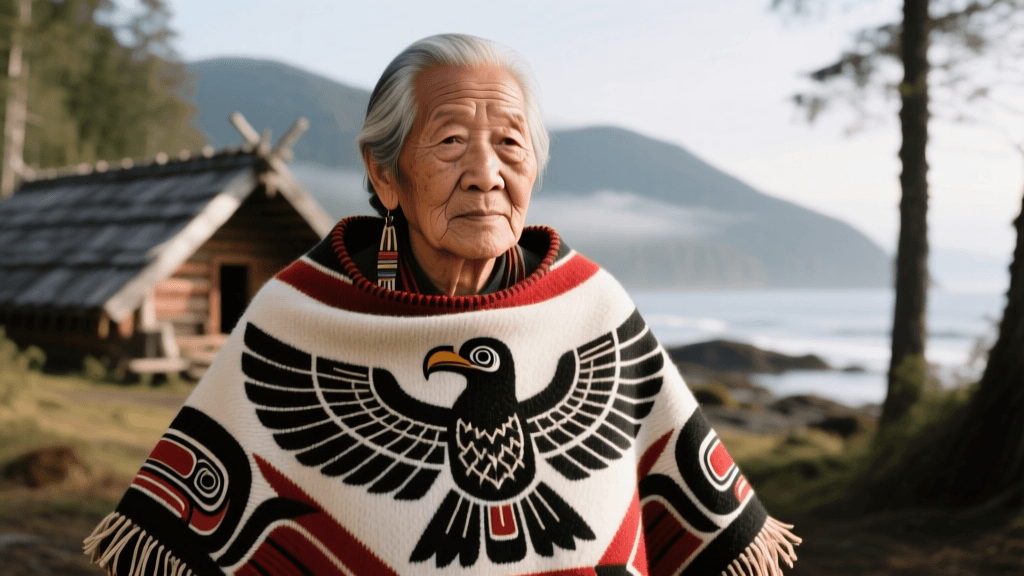
To understand Indigenous North American dress traditions in this region, one must first discard the Western concept of "clothing." In the context of a potlatch or a ceremonial dance, a woven robe is not a costume; it is a living entity. When a dancer spins, the long, weighted fringe of a Chilkat robe flares outward, mimicking the movement of water or the flight of a bird. The animals depicted on the textile—the bear, the raven, the eagle, or the killer whale—are believed to be temporarily awakened, wrapping the wearer in the spiritual protection and ancestral authority of their clan.
Chilkat Weaving: The Pinnacle of Formline Art
Chilkat weaving is widely considered the most complex and time-consuming textile art form in North America. Originating with the Tsimshian people and later adopted and perfected by the Tlingit and Haida, the art form takes its name from the Tlingit village of Jilkáat (Chilkat) in present-day Alaska. A single, master-crafted Chilkat dancing robe can take over a year of continuous, full-time labor to complete.
The technique is unique because it allows for the creation of curvilinear shapes, specifically the highly stylized "formline" designs that characterize Northwest Coast art. Unlike standard loom weaving, where the weft is passed horizontally through a fixed vertical warp, Chilkat weaving is a form of twining. The weaver works from the top down, often using a simple suspension loom, and must possess an extraordinary mental map of the design. Historically, a male artist would paint the complex formline pattern onto a wooden pattern board, and a female master weaver would translate this two-dimensional blueprint into a three-dimensional textile, interpreting the curves and ovoids with mathematical precision.
According to collections and research maintained by the Smithsonian National Museum of the American Indian, the structural integrity of a Chilkat robe relies on a hidden core of twisted cedar bark, completely encased in a soft outer layer of mountain goat wool. This gives the garment its distinctive heavy, fluid drape, which is essential for the dramatic visual effects required during ceremonial dances.
Ravenstail Weaving: The Geometric Ancestor
Before the curvilinear mastery of Chilkat, there was Ravenstail weaving. Characterized by stark, high-contrast geometric patterns—primarily utilizing black, white, and yellow—Ravenstail is an ancient technique that nearly faced extinction in the late 19th and early 20th centuries. However, leading up to 2026, Ravenstail has experienced a massive, community-led renaissance.
Ravenstail relies on complex twining techniques to create sharp angles, zigzags, and diamond shapes that represent the eyes, joints, and skeletal structures of ancestral beings. Because it does not utilize the flowing formline designs of Chilkat, Ravenstail requires a different type of mathematical focus. Contemporary master weavers from the Haida and Tlingit nations have spent the last decade reverse-engineering historical fragments, and today, a new generation of apprentices is actively producing Ravenstail tunics, leggings, and robes for ceremonial use.
Material Harvesting and Preparation in 2026
The creation of authentic Pacific Northwest regalia begins long before the loom is strung; it begins in the forest and the mountains. The two primary materials are the inner bark of the yellow cedar tree and the undercoat of the mountain goat. In 2026, climate change and environmental shifts in the Pacific Northwest have made traditional harvesting more challenging, prompting Indigenous communities to develop rigorous, sustainable harvesting protocols.
Yellow cedar bark must be harvested in the late spring or early summer when the sap is running, allowing the bark to be peeled from the tree in long, continuous ribbons. Only a small vertical strip is taken from a single tree to ensure its survival. The bark is then boiled, pounded, and separated into fine, silk-like threads. Mountain goat wool, specifically the soft, downy undercoat, was historically gathered from goats hunted for food or from wool caught on alpine brush. Today, ethical sourcing often involves partnerships with wildlife management agencies or the use of high-grade merino sheep wool for apprentice practice pieces.
Material Comparison: Traditional vs. Contemporary Sourcing
| Material Component | Traditional Source | 2026 Ethical Sourcing & Alternatives | Preparation Time |
|---|---|---|---|
| Warp (Hidden Core) | Yellow Cedar inner bark | Sustainably harvested cedar; commercial cotton core for study pieces | 40-60 hours |
| Weft (Surface Layer) | Mountain goat undercoat | Ethically shed goat wool; museum-grade merino blends for apprentices | 100+ hours |
| Natural Dyes | Western hemlock bark, wolf moss, copper | Foraged natural dyes; eco-friendly botanical equivalents | 20-30 hours |
| Fringe Weighting | Wrapped cedar bark and wool | Traditional wrapping maintained; heavy commercial yarn for practice | 50+ hours |
Beyond Weaving: The Evolution of the Button Blanket
While Chilkat and Ravenstail represent the zenith of woven textiles, the introduction of global trade routes in the 18th and 19th centuries birthed another iconic garment: the button blanket. Emerging primarily among the Tsimshian, Haida, and Kwakwaka'wakw, button blankets were created using trade wool broadcloth (often navy or black) and adorned with hundreds of pearl buttons and abalone shell.
In 2026, the button blanket remains a staple of potlatch regalia. Modern artisans have elevated the craft, integrating laser-cut abalone, intricate ribbon appliqué, and even LED threading for contemporary dance performances. The designs on button blankets strictly adhere to clan crests. Wearing a crest you do not have the hereditary right to claim is a severe breach of Indigenous law and cultural protocol. Institutions like the Burke Museum of Natural History and Culture frequently highlight how these garments serve as legal documents, visually recording land rights, lineage, and familial obligations.
Regional Variations in Fringe and Hem Treatment
When examining dress traditions by region, the treatment of the robe's hem and fringe offers distinct tribal identifiers. Tlingit robes from the Alaskan panhandle often feature exceptionally long, heavy fringe that reaches the floor, designed to create a sweeping, auditory "shushing" sound against the wooden dance floor. Haida weavers from Haida Gwaii (the Queen Charlotte Islands) historically incorporated intricate beadwork and dentalium shell borders into their later textile works, reflecting their extensive maritime trade networks. Meanwhile, Kwakwaka'wakw regalia from Vancouver Island often pairs woven elements with elaborate carved wooden frontlets and cedar bark neck rings, creating a multi-sensory experience of sound, motion, and visual storytelling.
Contemporary Revitalization and Educational Pathways
The year 2026 marks a golden era for Indigenous textile revitalization. Organizations such as the Sealaska Heritage Institute have been instrumental in funding apprenticeships, hosting weaving summits, and providing studio space for emerging artists. These programs ensure that the grueling, meditative process of thigh-spinning goat wool and the complex mathematics of twining are passed down without interruption.
Furthermore, contemporary Indigenous fashion designers are increasingly drawing upon these ancestral techniques, integrating Ravenstail geometric motifs and Chilkat color palettes into modern haute couture, streetwear, and formal evening wear. This fusion ensures that the visual language of the Pacific Northwest remains dynamic, proving that Indigenous dress is not confined to museum display cases, but is a living, breathing component of modern North American fashion.
How to Support Authentic Indigenous Artisans
For collectors, museums, and enthusiasts looking to support Pacific Northwest textile arts in 2026, ethical engagement is paramount. Always purchase directly from Indigenous artists, tribal cooperatives, or certified Native-owned galleries. Avoid mass-produced "tribal-inspired" textiles, which appropriate sacred clan crests and financially harm Indigenous communities. When attending public potlatches or cultural festivals, observe photography rules strictly—regalia is sacred, and capturing it without permission is deeply disrespectful. By prioritizing ethical sourcing and supporting educational initiatives, we can help ensure that the rhythmic sound of the cedar bark loom continues to echo through the coastal rainforests for generations to come.