Pacific Northwest Button Blankets 2026: Haida & Tlingit Guide
The Cultural Significance of the Button Blanket
The Pacific Northwest Coast is home to some of the most visually striking and culturally profound textile traditions in the Americas. Among the Tlingit, Haida, Tsimshian, and Kwakwaka'wakw peoples, the button blanket stands as a paramount symbol of clan identity, ancestral lineage, and spiritual authority. Unlike the intricate, loom-woven Chilkat blankets that require years of painstaking preparation, button blankets emerged in the 19th century as a dynamic fusion of Indigenous artistry and global trade materials. Today, in 2026, these garments are not mere historical artifacts confined to museum archives; they are living, breathing regalia worn during potlatches, naming ceremonies, and contemporary Indigenous graduation celebrations.
As cultural revitalization movements gain unprecedented momentum in 2026, a new generation of Indigenous artisans and allied makers are seeking to understand, source, and create these magnificent garments with strict adherence to cultural protocols. This comprehensive guide explores the anatomy, sacred motifs, and modern sourcing strategies for authentic Haida and Tlingit button blankets in the current market.
Historical Origins and Evolution
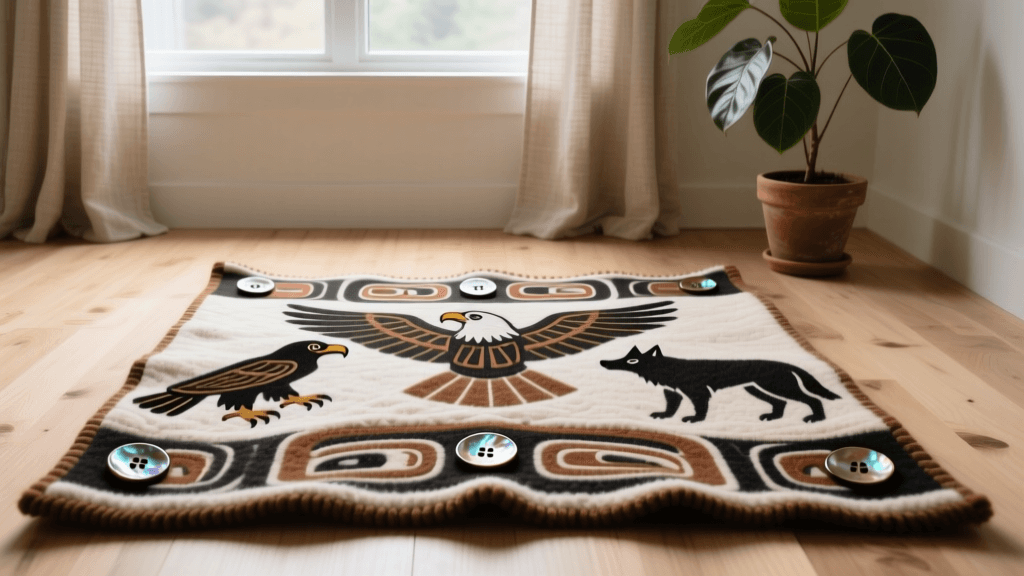
The origins of the button blanket are deeply intertwined with the maritime fur trade of the late 18th and 19th centuries. When European and American traders arrived on the Northwest Coast, they brought with them Hudson's Bay point blankets, brass buttons, glass trade beads, and mother-of-pearl buttons. Indigenous women, who were already master weavers of cedar bark and mountain goat wool, brilliantly adapted these new materials. They replaced the woven geometric patterns of traditional robes with bold, appliquéd clan crests outlined in hundreds of shimmering buttons.
According to cultural preservation resources at the Sealaska Heritage Institute, the button blanket quickly became the premier ceremonial garment for the Tlingit, Haida, and Tsimshian peoples. The reflective quality of the abalone and pearl buttons was not merely decorative; it was designed to catch the flickering light of the cedar fire in the longhouse, animating the crest figures during winter dances and imbuing the wearer with spiritual power.
Anatomy of a Traditional Haida and Tlingit Blanket
Creating an authentic button blanket requires a deep understanding of traditional material choices and structural integrity. A standard adult blanket is heavily weighted, often exceeding 15 to 20 pounds once fully adorned with buttons. The anatomy of the garment consists of three primary layers and components:
The Base Wool
The foundation of the blanket is traditionally a heavy, dark-colored Melton wool, most commonly navy blue or black. Melton wool is favored for its dense, wind-resistant, and non-fraying properties. In 2026, artisans still rely on heavyweight 24oz to 30oz Melton to ensure the blanket drapes correctly and can support the immense weight of the button work without tearing.
The Appliqué Crest
Over the dark wool base, the clan crest is applied using a contrasting fabric, historically red flannel or broadcloth. The appliqué is meticulously cut and sewn onto the base using a blind stitch, ensuring that no machine stitching or raw edges are visible on the front of the garment. The red broadcloth represents the lifeblood and vitality of the clan.
The Button Outline and Accents
The defining feature of the garment is the outlining of the appliqué crest with buttons. While early blankets used whatever trade buttons were available, modern 2026 standards heavily favor genuine Pacific abalone shell and high-grade mother-of-pearl. The buttons are sewn closely together to create a continuous, shimmering line that defines the formlines of the crest.
Sacred Motifs and Clan Crests
The designs featured on button blankets are not generic Indigenous patterns; they are highly specific, proprietary clan crests. In Haida and Tlingit societies, the right to display a specific crest is inherited and strictly guarded. The primary motifs include:
- Raven (Yéil / Yáahl): The trickster and creator figure, easily identified by its straight beak. Raven is a primary moiety crest for many Tlingit and Haida clans.
- Eagle (Ch'aak' / Xáa): Representing peace, leadership, and prestige, the Eagle is distinguished by a curved beak and is the opposing moiety to the Raven.
- Bear (Xóots / Xáa): Symbolizing strength, courage, and healing, the Bear crest often features a wide mouth with prominent canines and a protruding tongue.
- Killer Whale (Gúkw / Gúuts): A powerful marine crest featuring a prominent dorsal fin, representing longevity, familial bonds, and oceanic authority.
It is a fundamental rule of Northwest Coast art that an artisan must have the explicit permission of the clan leader to reproduce a specific crest. In 2026, digital archives and tribal copyright initiatives have made it easier to verify crest ownership and prevent cultural appropriation.
2026 Sourcing Guide: Materials and Artisan Supplies
For Indigenous makers and authorized artisans looking to construct a button blanket in 2026, sourcing high-quality, authentic materials is paramount. The global supply chain for natural shells and specialized wools has shifted, requiring makers to connect with specialized textile and marine suppliers. Below is a comprehensive breakdown of the current 2026 market for button blanket materials.
| Material Component | 2026 Estimated Cost | Recommended Sourcing Strategy | Artisan Notes |
|---|---|---|---|
| Heavyweight Melton Wool (Navy/Black) | $45 - $65 per yard | Pendleton Woolen Mills direct or specialized theatrical fabric districts | Ensure 24oz+ weight to prevent sagging under button weight. |
| Red Broadcloth / Cotton Flannel | $15 - $28 per yard | Imported textile wholesalers or Indigenous-owned fabric cooperatives | Pre-wash to prevent shrinkage that could pucker the wool base. |
| Genuine Pacific Abalone Buttons (1-inch) | $2.50 - $4.50 each | Pacific Coast marine shell suppliers and tribal artisan networks | Highly iridescent; requires heavy-duty thread and awl for piercing. |
| Mother-of-Pearl Buttons | $1.00 - $2.25 each | Specialty button importers and vintage estate salvage | Excellent for secondary outlines and interior crest detailing. |
| Waxed Linen or Sinew Thread | $12 - $20 per spool | Leatherworking suppliers and traditional craft outfitters | Crucial for securing heavy buttons without snapping over time. |
Construction Techniques and Weight Management
Sewing a button blanket is an exercise in structural engineering as much as it is an act of artistic expression. A single large blanket can feature upwards of 1,000 to 3,000 individual abalone or pearl buttons. In 2026, master artisans emphasize the importance of weight distribution. If buttons are only sewn through the top layer of wool, the fabric will stretch and tear.
To combat this, modern makers often use a hidden backing layer of sturdy canvas or heavy cotton drill between the wool and the inner lining. When sewing the buttons, the needle must pass through the wool, the backing, and sometimes a small, hidden reinforcing washer on the inside before being tied off. Furthermore, the edges of the blanket are traditionally bound with a contrasting ribbon or bias tape, and a heavy top border is added to house the ties or a cedar-bark neck rope, ensuring the blanket sits squarely on the dancer's shoulders without slipping during vigorous movement.
Protocols of Wearing and Gifting in 2026
Button blankets are deeply sacred items of property and spiritual significance. They are not casual wear; they are regalia. In contemporary 2026 society, the contexts for wearing these blankets have beautifully expanded while maintaining strict traditional protocols. They are prominently featured at potlatches—the complex ceremonial feasts where wealth is distributed, names are bestowed, and marriages are witnessed.
One of the most joyous modern applications of the button blanket is the Indigenous university graduation. Across institutions in British Columbia, Washington, and Alaska, the 2026 graduation season saw record numbers of Haida, Tlingit, and Tsimshian graduates wearing custom-commissioned button blankets over their academic gowns. This powerful visual synthesis of Western academia and Indigenous ancestral pride highlights the garment's enduring relevance. When a blanket is gifted, it is typically done so in a public forum, witnessed by the community, thereby transferring not just the physical garment, but the rights, responsibilities, and spiritual weight associated with it.
Contemporary Revitalization and Museum Repatriation
The year 2026 marks a critical era for the repatriation of historical regalia. Major institutions are increasingly returning 19th-century button blankets to their rightful clans, allowing contemporary artists to study the ancestral stitching techniques and natural dye variations up close. Collections at the Burke Museum have been instrumental in facilitating access to historical pieces for Indigenous researchers and artists, bridging the gap between ancestral mastery and modern creation.
Furthermore, the influence of the button blanket has permeated contemporary Indigenous high fashion. Exhibitions highlighted by the Portland Art Museum's Center for Contemporary Native Art frequently showcase how modern Native designers are translating the bold formlines and button-work aesthetics of the blanket into modern silhouettes, outerwear, and avant-garde runway pieces. This ensures that the visual language of the Haida and Tlingit button blanket continues to evolve, remaining a vibrant, protective, and deeply proud emblem of Pacific Northwest Coast identity in the 21st century.