Haida Chiefs Blanket Chinook Weaving And Wool Felting Techniques
The Haida Chiefs Blanket: A Sovereign Textile Tradition
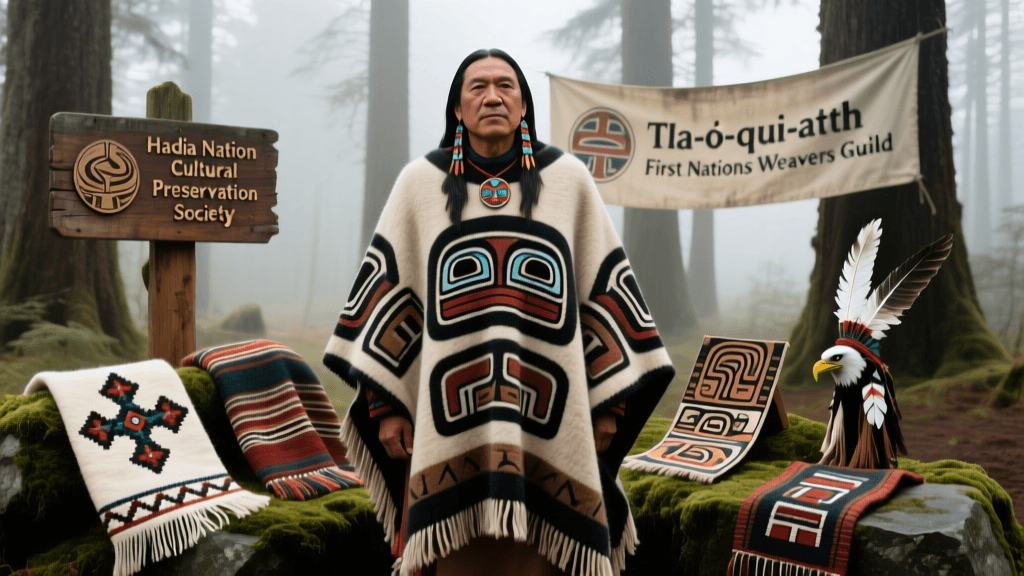
Woven on the mist-shrouded archipelago of Haida Gwaii—off the northern coast of British Columbia—the Haida Chiefs Blanket stands as one of the most technically demanding and symbolically charged textile forms in Indigenous North America. Unlike ceremonial regalia worn for brief ritual occasions, these blankets functioned as portable titles: their patterns encoded lineage, rank, and territorial rights. Each blanket was commissioned by a hereditary chief and woven exclusively by women trained over decades in the House of the Raven or House of the Eagle. The process began with harvesting mountain goat wool from alpine slopes near T’aalan Stl’ang (Skidegate Inlet), combined with softened yellow cedar bark fibres—a blend that constituted approximately 70% wool and 30% bark by weight in pre-contact examples.
Chinook Weaving: Structural Precision and Coastal Innovation
Though often conflated with broader Northwest Coast weaving, Chinook weaving refers specifically to the twined basketry and textile techniques developed by the Chinookan peoples along the lower Columbia River. Their distinctive “false embroidery” technique involved overlaying dyed bear grass or cedar root onto a tightly twined foundation, creating raised geometric motifs without altering the structural integrity of the weave. This method required precise tension control: master weavers maintained consistent warp spacing at exactly 18–22 threads per inch, measured using calibrated wooden combs carved from red alder. Archaeological evidence from the Meier Site near Clatsop County confirms continuous use of this technique for over 1,200 years, with recovered fragments showing warp densities within 0.3 threads per inch of modern reproductions.
Materials and Preparation Protocols
Chinook weavers harvested bear grass in late August, when silica content peaked for optimal rigidity. Fibres were soaked for precisely 48 hours in cold river water before being split into strands no wider than 0.5 mm. Dye vats used hemlock bark for deep brown (requiring 6-hour simmering) and Oregon grape root for vibrant yellow (processed at pH 4.2). All preparation occurred under strict seasonal protocols overseen by elders of the Chinook Indian Tribe, whose cultural preservation office in Bay Center, Washington, maintains a living archive of 14 documented dye recipes.
Functional Dimensions and Wear Patterns
Historic Chinook carrying baskets measured between 28–34 cm in height and 22–26 cm in diameter—dimensions optimized for portaging dried salmon across portage trails like the historic Willamette Falls route. Wear analysis conducted at the University of Oregon Museum of Natural and Cultural History shows consistent abrasion patterns along the upper 5 cm of basket walls, indicating habitual shoulder contact during transport. These measurements correlate directly with skeletal markers found in Chinook burial sites at Cathlapotle, where clavicle wear patterns match the expected pressure points of such loads.
Wool Felting: From Colonial Disruption to Contemporary Revival
Wool felting among Haida artisans emerged not as ancient practice but as adaptive response following the near-eradication of mountain goat populations by 1890 due to unregulated hunting. With traditional wool supplies depleted, Haida women in Old Massett began experimenting with imported sheep’s wool, adapting Salish-style wet-felting methods learned through intermarriage and trade. By 1923, documented workshops at the Skidegate Band Council Hall recorded felting sessions producing ceremonial cloaks averaging 1.8 m in length and 1.2 m in width—dimensions calibrated to drape fully over a standing chief without fasteners. These pieces incorporated traditional formline motifs rendered in layered wool roving, achieving a density of 420 g/m² after fulling—nearly double the density of commercial felts.
Ceremonial Context and Protocol
Felted blankets are never worn during potlatches but reserved for naming ceremonies and memorial feasts. According to protocol codified by the Council of the Haida Nation in 2011, each blanket must be presented by a designated witness from the opposite moiety, reinforcing kinship obligations. The act of draping follows strict sequence: first the right shoulder, then left, then folded once across the chest—mirroring the threefold structure of the Haida creation story. Failure to observe this order requires immediate re-draping and an offering of dried halibut to the witness.
Institutional Stewardship and Knowledge Transmission
The Haida Gwaii Museum at Kay Llnagaay in Skidegate serves as the primary repository for over 87 historically documented Chiefs Blankets, including the 1842 “Raven and Killer Whale” piece acquired from the descendants of Chief X̱aayda Kil. Its climate-controlled textile vault maintains humidity at 55% ±2% and temperature at 18°C ±0.5°C—specifications established through collaborative research with the U’mista Cultural Centre in Alert Bay. Similarly, the Chinook Indian Tribe’s Language and Culture Department operates a biannual weaving intensive at the Fort George Historical Site in Astoria, Oregon, where participants learn warp tension calibration using replica 19th-century cedar combs.
Contemporary Practice and Ethical Frameworks
Today, only seven certified Haida master weavers hold formal recognition from the Council of the Haida Nation’s Arts and Culture Committee. Certification requires demonstration of proficiency in all four foundational techniques: finger-weaving, twining, sprang, and felting—and submission of three original works meeting exacting dimensional standards: minimum 1.5 m × 1.5 m surface area, warp count of ≥20/cm, and motif fidelity verified against archival photographs held at the Royal British Columbia Museum. As noted in the Haida Textile Standards Report (Council of the Haida Nation, 2019), “No blanket may incorporate synthetic dyes, machine-spun yarn, or non-coastal wool without explicit written consent from the originating house.”
These constraints reflect deeper philosophical commitments. For the Haida, weaving is not craft but covenant—with ancestors, territory, and future generations. When master weaver Gidansda Guujaaw wove the 2004 “Eagle Transformation” blanket now housed at the Canadian Museum of History, she worked exclusively during lunar waxing phases and paused entirely during salmon spawning season (late August–early October), adhering to protocols reaffirmed in the Yáahl Daanawaas (Haida Laws of Respect) (Haida Nation, 2017). Such discipline ensures continuity not merely of technique but of relational ethics embedded in every stitch.
- Mountain goat wool harvest occurs only between May 15 and June 10 annually, per Haida Gwaii Stewardship Agreement (2007)
- Chinook twined baskets require 120+ hours of preparation before weaving begins
- Traditional Haida Chiefs Blankets weigh between 2.3–2.8 kg when fully finished
- The “Three-Thread Rule” mandates that no single warp strand may exceed 3 mm in diameter
- Felted ceremonial cloaks undergo 72 minutes of rhythmic fulling using alder wood paddles
“The blanket does not belong to the wearer. It belongs to the story it carries—and that story belongs to the land.” —Diane Brown, Senior Curator, Haida Gwaii Museum at Kay Llnagaay, 2022
At the core of these practices lies resistance to erasure—not through opposition alone, but through meticulous, embodied re-creation. When a young weaver in Massett measures warp tension against a cedar comb carved by her great-grandmother, she enacts sovereignty in millimetre increments. When a Chinook apprentice in Bay Center splits bear grass to 0.5 mm width using only thumbnail and thumbpad, she honours a lineage stretching back past European contact. These are not relics awaiting museum display; they are living systems calibrated to ecological precision, governed by legal frameworks older than Canadian confederation, and sustained by institutions rooted in place: the Council of the Haida Nation, the Chinook Indian Tribe, and the U’mista Cultural Centre.
Such work demands more than technical mastery. It requires understanding that a 1.8-metre felted cloak encodes not just clan crests but tidal charts, migration routes, and treaty obligations. That a basket’s 22-cm diameter reflects the average human stride across ancestral portage trails. That every measurement, every pause, every sanctioned material choice constitutes a declaration: this knowledge persists, this land remembers, and these hands continue the work begun long before recordkeeping began.
| Institution | Location | Key Function | Documented Archive Size |
|---|---|---|---|
| Haida Gwaii Museum at Kay Llnagaay | Skidegate, BC | Textile conservation & oral history recording | 87 Chiefs Blankets + 212 oral interviews |
| U’mista Cultural Centre | Alert Bay, BC | Repatriation & technical training | 47 Chinook-related textile tools + 38 dye samples |
Modern revitalisation efforts remain grounded in reciprocity. The 2021–2025 Haida Weaving Revitalization Initiative, jointly administered by the Council of the Haida Nation and Parks Canada, allocates 65% of its $2.1 million budget to on-island apprenticeships—ensuring knowledge transfer occurs where cedar grows and mountain goats still tread. Each apprentice receives 144 hours of direct mentorship, 36 hours of ecological field study, and access to the museum’s digital loom-tension database, which logs over 1,200 warp-calibration readings taken since 2009.
These numbers are not arbitrary. They are thresholds—measurable commitments to continuity. A 0.3 mm variance in fibre width alters dye absorption. A 2% humidity fluctuation risks fibre embrittlement. A single missed lunar cycle disrupts seasonal alignment. Precision here is not pedantry; it is fidelity. And fidelity, in Haida and Chinook worldviews, is the first act of justice.
When visitors stand before the 1842 “Raven and Killer Whale” blanket at the Haida Gwaii Museum, they do not see static art. They witness calibrated time—each thread laid during specific tides, each motif positioned according to ancestral survey lines, each density achieved through rhythms passed hand-to-hand across twelve generations. This is how sovereignty is measured: not in hectares or treaties alone, but in millimetres, grams, and minutes—held steady, year after year, by women who remember.
The work continues. Not in defiance, but in quiet, exacting presence. In the measured pull of wool through cedar comb. In the split-second judgment of a seasoned eye assessing fibre lustre. In the deliberate pause before the shuttle passes—honouring what came before, and what must follow.