Guizhou Miao Traditional Dress: Silverwork & Embroidery Guide
Introduction to Guizhou Provincial Miao Dress
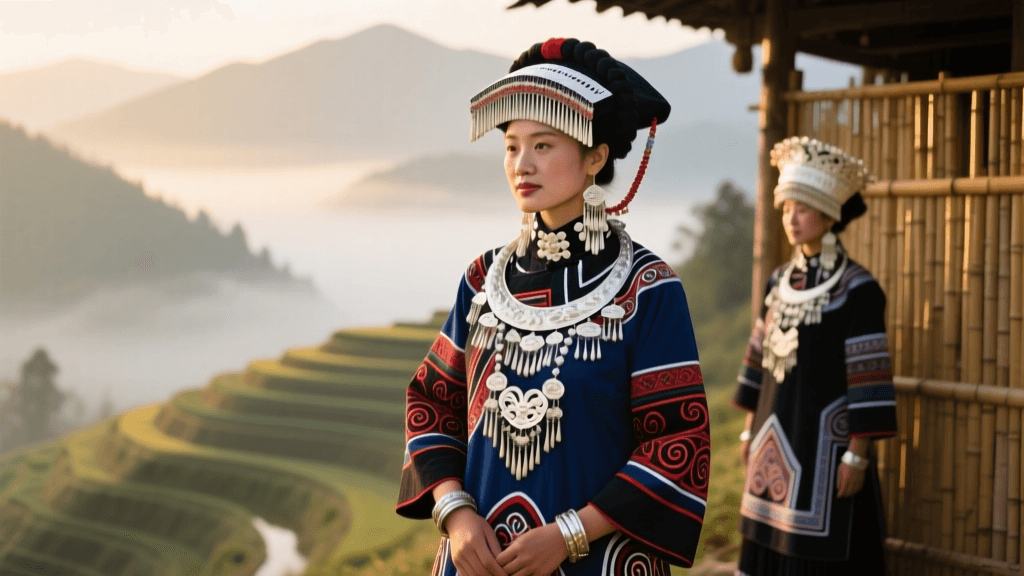
The mountainous terrain of Guizhou province in southwestern China is home to one of the most visually stunning and culturally rich sartorial traditions in Asia: the provincial dress of the Miao (Hmong) people. Unlike the standardized silhouettes of the Han Chinese hanfu or the Manchu qipao, Miao traditional clothing is a hyper-regionalized tapestry of clan identity, mythological storytelling, and ancestral migration. Because the Miao people historically lacked a formalized written script, their textiles and garments evolved into a complex, wearable codex. Every stitch, dye, and silver ornament serves as a historical document, recording the rivers crossed, the mountains climbed, and the spiritual guardians revered by their ancestors.
For textile collectors, cultural historians, and travelers, understanding the nuances of Guizhou Miao dress requires looking beyond the surface-level spectacle of festival attire. It demands an appreciation of the grueling craftsmanship behind natural indigo dyeing, the structural engineering of heavy silverwork, and the distinct regional dialects expressed through embroidery.
The Weight of Tradition: Miao Silverwork
No discussion of Miao provincial dress is complete without addressing the breathtaking silverwork that accompanies festive attire. In Miao culture, silver is not merely decorative; it is a spiritual armor believed to ward off malevolent spirits, a symbol of familial prosperity, and a crucial component of a woman's dowry. During major festivals, a Miao woman may wear a silver headdress, multiple neck rings, chest plaques, and hairpins that collectively weigh between 3 to 10 kilograms (6.6 to 22 pounds).
Actionable Guide to Commissioning and Buying Silver
If you are traveling to Guizhou to acquire authentic Miao silverwork, particularly in renowned silversmithing hubs like Xijiang Miao Village or Shidong, you must understand the local market mechanics:
- Purity and Material: Traditional Miao silverwork utilizes 999 pure silver. This high purity makes the metal exceptionally soft, allowing artisans to execute microscopic filigree and repousse work. However, structural elements like clasps may use 925 sterling silver for durability.
- Pricing Structure: Artisan silver is priced by weight plus a craftsmanship fee. Expect to pay between 15 to 35 RMB ($2 to $5 USD) per gram, depending on the complexity of the design and the reputation of the master silversmith.
- Cost Estimates: A standard, intricately woven silver neck ring weighing 500 grams will typically cost between 7,500 and 17,500 RMB ($1,050 to $2,450 USD). Full festival headdresses can easily exceed 50,000 RMB ($7,000 USD).
- Verification: Always request a purity test. Reputable silversmiths in Kaili and Xijiang will use a spectrometer or traditional touchstone methods to verify 999 purity before finalizing the sale.
Regional Variations in Miao Embroidery
Miao embroidery is famously diverse, with techniques and motifs changing drastically from one mountain valley to the next. The Smithsonian Center for Folklife and Cultural Heritage has extensively documented these regional variations, noting that a trained eye can identify a wearer's specific village and marital status simply by the cut of the collar and the stitch of the sleeve.
| Region / County | Primary Technique | Key Motifs | Color Palette |
|---|---|---|---|
| Leishan (Xijiang) | Double-stitch and flat stitch with heavy silk thread | Buffalo horns, dragons, geometric river maps | Vibrant reds, greens, and blues on dark indigo |
| Taijiang (Shidong) | Buzhou (seed stitch) and intricate applique | The Butterfly Mother, mythological birds | High contrast: bright pinks, purples, and yellows |
| Rongjiang | Tin-thread embroidery (weaving metallic threads into cotton) | Abstract geometric patterns, starbursts | Monochromatic indigo and silver/white tin |
| Danzhai | Batik (wax resist dyeing) combined with cross-stitch | Pomegranates, fish, lotus flowers | Deep blues and crisp whites |
The Indigo Pleated Skirt: A Masterclass in Patience
The quintessential lower garment for many Miao subgroups in Guizhou is the pleated skirt, or bai zhe qun. The creation of a single skirt is an exercise in extreme patience and physical labor. According to textile conservation records highlighted by the Victoria and Albert Museum, the cultivation of natural indigo and the subsequent dyeing processes represent some of the most complex organic chemistry practiced in traditional folk art.
Measurements and Manufacturing Process
A high-quality festive pleated skirt requires between 15 to 20 meters (49 to 65 feet) of hand-woven, unbleached cotton. The fabric is repeatedly dipped into vats of fermented indigo, oxidized in the air, and beaten with wooden mallets to achieve a deep, lustrous navy blue that borders on black. The pleating process is equally arduous. Artisans fold the fabric into hundreds of microscopic, uniform pleats, bind it tightly with hemp string, and steam it over boiling water to set the creases. This setting process can take up to a month. When purchasing a vintage or newly commissioned skirt, count the pleats; a master-crafted skirt will feature over 1,000 individual pleats and possess a stiff, almost architectural drape.
Mythology in Stitches: The Butterfly Mother
To understand the soul of Miao provincial dress, one must understand the myth of Mais Bangx Mais Lief, the Butterfly Mother. According to Miao creation mythology, the universe began with a sacred maple tree. From this tree emerged a butterfly who mated with a water bubble, laying twelve eggs. These eggs hatched into the founders of the world, including the first human, the thunder god, and the tiger. The butterfly is therefore revered as the ultimate matriarch and protector of children. You will find the Butterfly Mother motif embroidered onto the back panels of children's carrying blankets and the collars of women's jackets. It is considered highly auspicious and is a focal point for collectors of Miao folk art.
Practical Travel and Acquisition Guide
For those planning to witness these garments in their proper context or acquire authentic pieces, timing and location are critical. The preservation of these traditions is heavily tied to the lunar calendar and local agricultural cycles, as recognized by global heritage organizations like UNESCO Intangible Cultural Heritage.
When to Visit: Festival Timing
- The Sisters' Meal Festival (Zimei Fan Jie): Usually falling in April (the 15th day of the third lunar month), this is the premier event to see young, unmarried women wearing their most elaborate silver headdresses and vibrant, newly embroidered jackets in Taijiang and Zhenyuan counties.
- The Lusheng Festival: Held in the autumn (typically the 9th lunar month), this harvest festival features men playing the lusheng (a traditional pipe instrument) while women dance in heavy pleated indigo skirts and silver chest plaques. Kaili and surrounding villages are the best vantage points.
What to Look For When Buying Textiles
When navigating the markets in Kaili or the antique shops in Guiyang, use these practical checks to ensure authenticity:
- The Scent Test: Genuine natural indigo has a distinct, earthy, slightly fermented aroma. If the garment smells sharp, chemical, or like plastic, it has been dyed with synthetic aniline dyes, drastically reducing its cultural and monetary value.
- The Reverse Side: Examine the back of the embroidery. Hand-stitched Miao work is often nearly as neat on the reverse as it is on the front, especially in double-sided stitching techniques. Machine embroidery will show chaotic, loose threading and uniform, perfectly straight stitch lines.
- Fabric Base: Rub the base fabric between your fingers. Hand-spun, hand-woven cotton will have slight irregularities in the thread thickness (slubs) and a stiffer, more organic texture compared to the uniform smoothness of commercially milled cotton or polyester blends.
Ultimately, the provincial dress of the Guizhou Miao is not merely a costume; it is a living, breathing archive of a resilient people. Whether you are studying the structural brilliance of a 5-kilogram silver horned crown or tracing the microscopic seed stitches of a Butterfly Mother motif, you are engaging with one of Asia's most profound and enduring textile traditions.