Guizhou Miao Folk Dress: Silver Crowns & Pleated Skirts
The Wearable Archives of Guizhou Province
Deep within the mountainous terrain of southwestern China lies Guizhou Province, a region globally celebrated for its vibrant ethnic minority cultures. Among these, the Miao people (often referred to as Hmong in diaspora communities) possess one of the most visually striking and culturally profound sartorial traditions in Asia. Because the Miao historically lacked a formal written language, their clothing evolved into a complex, wearable archive. Every stitch, motif, and silver ornament tells a story of migration, mythology, and regional identity.
The geographical isolation of these mountain communities allowed highly distinct provincial dress styles to flourish. As documented in Britannica's geographical analysis of Guizhou, the rugged karst landscapes naturally segregated villages, resulting in over 100 distinct subgroups of Miao, each identified by the unique cut, color, and embellishment of their traditional garments. Today, the regional folk dress of the Guizhou Miao is not merely a relic of the past; it is a living, breathing craft that continues to dictate local economies, festival preparations, and artisan livelihoods.
The Anatomy of the Miao Festival Outfit
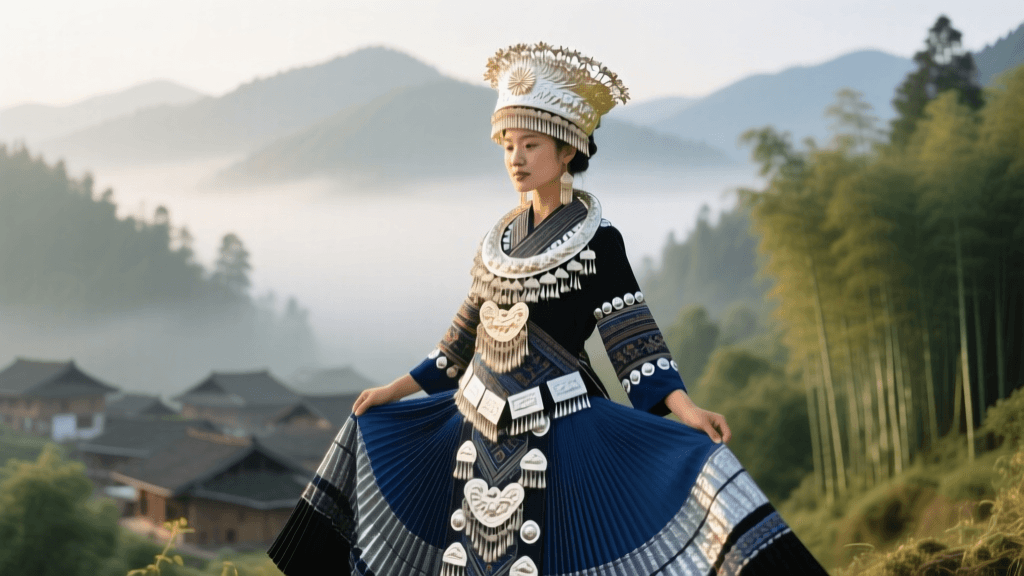
A full Miao festival outfit is a masterpiece of provincial craftsmanship, often taking years to complete and weighing heavily on both the wearer and the wallet. The ensemble is primarily defined by three core components: the silver ornaments, the indigo pleated skirt, and the embroidered bodice.
The Silver Crown and Ornaments
The most iconic element of the Miao festival dress is the elaborate silver headdress, often featuring a massive 'Yinjiao' (silver horn). According to anthropological records of the Miao people, silver represents wealth, purity, and spiritual protection against evil spirits. A full festival silver set includes a horned crown, hairpins, neck rings, chest locks, and bracelets.
- Weight and Measurements: A complete, authentic silver headdress and bodice set can weigh anywhere from 5 to 10 kilograms (11 to 22 lbs). The horns alone can span up to 1 meter in width.
- Motifs: The silver is hammered and filigreed into shapes of buffalo horns (representing agricultural wealth), butterflies (honoring the 'Butterfly Mother' of Miao creation myth), and dragons.
- Artisan Craftsmanship: Silversmiths use over 30 distinct techniques, including wire drawing, hammering, and granulation, to create the delicate, lace-like textures of the crown.
The Indigo Pleated Skirt
The 'Bai zhe qun', or hundred-pleat skirt, is a marvel of textile engineering. Despite appearing as a thick, structured bell shape, the skirt is actually constructed from a single, continuous piece of hand-woven cotton.
- Measurements: A single skirt requires between 15 to 20 meters of hand-loomed cotton fabric, which is meticulously folded into 500 to 1,000 micro-pleats.
- The Dyeing Process: The fabric is repeatedly submerged in natural indigo vats over several weeks. To achieve the signature stiff, glossy finish that holds the pleats, the fabric is treated with a mixture of ox blood, egg white, and rice water, then beaten with wooden mallets.
- Styling: The skirt is wrap-around and secured with a heavily embroidered woven sash. It is traditionally paired with indigo-dyed leg wrappings.
Cross-Stitch and Batik Embroidery
Miao embroidery ('Miao Xiu') is renowned for its three-dimensional texture and vibrant colors. Unlike standard flat embroidery, Miao artisans use techniques like the 'wrinkle stitch' and 'braid stitch' to create raised, sculptural motifs. The preservation of these complex provincial textile techniques is of global cultural importance, aligning with the safeguarding missions outlined by the UNESCO Intangible Cultural Heritage frameworks.
'To wear the Miao dress is to wear the history of our ancestors. The butterfly on the silver crown and the river patterns on the pleated skirt map the journeys our people took across the mountains centuries ago.' — Local Artisan in Xijiang
Regional Variations: A Subgroup Comparison
The 'Miao' is an umbrella term encompassing diverse subgroups whose provincial dress varies dramatically based on their specific valley or mountain range. Below is a comparison of three prominent Guizhou subgroups and their distinct folk dress characteristics.
| Subgroup Name | Primary Region | Skirt Style & Length | Average Silver Weight | Dominant Embroidery Motif |
|---|---|---|---|---|
| Long Skirt Miao | Xijiang / Leishan | Floor-length, heavy pleats | 7 - 10 kg | Buffalo Horns & Dragons |
| Short Skirt Miao | Danan / Rongjiang | Knee-length, layered aprons | 2 - 4 kg | Pheasant Feathers & Birds |
| Black Miao | Shidong / Taijiang | Calf-length, dark indigo | 4 - 6 kg | Butterflies & Geometric Rivers |
Practical Guide: Sourcing and Wearing Miao Garments Today
For collectors, textile enthusiasts, and cultural travelers, acquiring authentic Guizhou Miao provincial dress requires specific knowledge of local markets, pricing, and timing. Here is your actionable guide to sourcing these garments.
Costs and Commissioning
Authentic, handmade Miao garments are luxury artisanal items. Do not expect bargain prices for genuine provincial folk dress.
- Silver Ornaments: Artisan silver in Guizhou is typically priced by weight plus a craftsmanship fee. Expect to pay around 25 to 35 RMB per gram. A modest 2kg silver chest and headpiece set will cost roughly 50,000 to 70,000 RMB ($7,000 - $9,800 USD).
- Pleated Skirts: A genuine, hand-dyed, and hand-pleated indigo skirt takes months to produce. Prices range from 1,500 to 4,000 RMB ($210 - $560 USD) depending on the density of the pleats and the quality of the indigo.
- Embroidered Bodices: Vintage or newly commissioned bodices featuring dense, raised cross-stitch work typically cost between 2,000 and 8,000 RMB.
- Rentals: For travelers wishing to wear the dress for photography without the investment, full festival sets (including heavy silver) can be rented in Xijiang Miao Village for 200 to 500 RMB per day.
Timing Your Visit
To witness the provincial dress in its full, living context, time your visit to coincide with major agricultural and lunar festivals. The Miao New Year (usually falling in November or December) is the premier event for viewing heavy silver and long pleated skirts. Alternatively, the Sisters' Meal Festival (held in April) in the Taijiang and Shidong regions showcases intricate embroidery and elaborate silver hairpins as young women parade in their finest courtship garments.
Authenticating Silver and Textiles
Tourist hubs like the main commercial streets of Xijiang are flooded with mass-produced, machine-embroidered replicas and Tibetan-style alloy 'silver'. To ensure authenticity:
- Verify Silver Purity: Authentic Miao silversmiths use 999 pure silver, which is highly malleable and necessary for intricate filigree. Ask for the artisan's stamp and use a magnet test (pure silver is non-magnetic). For guaranteed authenticity, visit the dedicated silversmith alleys in Kaili City or the village of Shidong.
- Inspect the Embroidery: Genuine Miao Xiu uses silk threads and features complex backing. Turn the fabric over; authentic hand-embroidery will show neat, structured stitching on the reverse, whereas machine embroidery often has messy, interconnected jump-stitch threads.
- Smell the Indigo: Authentic fermented indigo dye has a distinct, earthy, slightly sour odor. Synthetic dyes will smell like chemicals or have no scent at all.
Caring for Provincial Folk Dress
Maintaining these garments requires specialized care to preserve their structural integrity and natural dyes.
- Indigo Skirts: Never machine wash or use harsh chemical detergents on a natural indigo pleated skirt. Spot clean only with cold water and a mild, pH-neutral soap. To maintain the stiffness of the pleats, store the skirt tightly rolled and bound with cotton string in a cool, dry place.
- Silver Ornaments: Pure silver tarnishes quickly when exposed to humidity and sulfur. After wearing, gently polish the silver with a microfiber cloth and store it in an airtight container with anti-tarnish silica gel packets. Never use liquid silver dips, as they can ruin the intentional oxidized blackening used to highlight the filigree details.
- Embroidered Bodices: Store flat, interleaved with acid-free tissue paper to prevent the heavy raised stitches from crushing one another.
Conclusion
The regional folk dress of the Guizhou Miao is far more than traditional attire; it is a masterclass in provincial textile engineering and metallurgical art. From the staggering weight of the silver horns to the hundreds of meticulously set indigo pleats, these garments represent a profound dedication to cultural memory. Whether you are a textile collector seeking authentic artisanal pieces or a traveler aiming to understand the deep roots of Asian provincial dress, approaching the Miao sartorial tradition with an eye for detail, craftsmanship, and historical context will deeply enrich your appreciation of this living heritage.