DIY Hanfu Sewing: Fabric Selection & Pattern Guide
Introduction to DIY Hanfu Construction
The global Hanfu revival has sparked a massive interest in traditional Chinese clothing, moving beyond mere appreciation to active creation. For sewing enthusiasts and cultural historians alike, constructing your own Hanfu offers a profound connection to the past. Unlike modern Western tailoring, which relies heavily on complex curved darts and structured interfacing, traditional Hanfu patterns are predominantly flat, geometric, and modular. This makes DIY Hanfu sewing an incredibly rewarding pursuit for intermediate sewists looking to expand their skills into historical garment construction.
In this comprehensive guide, we will explore the nuances of fabric selection, yardage calculations, and pattern drafting, with a specific focus on the iconic Ming Dynasty Mamianqun (horse-face skirt) and the versatile Ru (cross-collar top). Whether you are sourcing luxurious silks or practical everyday blends, understanding the behavior of your textiles is the first step toward a flawless historical garment.
Fabric Selection: Weight, Drape, and Material
Choosing the right fabric is arguably the most critical decision in Hanfu construction. Traditional Chinese garments rely on the natural drape and weight of the fabric to create their elegant silhouettes, rather than relying on internal structure. According to the UNESCO Intangible Cultural Heritage archives, traditional Chinese sericulture and silk craftsmanship involve meticulous processes that yield textiles with unparalleled luster and tensile strength. While authentic mulberry silk remains the gold standard, modern sewists have a variety of options depending on their budget and the garment's intended use.
Best Fabrics for Hanfu Tops (Ru and Shan)
For summer tops (Shan), breathability and sheer elegance are paramount. Silk chiffon (8 to 10 momme) and lightweight linen are excellent choices. The Metropolitan Museum of Art's Heilbrunn Timeline of Art History notes that silk weaving in China evolved to include complex, lightweight weaves that were highly prized for warm-weather garments. For winter tops (Ao), opt for 19 momme silk charmeuse, silk brocade, or a heavy cotton-linen blend, often lined with cotton flannel or fleece for warmth.
Best Fabrics for Hanfu Skirts (Mamianqun)
The Mamianqun requires a fabric with enough body to hold crisp knife pleats (jian zhe) while still allowing the flat front and back panels to drape gracefully. Silk jacquard, medium-weight taffeta, and high-quality polyester brocades are ideal. Avoid overly stiff upholstery fabrics, as they will make the waistband bulky and uncomfortable.
Fabric Comparison Chart
| Fabric Type | Best Garment Use | Weight / Thickness | Drape Quality | Est. Cost (per yard) |
|---|---|---|---|---|
| Silk Chiffon (8mm) | Summer Shan, Veils | Very Lightweight | Fluid, Sheer | $15 - $25 |
| Silk Charmeuse (19mm) | Winter Ao, Lining | Medium Weight | Heavy, Liquid | $25 - $40 |
| Silk Jacquard / Brocade | Mamianqun, Formal Ao | Medium-Heavy | Structured, Crisp | $30 - $60 |
| Cotton-Linen Blend (55/45) | Everyday Ru, Practice Skirts | Medium Weight | Matte, Moderate | $10 - $18 |
Yardage Calculations and Loom Widths
Historically, Chinese textiles were woven on narrow looms, typically producing fabric widths of about 50 to 60 centimeters (20 to 24 inches). Garments were constructed by piecing these narrow panels together, resulting in the characteristic center-back and center-front seams seen in traditional Hanfu. Today, most commercial fabrics come in 45-inch or 60-inch widths. While you can mimic historical construction by cutting your wide fabric into narrow strips, most modern DIYers adapt the patterns to utilize the full width of modern fabric to minimize waste and reduce seams.
General Yardage Guide (based on 45-inch wide fabric):
- Cross-Collar Ru (Top): 2.5 to 3 yards (includes wide sleeves and facing).
- Mamianqun (Skirt): 3.5 to 5 yards, depending on the desired fullness and your waist size.
- Banbi (Half-Sleeve Vest): 1.5 to 2 yards.
Drafting the Mamianqun (Horse-Face Skirt)
The Mamianqun is a masterpiece of geometric tailoring. It consists of two identical, overlapping rectangular panels. Each panel features a flat, unpleated section in the center (the 'horse face') and heavily pleated sections on the sides. As detailed in the Met Museum's overview of Ming Dynasty art and culture, clothing regulations and textile motifs were highly codified, and the Mamianqun became a staple of women's wardrobes due to its elegance and ease of movement.
The Math Behind the Pleats
To draft your pattern, you need three primary measurements: your waist circumference, your desired skirt length, and the width of your flat 'horse face' panel (typically 20 to 25 cm for an average build).
- Calculate the Waist Coverage: Take your waist measurement and add 15 cm for the overlap and closure. Divide this number by 2 (since there are two overlapping panels). This is the finished width of each panel at the waist.
- Determine the Pleat Depth: A standard knife pleat takes up about 3 cm of fabric on the outside and conceals 6 cm inside. Therefore, each pleat requires 9 cm of fabric.
- Calculate Total Panel Width: If your flat horse face is 22 cm, and you want 6 pleats on each side of the horse face, your math looks like this: 22 cm (flat) + [6 pleats x 9 cm] + [6 pleats x 9 cm] = 130 cm total width per panel before hemming and seam allowance.
Sewing Techniques and Finishing
Sewing Hanfu requires a departure from modern finishing techniques. Because historical garments were often unlined or featured delicate silk linings, seam finishes must be clean and unobtrusive.
- French Seams: Essential for sheer fabrics like silk chiffon. Sew the seam wrong-sides together first, trim the allowance, press, and then sew right-sides together to enclose the raw edge.
- Rolled Hems: Use a rolled hem foot on your sewing machine or hand-stitch a baby hem for the bottom of the skirt and the edges of the sleeves. This preserves the fluid drape of the silk.
- Waistband Attachment: The waistband of a Mamianqun is typically made of a contrasting cotton or linen fabric to provide grip and structure. Interface the waistband with medium-weight woven interfacing before attaching it to the heavily pleated skirt top.
Pro Tip: When setting pleats on a Mamianqun, use a tailor's clapper immediately after pressing with a steam iron. The trapped heat and weight will force the fibers to cool in a perfectly crisp line, preventing the pleats from springing open during the waistband attachment. For silk, always use a pressing cloth to avoid water spots and scorching.
Drafting the Ru (Cross-Collar Top)
The Jiao Ling You Ren (cross-collar, right-over-left) top is the foundational garment of the Hanfu wardrobe. The pattern is essentially a series of rectangles with a curved neckline and an extended underarm gusset for mobility.
When drafting the collar, the inner collar band must be cut slightly shorter than the outer collar to prevent it from peeking out and to ensure a smooth roll over the neck. The iconic wide sleeves (Da Xiu) can be drafted as simple rectangles attached to the bodice, but for a more historically accurate drape, add a slight curve to the underarm seam and taper the sleeve hem inward. Always remember the golden rule of traditional Chinese dress: the left panel must always cross over the right panel. Reversing this (right over left) is historically reserved for burial garments and is considered highly inauspicious.
Essential Tools for the Hanfu Sewist
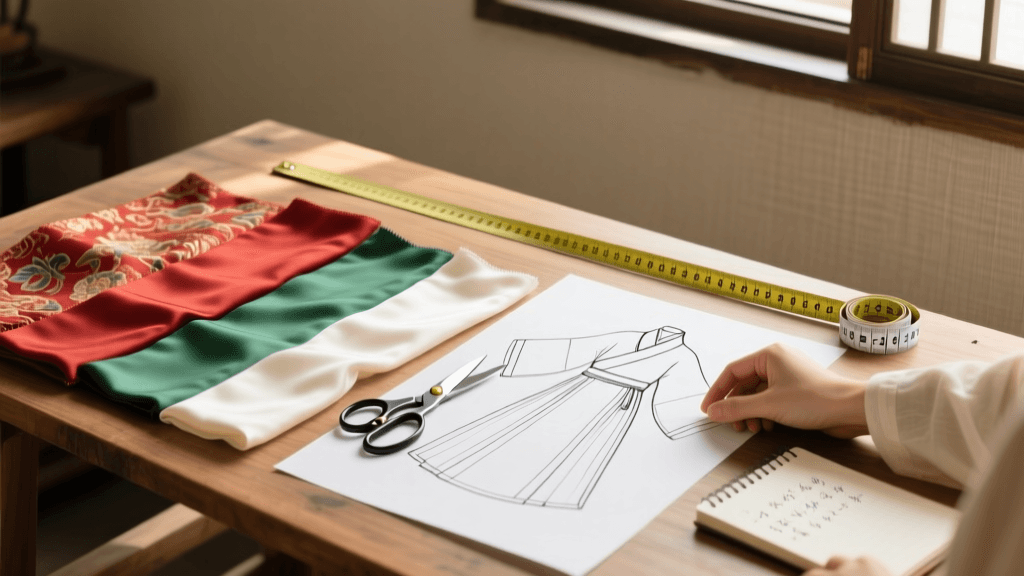
To achieve professional results, equip your sewing space with the following specialized tools:
- Silk Pins: Extra-fine, sharp pins that will not leave permanent holes in delicate silks.
- Microtex/Sharp Needles: Size 60/8 or 70/10 machine needles specifically designed for tightly woven silks and jacquards.
- Awl: Invaluable for gently coaxing fabric under the presser foot when sewing thick pleated waistbands without breaking needles.
- Weighted Pattern Paper: Because Hanfu patterns consist of large, straight geometric blocks, using pattern weights and a rotary cutter on a large mat is significantly faster and more accurate than pinning paper patterns.
Conclusion
Sewing your own Hanfu is a journey through textile history, geometry, and mindful craftsmanship. By carefully selecting the appropriate fabric weight, mastering the mathematical precision of the Mamianqun pleats, and utilizing traditional seam finishes, you can create garments that are not only historically resonant but also beautifully tailored to your modern body. Whether you are crafting a breathable linen Ru for a summer festival or a heavy brocade Mamianqun for winter photography, the skills you develop in DIY Hanfu construction will elevate your entire approach to garment sewing.