Guizhou Miao Provincial Dress: Silverwork and Embroidery Guide
Introduction to Guizhou Miao Provincial Dress
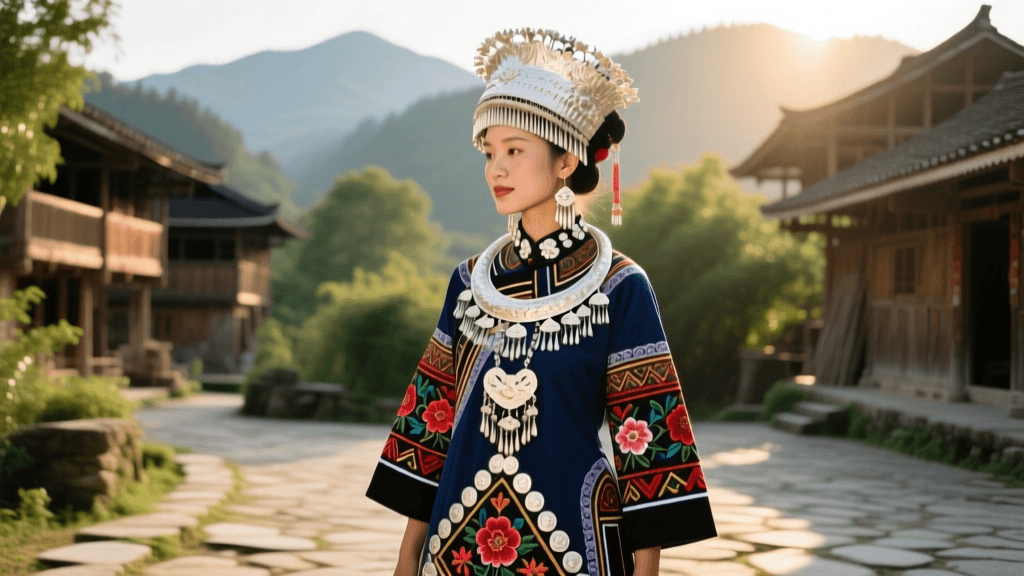
The mountainous terrain of Guizhou Province in southwestern China has long served as a sanctuary for the Miao (Hmong) people, preserving one of the most intricate and visually stunning sartorial traditions in Asia. Unlike the standardized court garments of the Han or Manchu dynasties, Miao provincial dress is profoundly regional, serving as a wearable archive of clan history, mythology, and social status. According to cultural overviews provided by Encyclopedia Britannica, the Miao people possess a deeply complex social fabric where clothing acts as a primary identifier of specific sub-groups, marital status, and regional origin. For textile collectors, cultural travelers, and fashion historians, understanding the nuances of Guizhou's regional folk dress requires a deep dive into its foundational elements: indigo dyeing, pleated skirts, master-level silverwork, and mythological embroidery.
The Foundation: Indigo Dyeing and the Pleated Skirt
Before a single stitch of embroidery is laid or a silver ornament is forged, the foundation of the Miao garment must be established. The traditional Miao pleated skirt, known as the baiqun, is a masterpiece of structural textile engineering. Crafted from hand-woven cotton, the fabric undergoes a rigorous dyeing process using fermented indigo. Artisans in villages like Xijiang and Danzhai maintain active indigo vats, feeding the fermentation process with rice wine, wood ash, and organic matter to achieve a deep, lustrous navy that borders on black.
The creation of the pleats is an arduous task requiring immense physical labor and precision. A high-quality ceremonial skirt from the Leishan region requires between 15 to 20 meters of fabric and features anywhere from 50 to over 100 distinct pleats. The artisan folds the damp, dyed cotton by hand, binding it tightly with thread and allowing it to set in the sun for weeks. The result is a skirt that flares dramatically during the rhythmic stomping of traditional Lusheng (reed pipe) dances, creating a mesmerizing visual effect. When purchasing or appraising an authentic vintage Miao skirt, count the pleats and examine the hem; genuine hand-pleated skirts retain a permanent, stiff memory in the cotton, whereas modern tourist-market replicas use heat-set synthetic blends that lack structural integrity.
Regional Variations: A Comparative Guide
Guizhou is not a monolith; its valleys and mountains have isolated communities just enough to foster hyper-local variations in dress. The The Metropolitan Museum of Art notes in its Asian textile collections that Miao garments vary wildly in silhouette, color palette, and ornamentation depending on the specific county. Below is a structured comparison of four major regional styles within Guizhou.
| Region / County | Key Garment Feature | Silver Style & Weight | Skirt Length & Pleats | Primary Embroidery Technique |
|---|---|---|---|---|
| Xijiang (Leishan) | Short pleated skirt, heavy silver horn headdress | Massive silver horns and chest plates (up to 10kg total) | Mini-length (knee-high), 50-80 pleats | Flat stitch, cross-stitch, silk threading |
| Danzhai | Long tunic, minimal silver, focus on textile art | Small silver hairpins, lightweight bracelets | Ankle-length, wide box pleats | Tin embroidery (Xihui), batik (Lahuan) |
| Rongjiang | Apron-centric, vibrant red and green accents | Layered silver neck rings, conical hair ornaments | Mid-calf, densely packed micro-pleats | Seed stitch, applique, woven brocade |
| Huangping | Elaborate woven sashes, geometric caps | Intricate filigree hair combs, silver bells | Wrap-around style, structured folds | Pick-weave, geometric cross-stitch |
The Crown of Silver: Forging and Ornamentation
No discussion of Miao provincial dress is complete without addressing the staggering weight and craftsmanship of Miao silverwork. Silver is not merely decorative; it is a spiritual shield against malevolent spirits and a tangible display of a family's wealth and devotion to their daughters. A full bridal silver set from Xijiang can weigh between 8 to 12 kilograms, comprising a towering horned headdress, multiple tiered neck rings, chest locks, and silver-belled sashes.
The motifs forged into the silver are deeply tied to Miao animism and creation myths. The 'butterfly mother' (Mais Bangx) is a ubiquitous motif, representing the ancestor of all living things. Dragons, water buffalo, and phoenixes are also common, though the Miao dragon is often depicted with a more serpentine, benevolent form compared to the imperial five-clawed dragons of Han Chinese tradition. The UNESCO Intangible Cultural Heritage frameworks frequently highlight the complex metallurgical knowledge passed down through generations of Miao silversmiths, who utilize techniques such as filigree, repousse, and granulation without the use of modern molds.
Actionable Guide: Sourcing Authentic Silver and Textiles
For collectors, designers, and cultural enthusiasts looking to acquire authentic Miao garments or silverwork, navigating the markets of Guizhou requires specific knowledge to avoid mass-produced counterfeits.
1. Identifying and Pricing Authentic Miao Silver
- Material Verification: Authentic Miao silver is traditionally high-purity sterling or fine silver. Modern tourist markets are flooded with 'Tibetan silver' or white copper alloys. Always request a hallmark or perform a basic sound test; pure silver emits a dull, soft thud when tapped, whereas alloys produce a high-pitched ring.
- Cost Breakdown: In Guizhou's silver hubs like Kaili or Xijiang, pricing is transparently split into two parts: the raw material cost and the craftsmanship fee (gongfei). Expect raw silver to track with global market rates, roughly 5 to 7 RMB per gram. The craftsmanship fee ranges from 10 to 25 RMB per gram, depending on the complexity of the filigree.
- Total Investment: A solid, hand-forged silver neck ring weighing 300 grams will cost approximately 4,500 to 9,600 RMB ($620 to $1,330 USD). Avoid vendors selling full 'bridal sets' for under 2,000 RMB; these are guaranteed to be electroplated base metals.
2. Sourcing Handmade Embroidery and Batik
- The Reverse Test: To distinguish between hand-embroidery and machine-embroidery, always examine the reverse side of the textile. Hand-stitched Miao cross-stitch and flat-stitch will show nearly identical, neat patterns on the back. Machine embroidery will reveal chaotic, tangled bobbin threads and white underlay stitching.
- Danzhai Tin Embroidery (Xihui): This rare technique involves wrapping silk threads around ultra-fine strips of hammered tin before stitching. It creates a shimmering, metallic relief effect. Authentic Xihui jackets are rare and command premium prices, starting around 3,000 RMB for a lightly decorated panel and exceeding 15,000 RMB for a fully embroidered ceremonial jacket.
- Vintage vs. New: Vintage garments (pre-1980s) feature hand-spun cotton and naturally fermented indigo, which emits a faint, earthy, herbal scent even decades later. New garments dyed with synthetic indigo will smell of chemicals or lack scent entirely. Vintage pieces should be sourced from reputable antique textile dealers in Guiyang or Beijing, rather than street vendors in tourist villages.
Experiencing the Dress in Context: Timing Your Visit
To truly understand the kinetic energy of Miao provincial dress, one must see it in motion during traditional festivals. The garments are heavy, restrictive, and designed specifically for the rhythmic, communal dances that define Miao social life.
The most spectacular event for observing regional dress variations is the Sisters' Meal Festival (Zimei Fan Jie), often described as the oldest Eastern Valentine's Day. Held annually in the third lunar month (typically April on the Gregorian calendar) in areas like Taijiang and Xijiang, young women don their heaviest silver headdresses and finest pleated skirts to dance in the village squares. The visual of hundreds of silver horns catching the spring sunlight, accompanied by the rhythmic chiming of silver bells and the deep resonance of the Lusheng pipes, is an unparalleled cultural experience.
Another critical period is the Lusheng Festival, celebrated in the late summer or early autumn (usually the eighth or ninth lunar month). During this time, the long, sweeping skirts of the Danzhai and Rongjiang regions take center stage, allowing observers to appreciate the structural differences in pleating and the vibrant, localized color palettes that distinguish the southern Miao branches from their northern counterparts.
Conclusion
The traditional dress of Guizhou's Miao people is far more than a collection of beautiful garments; it is a resilient, wearable language that has survived centuries of migration and assimilation pressures. From the structural genius of the indigo pleated skirt to the mythological narratives encoded in Danzhai tin embroidery and Xijiang silverwork, Miao provincial dress offers a profound window into the soul of China's ethnic minorities. Whether you are a textile collector appraising a vintage jacket, a jeweler studying traditional filigree, or a traveler seeking authentic cultural immersion, approaching Miao dress with an understanding of its regional nuances, material costs, and spiritual significance will deeply enrich your engagement with this extraordinary Asian tradition.