Guizhou Miao Dress: Pleated Skirts & Silverwork Guide
The Living Textile Heritage of the Miao People of Guizhou
Nestled in the karst mountain ranges of southwestern China, Guizhou Province is the cultural heartland of the Miao people. According to historical records and anthropological studies documented by the Encyclopedia Britannica, the Miao (often known globally as the Hmong in diaspora communities) possess a rich, complex history marked by centuries of migration and highland adaptation. Because the Miao traditionally lacked a formalized written script, their history, mythology, and cosmological beliefs were encoded directly into their garments. Today, regional folk and provincial dress in Guizhou is not merely a matter of aesthetic tradition; it is a living, wearable archive. For textile collectors, cultural historians, and travelers, understanding the intricate mechanics of Miao clothing—specifically the legendary indigo pleated skirts and the heavy, spiritually charged silverwork—is essential for authentic appreciation and ethical sourcing.
Anatomy of the Miao Pleated Skirt (Baiqun)
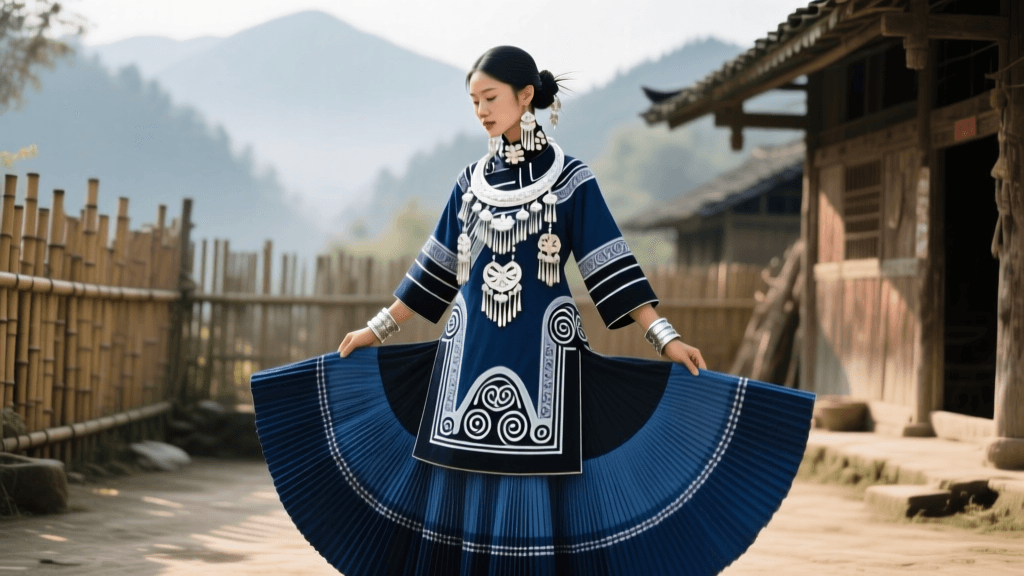
The crown jewel of Miao provincial dress is the baiqun, or the traditional pleated skirt. Unlike Western tailoring, which relies on darts and seams to create volume, the Miao pleated skirt achieves its dramatic, bell-like silhouette through sheer mathematical precision and immense physical labor. A single authentic festival skirt requires between six to eight meters of hand-woven cotton or hemp fabric. The most prized skirts feature anywhere from 500 to over 1,200 individual micro-pleats.
The Indigo Dyeing Process
Before pleating begins, the fabric must undergo the rigorous banlan (indigo) dyeing process. Artisans cultivate the Strobilanthes cusia plant, fermenting its leaves in alkaline wood-ash lye to create a living dye vat. Authentic dyeing requires dipping the fabric 20 to 30 times over a two-to-three-week period, oxidizing the cloth in the mountain air between each dip. Many artisans also add juice from the Dioscorea cirrhosa tuber, which acts as a natural mordant and gives the fabric a stiff, leathery texture that is highly prized in provincial dress.
Actionable Advice for Buyers: When sourcing antique or newly crafted Miao indigo textiles, perform the 'smell and rub' test. Genuine fermented indigo retains a faint, earthy, herbal scent even years after dyeing. Furthermore, real indigo will leave a slight blue residue on your fingers when rubbed vigorously, whereas chemical dyes will either not rub off or will leave a harsh, uniform synthetic stain. Expect to pay between 300 to 500 RMB ($40 to $70 USD) per meter for authentic, hand-dyed, hand-woven indigo cloth in local Guizhou markets.
Pleating Mechanics and Setting
The pleating process is a communal effort. The damp, dyed cloth is folded accordion-style on a low wooden table, often requiring two or three women to pull the fabric taut and pin each millimeter-wide fold. Once pleated, the skirt is bound tightly with cotton thread and steamed. To set the pleats permanently, artisans traditionally brush the fabric with a mixture of egg white or natural tree resins. This creates a stiff, structured garment that rustles distinctively when the wearer dances.
Decoding the Motifs: Butterfly Mother and the Dragon
Miao embroidery is the connective tissue that binds the indigo skirts and silverwork together. Unlike Han Chinese embroidery, which often focuses on realistic flora and fauna, Miao motifs are deeply mythological and surreal. The most prominent figure is the 'Butterfly Mother', who, according to Miao creation myths, laid the twelve eggs that hatched the first humans, dragons, and beasts.
Actionable Detail: When examining antique Miao jacket panels, look for the 'broken stitch' or 'flat stitch' techniques unique to Guizhou's Taijiang and Jianhe counties. Authentic vintage embroidery from the 1970s or earlier uses hand-spun silk threads dyed with local botanicals. Modern tourist-market pieces use synthetic rayon threads that shine unnaturally under UV light. A genuine vintage embroidered jacket panel (approx. 40cm x 60cm) will cost between $300 and $800 USD at reputable antique textile dealers in Kaili, whereas modern synthetic replicas sell for under $50.
Miao Silverwork: Wearable Wealth and Spiritual Armor
If the indigo skirt represents the earth and the ancestral journey, Miao silverwork represents spiritual armor and familial wealth. The UNESCO Intangible Cultural Heritage frameworks have increasingly recognized the vital importance of protecting indigenous silversmithing techniques, which are passed down patrilineally in specific Guizhou villages. Miao silver is not merely jewelry; it is believed to possess apotropaic qualities, warding off evil spirits and illuminating the path to the afterlife. During major provincial festivals, a single Miao woman may wear up to 10 kilograms of silver.
| Silver Accessory | Traditional Weight | Estimated Cost (USD) | Crafting Time |
|---|---|---|---|
| Buffalo Horn Headdress | 1.5 - 2.5 kg | $400 - $700 | 30 - 45 Days |
| Multi-Layered Neck Torc | 0.8 - 1.2 kg | $200 - $350 | 15 - 20 Days |
| Embroidered Silver Jacket | 3.0 - 5.0 kg | $800 - $1,500 | 60 - 90 Days |
| Filigree Hair Comb | 50 - 100 g | $30 - $60 | 3 - 5 Days |
Practical Guide for Collectors and Travelers
For collectors and travelers venturing into Guizhou to acquire these pieces, distinguishing between authentic provincial silver and mass-produced tourist trinkets is critical. In commercial hubs like Xijiang Miao Village, many shops sell 'Tibetan Silver' or 'Miao Silver' that is actually a copper-nickel-zinc alloy.
Sourcing Authentic Pieces
- Purity Standards: Authentic Miao silverwork is typically crafted from 925 sterling or 990 pure silver. Always ask the silversmith for the silver purity stamp and use a portable precious metal tester or a strong magnet (silver is non-magnetic) for basic verification.
- Pricing Mechanics: Silver in China is traded daily. Raw silver costs roughly 6 to 8 RMB per gram. However, Miao silverwork is priced by weight plus a craftsmanship fee. Expect to pay 15 to 30 RMB per gram for the finished piece, reflecting the hundreds of hours spent on wire-drawing, filigree, and repoussé.
- Location and Timing: Bypass the main commercial streets of Xijiang. Instead, visit the Kaili Sunday Market or specialized silversmithing villages like Shiqiao or Huangping. The best time to observe these garments in their full cultural context is during the Sisters' Meals Festival in April or the Lusheng Festival in autumn.
Care and Maintenance
Maintaining provincial folk dress requires specific environmental controls, especially when transporting pieces internationally. Guizhou is highly humid; storing these items in a climate-controlled environment (40-50% relative humidity) is crucial to prevent mold on the hemp and aggressive sulfide tarnishing on the silver.
- Indigo Textiles: Never dry-clean authentic indigo-dyed pleated skirts. The harsh chemicals will strip the natural oils and egg-white binders, causing the pleats to collapse. Spot clean with cold water and a mild, pH-neutral soap. Store the skirt rolled (never folded) in acid-free tissue paper.
- Silverwork: Miao silver is often intentionally oxidized to highlight the intricate filigree patterns. Do not use commercial silver dips or polishing cloths, as these will erase the blackened contrast in the recessed areas. Clean gently with a soft-bristled toothbrush and mild dish soap, drying immediately.
Conclusion
The regional dress of the Miao people is a masterclass in sustainable, deeply meaningful fashion. From the mathematical rigor of the thousand-pleat indigo skirt to the heavy, spiritual resonance of the buffalo horn headdress, these garments transcend mere clothing. By understanding the measurements, costs, and crafting timelines associated with these provincial traditions, collectors and enthusiasts can engage with the Miao textile market ethically and knowledgeably. For further reading on Asian minority textiles and preservation efforts, the Smithsonian Institution frequently publishes extensive field research on the preservation of highland textile techniques, ensuring that this extraordinary sartorial heritage continues to thrive in the modern era.