Guizhou Miao Dress: Silverwork, Embroidery & Regional Styles
The Living Textile Archives of Guizhou
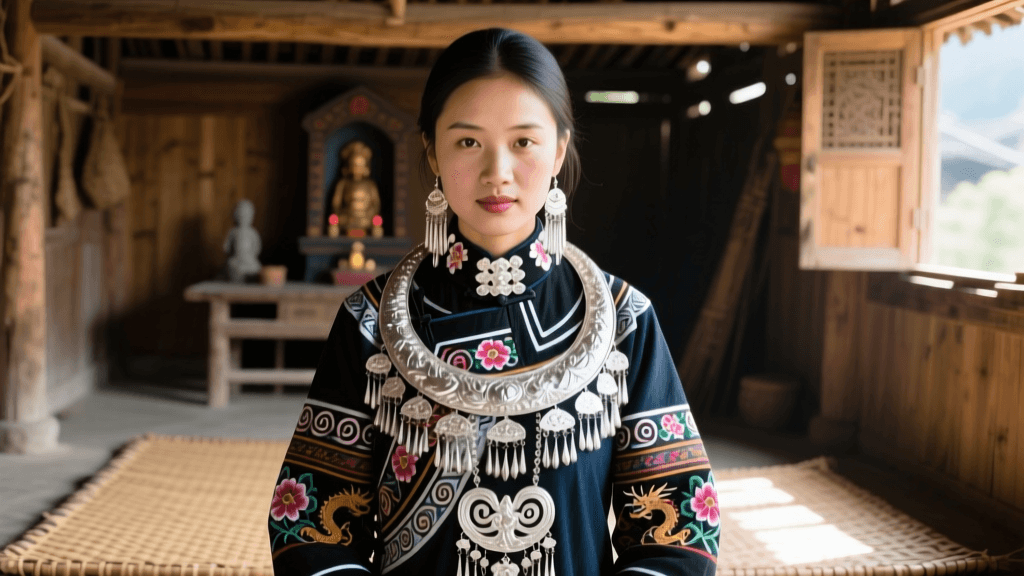
In the mountainous terrain of southwestern China's Guizhou province, the Miao (Hmong) people have cultivated one of the most visually striking and culturally significant sartorial traditions in Asia. Because the Miao historically lacked a formalized written language, their garments evolved into "wearable epics." Every stitch, dye bath, and hammered silver motif serves as a historical record, documenting ancient migrations, cosmological beliefs, and clan lineages. Today, the provincial dress of the Miao is not merely a relic of the past; it is a vibrant, living tradition that continues to dictate social structures, festival preparations, and regional economies.
Recognizing the profound cultural weight of these traditions, frameworks established by UNESCO's Intangible Cultural Heritage have increasingly highlighted the necessity of preserving indigenous craftsmanship, including Miao epics and textile arts, which are intrinsically linked to the visual language of their clothing. To understand Miao dress is to read the history of a resilient people mapped onto indigo cotton and hammered silver.
Regional Variations: A Province of Diverse Branches
Guizhou is home to numerous Miao subgroups, often categorized by outsiders based on their most prominent sartorial features or the dominant colors of their provincial dress. The geographical isolation of the region's deep valleys and karst mountains allowed distinct aesthetic and structural variations to flourish within mere miles of one another.
| Miao Branch | Skirt Length | Primary Colors | Festival Silver Weight | Key Motifs |
|---|---|---|---|---|
| Long Skirt Miao (Changqun) | 70-80 cm | Deep Indigo, Black, Red | 3-5 kg | Dragons, Birds, Rivers |
| Short Skirt Miao (Duanqun) | 15-20 cm | Black, Bright Pink, Green | 1-2 kg | Geometric, Abstract |
| Black Miao (Hei Miao) | 40-50 cm | Black, Dark Purple | 4-8 kg | Butterfly Mother, Buffalo |
The Long Skirt Miao (Changqun Miao)
Concentrated around the Xijiang and Leishan areas, the Long Skirt Miao are famous for their sweeping, pleated skirts that can require up to 15 meters of hand-woven cotton. The pleating process is an art form in itself, involving folding the damp, indigo-dyed fabric and binding it tightly with thread before allowing it to set in the sun for weeks. The resulting accordion-like structure allows for fluid movement during the lusheng (bamboo pipe) circle dances.
The Short Skirt Miao (Duanqun Miao)
Found primarily in Rongjiang and Jianhe counties, the Short Skirt Miao wear remarkably brief, stiffened skirts (often only 15 to 20 centimeters long) paired with heavily embroidered aprons and leg wrappings. This style is historically linked to the necessity of navigating dense, thorny underbrush and steep mountain paths, where long fabric would be a hindrance.
The Art of Miao Embroidery (Miao Xiu)
Miao embroidery is celebrated globally for its technical complexity and three-dimensional texture. As documented in the textile archives of The Metropolitan Museum of Art's Asian Art Department, the structural integrity and density of Miao stitching rival the most advanced tapestries of Europe, yet they are executed entirely by hand, often without a pre-drawn pattern.
Core Techniques
- Seed Stitch (Daguzi): A painstaking technique where tiny knots are tied continuously to create a raised, velvety surface. A single jacket sleeve using the daguzi technique can take a master embroiderer over six months to complete.
- Braid Stitch (Bianxiu): Silk threads are braided into flat ribbons and then couched onto the cotton base fabric, creating bold, graphic outlines.
- Flat Stitch (Pingxiu): Used for filling in large areas with vibrant silk floss, allowing for intricate color gradients that depict scales, feathers, and petals.
Mythological Motifs
The most revered motif in Miao embroidery is the Mai Bang, or "Butterfly Mother." According to Miao creation mythology, the Butterfly Mother laid twelve eggs, which hatched into the first humans, dragons, buffaloes, and tigers. Therefore, butterflies, dragons, and water buffaloes are not merely decorative; they are ancestral protectors stitched into the garments of children and brides to ensure fertility and safety.
The Weight of Tradition: Miao Silverwork
No Miao festival garment is complete without an overwhelming display of silver. For the Miao, silver represents light, purity, and the warding off of evil spirits. It is also a crucial form of generational wealth, passed from mother to daughter.
A full festival headdress for a Black Miao bride can feature massive silver horns spanning up to 60 centimeters in width, adorned with dangling sun and moon motifs. When combined with multi-layered neck torcs, chest plates, and hairpins, a woman's complete silver ensemble can weigh between 5 and 10 kilograms. The silversmithing process involves melting silver ingots, drawing them into fine wires, and utilizing intricate filigree and repoussé techniques to craft dragons, phoenixes, and floral patterns.
"To wear Miao clothing is to wear the history of a people who mapped their migrations, myths, and cosmos onto indigo and silver. It is an armor of identity."
Practical Buyer’s Guide: Sourcing Authentic Miao Garments
For collectors, textile designers, and cultural enthusiasts, acquiring authentic Miao provincial dress requires an understanding of regional markets, pricing structures, and material authenticity. The commercialization of ethnic tourism has flooded markets with machine-made replicas, making a discerning eye essential.
Where and When to Buy
While tourist hubs like Xijiang Thousand Households Miao Village offer convenience, serious collectors should venture to local rural markets. The Kaili Sunday Market and the Shidong Village Silver Market (in Taijiang County) are premier destinations. Timing your visit to coincide with the Sisters' Meal Festival (usually falling in April or May, based on the lunar calendar) provides access to families selling older, heirloom pieces to fund the creation of new festival attire for their daughters.
Cost and Pricing Breakdown
Pricing varies wildly based on age, material purity, and stitch density. Below is a practical pricing guide for the current market (prices in USD):
- Modern Machine-Embroidered Jackets: $30 - $80 (Suitable for costumes, not collectors).
- Authentic Hand-Embroidered Vintage Jackets (1980s-2000s): $250 - $600 (Look for natural indigo and silk thread).
- Antique Festival Skirts (Pre-1950s): $800 - $2,500+ (Highly sought after by museums and serious collectors).
- Modern Silver Headdress (Alloy/Mixed Metal): $100 - $300 (Sold by weight, but lacks purity).
- Authentic Sterling Silver Torcs & Horns: $1,000 - $5,000+ (Priced by the gram, usually 990 or 999 purity silver).
Identifying Authenticity
Historical analyses from The British Museum's ethnographic archives reveal that early Miao silversmiths often melted down regional silver coins, resulting in antique pieces with distinct patinas and lower, mixed-metal purities. When evaluating pieces today:
- The Indigo Test: Authentic hand-dyed indigo will have a distinct, earthy scent and may slightly rub off on a damp white cloth. Synthetic dyes will smell of chemicals and bleed uniformly in water.
- The Silver Sound Test: Pure silver produces a dull, soft thud when tapped, whereas alloyed metals or silver-plated brass will produce a high-pitched, ringing chime.
- The Embroidery Backing: Turn the garment inside out. Hand embroidery will show irregular, complex knotting and thread paths. Machine embroidery will feature uniform, grid-like backing stitches.
Caring for Provincial Textiles and Silver
Preserving Miao provincial dress requires specialized care, as the materials are inherently organic and reactive.
- Textile Storage: Never hang heavily embroidered Miao jackets on standard hangers; the weight of the embroidery and silver coin accents will warp the cotton base. Store them flat, folded with acid-free tissue paper to prevent the indigo from transferring to lighter embroidered sections.
- Indigo Maintenance: Avoid dry cleaning or harsh detergents. If a garment must be cleaned, spot clean with cold water and a pH-neutral soap. Indigo dye continues to oxidize and shift in color when exposed to direct sunlight, so store textiles in dark, climate-controlled environments.
- Silver Care: Miao silver is often left unpolished by locals, as the dark oxidation (patina) in the crevices of repoussé work highlights the intricate designs. If polishing is desired, use a soft jeweler's cloth and avoid liquid chemical dips, which can strip the dark contrast from the filigree recesses. Store silver with anti-tarnish strips in airtight cloth bags.
Conclusion
The provincial dress of the Guizhou Miao is a masterclass in wearable anthropology. From the gravity-defying pleats of the Long Skirt Miao to the mythological density of the Butterfly Mother embroidery, these garments demand respect not just as fashion, but as historical documents. Whether you are a textile collector navigating the markets of Kaili or a designer studying the structural genius of indigenous pleating, approaching Miao dress with an understanding of its regional nuances and craftsmanship ensures that this profound cultural legacy continues to be valued and preserved.