Decoding Chinese Rank Badges: Buzi Symbolism and Color Codes
Introduction to Buzi: The Visual Language of Imperial China
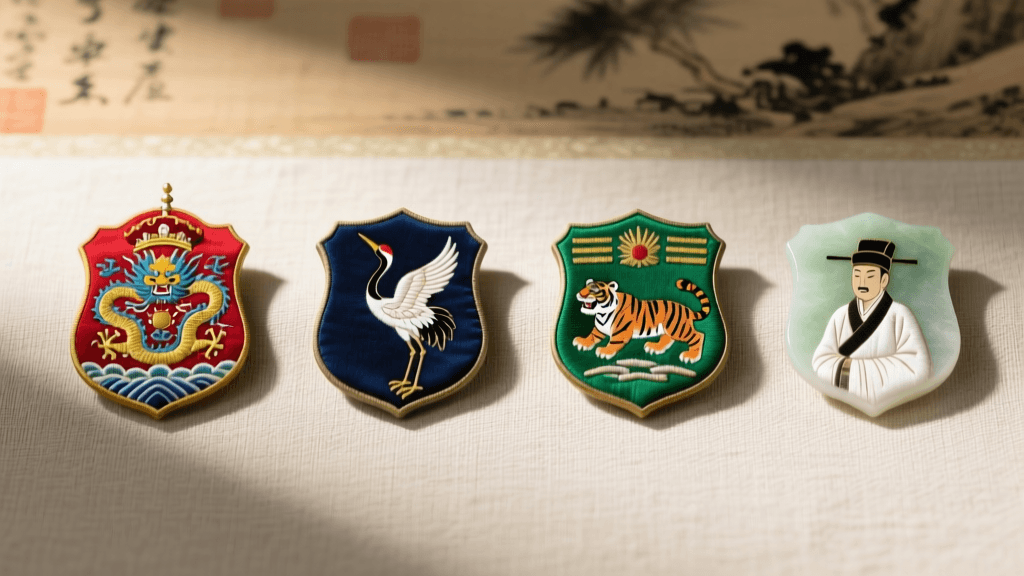
In the intricate tapestry of Asian traditional garments, few elements communicate social hierarchy, political power, and cosmic symbolism as explicitly as the Chinese rank badge, known as the buzi (Mandarin square). Worn primarily during the Ming (1368–1644) and Qing (1644–1911) dynasties, these embroidered squares were affixed to the front and back of the surcoats worn by civil and military officials. Far from being mere decorative embellishments, these badges functioned as a strict, legally enforced visual language. They instantly communicated the wearer's exact rank, their civil or military status, and their proximity to the Emperor.
Understanding the buzi requires a deep dive into the rigid sumptuary laws of imperial China, where every thread, hue, and motif was heavily regulated. According to educational resources provided by the Smithsonian National Museum of Asian Art, the visual hierarchy of the Qing court was designed to maintain strict social order, ensuring that no official could visually overstep their designated boundaries. For modern antique collectors, museum curators, and historical costumers, decoding these symbols is not just an academic exercise; it is essential for authentication, accurate reproduction, and proper valuation.
The Imperial Palette: Color Codes and Sumptuary Laws
While the embroidered animals on the buzi denoted specific numerical ranks, the color of the underlying robe and the threads used in the embroidery were governed by an equally strict color code. In traditional Chinese culture, colors are deeply tied to the Wu Xing (Five Elements) theory, but in the imperial court, they were tools of political control.
- Imperial Yellow (Minghuang): The most restricted color in the empire. A bright, vibrant yellow derived from the pagoda tree bud was reserved exclusively for the Emperor, the Empress, and the Empress Dowager. Any unauthorized use was punishable by death.
- Apricot and Golden Yellow: Slightly muted or darker yellows were permitted only for the Crown Prince and the Emperor's direct sons.
- Red and Crimson: Symbolizing fire, joy, and high status, deep reds were heavily utilized by high-ranking officials (Ranks 1 to 3) and the imperial family. The dye was often extracted from safflower, a costly and labor-intensive process.
- Stone Blue and Azure: Associated with the heavens and the east, blue was the standard color for mid-tier officials and scholars. Indigo dyeing was widespread, making it accessible yet dignified.
- Green and Teal: Often worn by lower-ranking civil officials and military officers, symbolizing wood and spring.
- Black and Dark Brown: Reserved for the lowest ranks of officialdom and commoners, representing water and the north.
Conservation notes from the Victoria and Albert Museum highlight how natural dyes like safflower red are highly fugitive and prone to fading when exposed to light, whereas indigo blues remain remarkably stable. This chemical reality is a crucial metric for collectors authenticating antique textiles today; a badge with perfectly vibrant, uniform red silk under UV light may indicate synthetic aniline dyes introduced in the late 19th or early 20th century.
Decoding the Buzi: Civil vs. Military Rank Badges
The core of the buzi system lies in its zoological taxonomy. Civil officials, who were selected through rigorous literary examinations, were represented by birds, symbolizing grace, intellect, and literary elegance. Military officials, who earned their positions through martial prowess, were represented by mythical and real beasts, symbolizing courage, ferocity, and protection.
During the Qing dynasty, a badge worn on the front of a surcoat was split into two halves to accommodate the center-front opening of the garment, while the back badge was a single, continuous square. A key identifying feature of Qing badges is the inclusion of a red sun disk in the top left or right corner, which the official would 'face' when bowing to the Emperor. Ming dynasty badges, by contrast, were generally larger, lacked the sun motif, and often featured two animals facing each other.
The Nine Ranks of Imperial Officials
| Rank | Civil Official (Bird) | Military Official (Beast) | Symbolic Meaning |
|---|---|---|---|
| 1st Rank | Red-Crowned Crane | Qilin (Mythical Chimera) | Supreme wisdom; divine protection |
| 2nd Rank | Golden Pheasant | Lion | Cultural refinement; martial bravery |
| 3rd Rank | Peacock | Leopard | Beauty and dignity; fierce agility |
| 4th Rank | Wild Goose | Tiger | Loyalty and teamwork; absolute power |
| 5th Rank | Silver Pheasant | Bear | Resilience; physical strength |
| 6th Rank | Egret | Panther | Purity; stealth and strategy |
| 7th Rank | Mandarin Duck | Rhinoceros | Fidelity; impenetrable defense |
| 8th Rank | Quail | Seal / Sea Horse | Peace; adaptability |
| 9th Rank | Paradise Flycatcher | Seahorse (Mythical) | Vigilance; naval command |
Practical Guide for Antique Collectors
For collectors navigating the antiquities market, authenticating a buzi requires a keen eye for material, technique, and historical context. Examples of the intricate metallic couching and silk floss work characteristic of the era can be examined in the Metropolitan Museum of Art's collection, which provides excellent high-resolution references for genuine 19th-century craftsmanship.
Authentication Metrics and Pricing
- Measurements: Authentic Qing dynasty badges typically measure exactly 28cm x 28cm (approx. 11 x 11 inches). Ming badges are noticeably larger, often exceeding 35cm, and are significantly rarer on the open market.
- Material Analysis: Genuine pieces use hand-spun silk and metallic threads made by wrapping flattened gold or silver foil around a silk core. If the metallic threads appear overly uniform, bright yellow without tarnish, or test positive for modern synthetic polymers, the piece is likely a 20th-century tourist trade reproduction.
- Backing and Wear: Original badges were sewn onto robes and often removed later. Look for needle holes along the perimeter and remnants of the original robe silk on the back. A pristine, stiff backing often indicates a modern framing job or a replica.
- Market Costs: A standard, authentic 19th-century Qing badge (e.g., 6th to 8th rank) in good condition typically ranges from $800 to $2,500 at auction. First-rank Crane or Qilin badges, especially those featuring intricate Peking knot embroidery and real gold thread, can command $5,000 to $15,000+ depending on provenance and condition.
Commissioning Replicas for Theater and Cosplay
For historical costumers, theater wardrobe departments, and high-end cosplayers, acquiring accurate replicas is a meticulous process. Mass-produced, machine-embroidered patches found online lack the dimensional texture, correct scale, and material accuracy required for screen-accurate or museum-grade reproductions.
Sourcing and Specifications
To commission a high-quality, hand-embroidered replica, you must engage artisans specializing in Su Xiu (Suzhou embroidery) or Jing Xiu (Beijing imperial embroidery). Here is the actionable data for your next commission:
- Product Specification: Request 'Traditional Couching and Seed Stitch Buzi on Hand-Loomed Silk Damask'. Specify the exact rank (e.g., '4th Rank Wild Goose with red sun motif and wave border').
- Measurements: Provide exact dimensions of 28cm x 28cm for the embroidered area, but request an additional 5cm silk border on all sides to allow for proper mounting or sewing onto a surcoat.
- Timing: True hand-embroidery using silk floss and wrapped metallic threads is incredibly time-consuming. Expect a turnaround time of 6 to 10 weeks for a single, highly detailed square. Plan your production schedules accordingly.
- Costs: Museum-grade, hand-embroidered replicas sourced directly from master artisans in Suzhou or Beijing typically cost between $350 and $800 per badge, depending on the complexity of the animal and the amount of gold thread couching required. Shipping and customs fees for antique-style textiles should add an estimated $50 to $100 to your budget.
Conclusion
The buzi is far more than a beautiful piece of Asian textile art; it is a woven document of imperial history, social stratification, and cosmological belief. Whether you are an antique collector analyzing the oxidation of silver threads under a loupe, or a costume designer sourcing authentic silk damask for a period drama, understanding the strict color codes and rank symbols of the Ming and Qing dynasties is paramount. By respecting the historical parameters of these garments, we preserve the visual language of an empire, ensuring that the cranes, lions, and colors of imperial China continue to speak across the centuries.