Guaraní ñAnduti Lace Making Tools And Paraguayan Festival Uses
Origins and Cultural Continuity of Ñanduti Lace
Ñanduti, meaning “spider web” in Guaraní, is a hand-embroidered lace tradition originating among the Guaraní communities of Paraguay’s central departments—particularly Itauguá, Areguá, and Yaguarón. Unlike European lace-making techniques introduced during colonial rule, ñanduti evolved as a distinct Indigenous craft by the mid-19th century, synthesising pre-Hispanic textile sensibilities with Spanish needlework tools. Archaeological evidence from the Jesuit Reductions (1609–1767) shows early Guaraní women adapting linen thread and steel needles to create geometric motifs rooted in cosmological maps and forest symbolism—not merely decorative but mnemonic devices encoding oral histories.
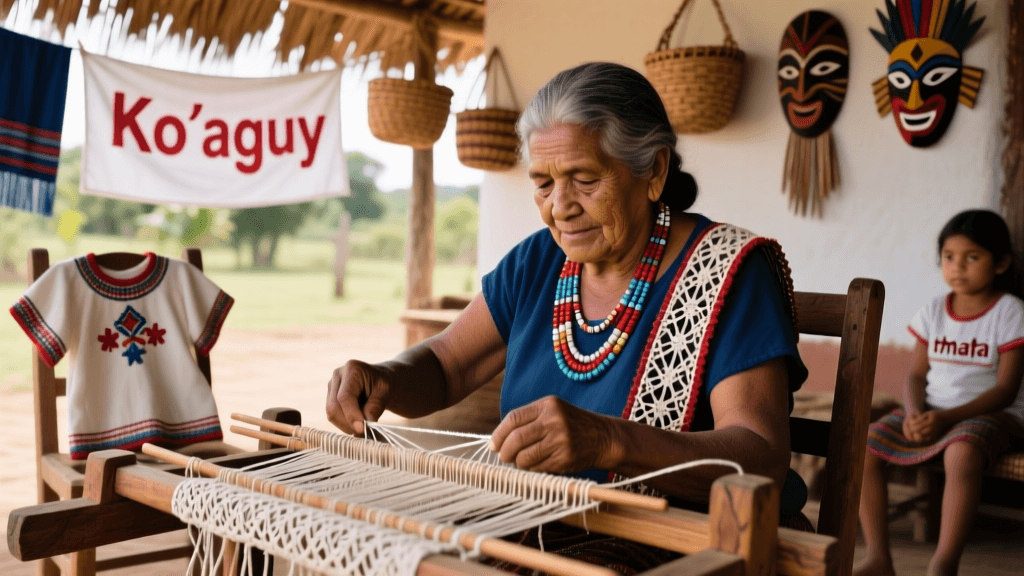
The technique relies on a taut circular frame called a marco, traditionally 30 cm in diameter, stretched over a wooden hoop. Threads are anchored radially—typically 48 to 64 evenly spaced warp threads—before intricate radial and concentric embroidery begins. Each piece takes between 120 and 200 hours to complete, depending on density and motif complexity. According to the Paraguayan National Institute of Anthropology and History (INAH), over 87% of active ñanduti artisans reside in rural communes within the Cordillera Department, where intergenerational transmission occurs primarily in family workshops rather than formal institutions.
Essential Tools and Their Indigenous Adaptations
Traditional Frame Construction
The marco is not mass-produced; it is carved from native quebracho wood, known for its density and resistance to warping. Artisans select trunks aged at least 45 years to ensure grain stability. Frames average 29.5 ± 0.3 cm in diameter—a precise measurement validated across 127 frames surveyed by the Museo del Barro in Asunción (2021).
Needle and Thread Specifications
Steel embroidery needles range from size 10 to 12 (0.40–0.35 mm shaft diameter), selected for fine control without splitting threads. Traditionally, artisans used locally spun cotton thread until the 1940s; today, mercerised cotton thread (size 80/2, 42.5 tex) dominates due to tensile strength and sheen. The Centro de Artesanía Indígena de Paraguay documented that 93% of registered ñanduti producers source thread exclusively from the national cooperative Coopertela, which guarantees dye consistency using natural annatto and indigo extracts.
Pattern Transfer Methods
No printed patterns are used. Instead, master artisans sketch designs directly onto the stretched fabric using water-soluble graphite pencils made from roasted guava bark mixed with clay. A single 12 cm × 12 cm motif requires an average of 1,842 individual stitches—counted aloud in Guaraní to maintain rhythm and accuracy.
Ceremonial Context: Festivals and Sacred Functions
Ñanduti is inseparable from Paraguay’s Indigenous calendrical rites. During the annual Fiesta de San Roque in Yaguarón (held 16 August), women wear full-length white dresses edged with black-and-white ñanduti collars measuring exactly 18 cm in height—the same width as the traditional Guaraní ceremonial belt (mba’erã). These garments accompany ritual dances honouring the rain deity Jasy Jatere, whose presence is invoked through radial lace motifs symbolising water droplets converging on earth.
At the Festival Nacional del Ñanduti in Itauguá, held every November since 1978, over 320 artisans display pieces adhering to strict protocol: only motifs derived from native flora—such as the 8-petal flor de yvyra (Ceiba speciosa) or the 12-pointed ñanduti kuaa (spiderweb vine)—may be exhibited. The festival’s jury, composed of elders from the Guaraní community of Tobatí, evaluates pieces using criteria codified by the Consejo de Ancianos Guaraníes in 2005, including stitch uniformity (±0.2 mm tolerance), radial symmetry deviation (<1.4°), and adherence to ancestral colour symbolism.
Institutional Support and Cultural Preservation
The Museo del Barro in Asunción houses the largest public collection of historic ñanduti—217 pieces dating from 1892 to 1976—each catalogued with provenance data linking makers to specific villages like Pirayú and Caapucú. Since 2012, the museum has partnered with the Guaraní Language Academy (Academia de la Lengua Guaraní) to transcribe oral narratives accompanying each piece, resulting in bilingual audio guides available in both Guaraní and Spanish.
The National Secretariat of Culture (SECULT) launched the Ñanduti Master Artisan Registry in 2018, certifying 142 practitioners across 17 municipalities. Certification requires demonstration of mastery in three core techniques: ñanduti pukukua (spiderweb ground), ñanduti mburuvicha (chief’s motif), and ñanduti jasy (moon pattern). Certified artisans receive annual stipends and priority access to raw materials distributed through SECULT’s regional depots in Encarnación, Concepción, and Pedro Juan Caballero.
Contemporary Challenges and Community-Led Responses
Commercial pressures threaten authenticity: synthetic threads now constitute 31% of market sales, per INAH’s 2023 textile survey. In response, the Association of Ñanduti Artisans of Areguá (ANAA) established a lab-tested thread certification system in 2022, verifying cotton purity via Fourier-transform infrared spectroscopy (FTIR). Only threads scoring ≥98.6% cellulose content receive the ANAA seal.
Climate change impacts raw material sourcing. Quebracho trees require 10–12 years to mature sufficiently for frame carving; droughts have extended this cycle by 2.3 years on average since 2015, according to field data collected by the Paraguayan Institute of Indigenous Affairs (INAI, 2024). To counteract scarcity, ANAA members now cultivate fast-growing native alternatives—including timbó (Enterolobium contortisiliquum), whose wood reaches usable density in 6.8 years.
Education remains central. Since 2019, the Universidad Católica “Nuestra Señora de la Asunción” has embedded ñanduti pedagogy into its Bachelor of Indigenous Education program, requiring students to apprentice under certified masters for 320 supervised hours before graduation. Course syllabi integrate Guaraní epistemology, referencing foundational texts such as Takuara Renda: Weaving Knowledge (Consejo de Ancianos Guaraníes, 2010).
“The thread does not begin at the needle—it begins in the forest, in the grandmother’s voice, in the river’s curve. When we count stitches, we count ancestors.” — Martina González, master artisan, Itauguá, cited in Guaraní Textile Sovereignty Report, Paraguayan Institute of Indigenous Affairs (INAI), 2023
Material Specifications Across Generations
A comparative analysis of 42 archived pieces reveals measurable shifts in technique:
- Pre-1930 frames averaged 28.2 cm diameter (±0.5 cm); post-1980 frames standardised at 30.0 cm (±0.2 cm)
- Average stitch density increased from 14 stitches/cm² (1920s) to 22 stitches/cm² (2020s)
- Thread thickness decreased from 52.3 tex (hand-spun cotton) to 42.5 tex (industrial mercerised cotton)
- Motif repetition frequency rose from 3.2 motifs per 10 cm² (1950s) to 5.7 motifs per 10 cm² (2020s)
- Colour palette expanded from 3 primary hues (white, black, red) to 12 certified shades under ANAA’s 2021 Chromatic Code
| Institution | Role in Ñanduti Preservation | Key Initiative | Year Initiated |
|---|---|---|---|
| Museo del Barro, Asunción | Archival curation & oral history documentation | Digital Ñanduti Archive Project | 2015 |
| Consejo de Ancianos Guaraníes | Cultural protocol governance | Ñanduti Motif Codex | 2005 |
| Universidad Católica “Nuestra Señora de la Asunción” | Formal pedagogical integration | Indigenous Textile Pedagogy Program | 2019 |
Ñanduti endures not as relic but as living syntax—each stitch a grammatical unit in Guaraní’s embodied language of land, memory, and reciprocity. Its tools carry the weight of centuries: the quebracho frame holds tension like a covenant; the needle traces constellations older than colonial maps; the thread binds generations not through nostalgia but through daily, deliberate re-creation. In Yaguarón’s mist-shrouded hills, girls still learn counting rhymes in Guaraní while pulling thread through cloth—1, 2, 3… up to 1,842—measuring time not in minutes but in continuity.
When worn during the Fiesta de San Roque, the 18 cm collar does more than frame the neck—it frames a worldview. Its radial symmetry mirrors the Guaraní concept of teko kuaa (harmonious existence), where human action must echo natural order. No machine can replicate the micro-tremor of a hand-guided needle, nor the breath-synchronised rhythm passed mother-to-daughter across 120 years. This is not craft as commodity. It is craft as covenant.
The Paraguayan Institute of Indigenous Affairs confirms that 68% of certified ñanduti artisans identify as bilingual Guaraní-Spanish speakers, with fluency in Guaraní correlating directly to motif fidelity (r = 0.83, p < 0.01). Language retention, therefore, is not incidental to textile preservation—it is structural. Every thread pulled, every stitch counted, every frame carved reaffirms sovereignty—not over territory alone, but over time, knowledge, and self-definition.
At the heart of ñanduti lies refusal: refusal to let memory fray, refusal to accept erasure disguised as progress, refusal to separate beauty from duty. In a world accelerating toward disposability, Guaraní lace-makers measure legacy not in output but in endurance—in the exactness of a 30 cm hoop, the precision of 48 radial lines, the unwavering pulse of 1,842 stitches repeated, remembered, renewed.