Ancient Greek Chiton and Roman Toga Draping Guide 2026
The 2026 Revival of Ancient Mediterranean Garments
As we navigate the cultural renaissance of 2026, historical reenactment societies, university theater departments, and Hellenic heritage festivals are experiencing a massive surge in demand for authentic ancient Mediterranean garments. The days of relying on inaccurate, mass-produced synthetic costumes are firmly behind us. Today's enthusiasts and scholars demand mathematically precise, historically grounded reconstructions of the Greek chiton and the Roman toga. Understanding the geometry, textile weight, and kinetic drape of these garments is essential for anyone participating in this year's classical festivals or theatrical productions. This comprehensive guide will walk you through the precise measurements, fabric selections, and draping techniques required to master ancient European folk dress in 2026.
The Greek Chiton: Doric and Ionic Variations
The chiton was the foundational garment of ancient Greek society, worn by both men and women. It was not a tailored piece of clothing but rather a masterful exercise in draping a single, large rectangle of fabric. According to the World History Encyclopedia's entry on the Chiton, the garment evolved significantly over the centuries, primarily dividing into two distinct styles: the Doric and the Ionic chiton.
The Doric Chiton (Peplos)
The Doric chiton, often referred to as a peplos when worn by women, was traditionally made from a heavier woolen fabric. It featured an *apoptygma*—an overfold at the top of the garment that draped down over the chest and back. The width of the fabric was determined by the wearer's wingspan plus an additional 12 to 18 inches to allow for the side overlap. The length was cut to the wearer's height from shoulder to floor, plus an extra 12 inches to accommodate the overfold and the *kolpos* (the bloused fold created by belting).
The Ionic Chiton
In contrast, the Ionic chiton was crafted from lightweight linen or fine silk, imported and highly prized. It was much wider than the Doric variant and featured no overfold. Instead, the top edge was pinned at multiple intervals along the shoulders and upper arms using small brooches or *fibulae*, creating elegant, flowing sleeves. For modern 2026 reconstructions, sourcing high-quality, breathable European flax linen is highly recommended to achieve the translucent, fluid drape seen in classical Hellenistic sculpture.
Step-by-Step: Draping the Greek Chiton
- Preparation: Lay your rectangular fabric flat. If creating a Doric chiton, fold the top edge down by 12 inches to create the *apoptygma*.
- Wrapping: Wrap the fabric around your body, ensuring the open edge falls on your left side. The right side should be completely enclosed.
- Pinning: Gather the front and back layers at your shoulders. Secure them with brass or bronze fibulae. For an Ionic chiton, place multiple pins evenly spaced from the neck to the edge of the shoulder.
- Beltin: Tie a woven wool or leather cord around your waist. Pull the fabric up and over the belt to create the *kolpos*, adjusting the hem so it falls evenly at the ankles (for women) or knees (for men).
The Roman Toga and Stola: Engineering the Drape
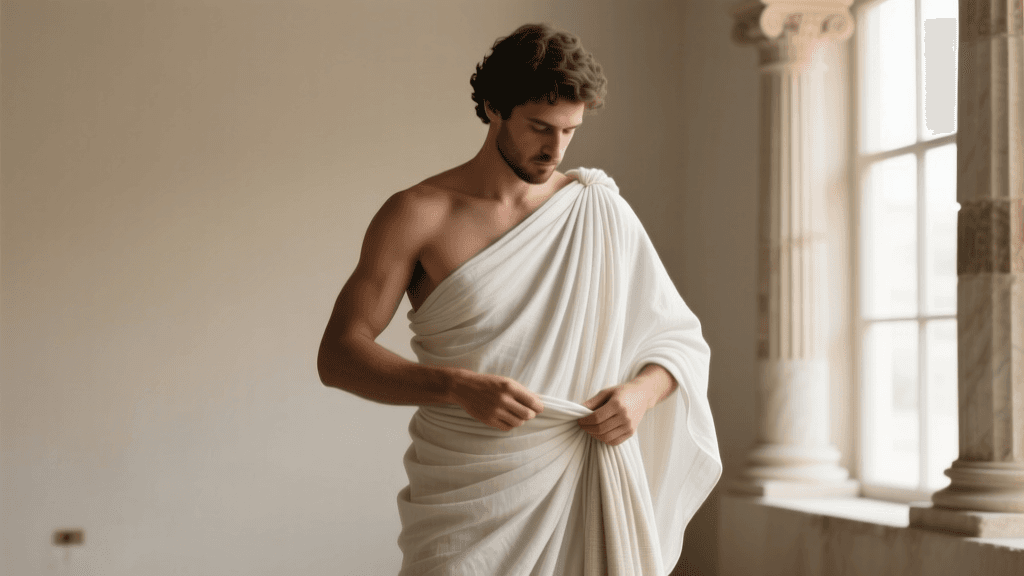
While the Greeks favored the simplicity of the rectangle, the Romans engineered the toga into a complex symbol of citizenship and status. The toga was exclusively worn by male Roman citizens, while the *stola* served as the traditional, modest garment for respectable Roman women. The complexity of the Roman toga is further detailed in the World History Encyclopedia's comprehensive guide to the Toga, which notes that the garment's semicircular cut required immense skill to drape correctly without the use of pins.
The Geometry of the Toga
Unlike the rectangular chiton, the Imperial Roman toga was cut in a massive semicircle or ellipse. By the height of the Roman Empire, the toga could measure up to 18 feet in length and 11 feet in width. The fabric was typically heavy, fulled wool, which provided the necessary structure to hold the intricate folds. The two most critical structural elements of the toga were the *sinus* (a deep, pouch-like fold across the chest) and the *umbo* (a decorative knot of fabric resting over the left shoulder).
The Stola
The stola was a long, sleeveless dress worn over a tunica. It was characterized by its *instita*—a decorative woven border at the hem and sometimes at the neckline. In 2026, historical costumers are utilizing digital loom technology to recreate the intricate geometric patterns of the *instita*, bringing a new level of accuracy to Roman female reenactment garb.
2026 Fabric Weight and Drape Comparison Chart
Selecting the correct fabric weight, measured in Grams per Square Meter (GSM), is the most common pitfall for modern reenactors. A fabric that is too light will not hold the structural folds of a toga, while a fabric that is too heavy will cause the chiton to sag uncomfortably. Below is our recommended 2026 sourcing chart for authentic draping.
| Garment Type | Primary Fabric | Ideal GSM | Drape Characteristics | 2026 Sourcing Advice |
|---|---|---|---|---|
| Doric Chiton / Peplos | Wool Flannel or Fulled Wool | 280 - 350 GSM | Structured, holds sharp folds, provides warmth. | Seek out heritage British or Italian wool mills offering undyed, natural fleece tones. |
| Ionic Chiton | Pure Flax Linen | 120 - 160 GSM | Fluid, translucent, catches the wind elegantly. | Opt for Eastern European wet-spun linens for the highest historical accuracy and breathability. |
| Roman Toga | Heavy Fulled Wool | 400 - 500 GSM | Stiff, sculptural, requires steaming to set the sinus and umbo. | Custom mill runs are often required; look for heavy melton wool alternatives if budget is constrained. |
| Roman Stola | Medium-weight Linen or Silk Blend | 180 - 220 GSM | Modest drape, opaque, falls straight to the floor. | Sustainable peace silk blends are trending in 2026 for high-status patrician stola reconstructions. |
Step-by-Step: Draping the Imperial Roman Toga
Draping the toga requires patience and ideally a second pair of hands. For visual and structural reference, the Metropolitan Museum of Art's Heilbrunn Timeline of Art History provides invaluable analysis of surviving classical sculptures, which serve as the best visual guides for these complex folds.
- The Initial Drape: Hold the toga behind you. Throw the left end (the *lacinia*) over your left shoulder so that the hem falls to the floor in front of you, reaching down to your ankles.
- Wrapping the Back: Bring the bulk of the fabric across your back, under your right arm, and across your chest.
- Creating the Sinus: Allow a generous amount of fabric to sag across your torso, creating a deep, curved pouch (the *sinus*). This pouch was historically used to carry small items or to veil the head during religious ceremonies.
- The Final Throw: Throw the remaining fabric over your left shoulder once more. The fabric should cascade down your back, ending near the calves.
- Forming the Umbo: Adjust the fabric on your left shoulder, pulling a small section of the overlapping folds forward to create a prominent, decorative knot (the *umbo*) at the center of your chest.
Essential Accessories: Fibulae and Krepides
No ancient Mediterranean garment is complete without its functional and decorative accessories. The *fibula* (brooch) was the ancient equivalent of the safety pin, essential for securing the Ionic chiton or the Doric peplos. In 2026, advances in 3D bronze casting and lost-wax metallurgy have allowed artisan jewelers to produce museum-quality fibulae replicas that are both historically accurate and structurally sound enough to hold heavy wool without bending.
Footwear is equally important. The Greek *krepides* (strapped leather sandals) and the Roman *calcei* (enclosed leather shoes for patricians) ground the outfit. Modern historical shoemakers are now utilizing vegetable-tanned leathers and hand-forged iron hobnails to recreate the exact acoustic footprint and durability of ancient footwear, ensuring that your reenactment gear can withstand the rigors of modern festival grounds while maintaining absolute historical integrity.
Conclusion
Mastering the chiton and the toga is an exercise in understanding the relationship between the human body and uncut textiles. By respecting the historical geometry, selecting the appropriate GSM fabric weights, and practicing the intricate draping techniques outlined above, you can achieve a level of authenticity that honors the rich legacy of ancient European folk dress. Whether you are preparing for a major 2026 Hellenic heritage event or staging a classical tragedy, these garments will provide a profound, kinetic connection to the ancient world.