Greek Chiton & Roman Stola Guide 2026: Authentic Draping Tips
The Renaissance of Classical Garments in 2026
The fascination with classical antiquity has experienced a massive resurgence in 2026, bridging the gap between rigorous historical reenactment and contemporary "Hellenic-core" fashion. From the flowing lines of the ancient Greek chiton to the structured, status-defining drapes of the Roman stola and toga, these garments represent the pinnacle of early European textile artistry. Unlike modern tailored clothing, classical dress relied entirely on the geometry of the fabric, the physics of gravity, and the skill of the wearer. According to the Metropolitan Museum of Art's Greek and Roman Art department, the brilliance of ancient Mediterranean clothing lies in its versatility; a single, uncut rectangular piece of cloth could be transformed into dozens of distinct silhouettes simply by altering the placement of pins and belts.
For modern enthusiasts, mastering these ancient garments requires an understanding of historical textiles, precise body measurements, and traditional draping techniques. This comprehensive 2026 guide will walk you through the construction, sourcing, and styling of the Greek chiton and Roman stola, ensuring your historical wardrobe is both authentic and elegantly executed.
Understanding the Greek Chiton: Doric vs. Ionic
The chiton was the foundational garment of ancient Greece, worn by both men and women, though women's versions typically extended to the ankles while men's often stopped at the knees. There are two primary styles that every classical dress enthusiast must know:
The Doric Chiton
The Doric chiton is the older, heavier, and more structured of the two styles. Traditionally made from heavyweight wool, it features a distinctive overfold called the apotyagma. This overfold is created by folding the top edge of the fabric down before pinning it at the shoulders, creating a layered, cascading effect over the chest and back. The Doric style typically requires only one or two pins (fibulae) at the shoulders, relying on the weight of the wool to keep the garment in place.
The Ionic Chiton
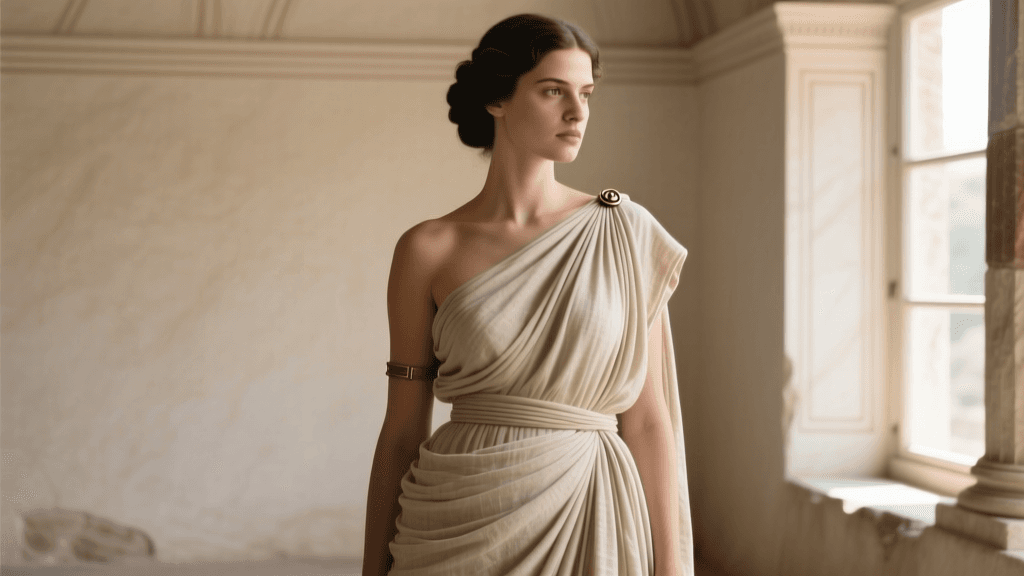
Emerging later and heavily influenced by Eastern Mediterranean styles, the Ionic chiton is characterized by its lighter, more voluminous drape. Made from finely woven linen or sheer silk (for the ultra-wealthy), the Ionic chiton lacks the heavy overfold of the Doric style. Instead, it is pinned multiple times along the arms, creating elegant, sleeve-like cascades. This style requires significantly more fabric width to achieve the desired billowing effect.
The Roman Stola and Toga: Symbols of Status
While the Greeks favored geometric simplicity, Roman dress was deeply codified, serving as a visual indicator of citizenship, gender, and social class. The British Museum's Greece and Rome collection highlights how Roman garments were not merely functional but acted as strict social signifiers in the bustling forums and patrician villas of the empire.
The Stola: The Matron's Garment
The stola was the traditional, formal dress of the married Roman woman (the matrona). Worn over a base tunic (tunica intima), the stola was a long, sleeveless garment suspended from the shoulders by straps or a series of small clasps. The defining feature of the stola was the institia, a decorative woven band that ran along the bottom hem and sometimes the V-shaped neckline. The stola was designed to create deep, vertical folds that conveyed modesty and dignity, completely obscuring the body's natural contours beneath layers of draped fabric.
The Toga: The Ultimate Draping Challenge
No garment in European folk and classical dress history is as notoriously difficult to drape as the Roman toga. Reserved exclusively for male Roman citizens, the toga was a massive, semi-circular piece of wool that could measure up to 20 feet in length and 8 feet in width. By the Imperial era, the toga had evolved into a highly ceremonial garment featuring complex folds like the sinus (a deep pouch across the chest used to carry small items) and the umbo (a decorative knot of fabric at the waist).
2026 Fabric Sourcing Guide for Reenactors
The success of any classical garment hinges entirely on the textile. Modern synthetic blends will cling, bunch, and drape poorly, ruining the historical silhouette. In 2026, the historical reenactment community heavily favors sustainably sourced, natural fibers that mimic the hand-woven textures of antiquity. Below is a comparison chart of the best fabrics for classical draping available on the market this year.
| Fabric Type | Weight (gsm) | Drape Quality | Historical Accuracy | 2026 Avg Cost (USD/Yard) |
|---|---|---|---|---|
| Medium-Weight Linen | 180 - 220 | Fluid, crisp folds | High (Ionic Chiton, Tunics) | $18 - $24 |
| Heavyweight Linen | 280 - 350 | Structured, heavy drops | High (Doric Chiton, Stola) | $25 - $32 |
| Tropical Wool | 150 - 190 | Excellent, breathable | Moderate (Summer Togas) | $28 - $35 |
| Fine Merino Wool | 250 - 300 | Superior, clings well | Very High (Doric Chiton, Toga) | $35 - $45 |
| Hemp-Linen Blend | 200 - 240 | Textured, stiff initially | Moderate (Working-class dress) | $15 - $20 |
When sourcing materials in 2026, look for "European Flax" certified linens, which guarantee a long-staple fiber that softens beautifully over time while maintaining the crispness required for sharp chiton pleats. For wool, avoid modern worsted suitings; instead, seek out woolen-spun fabrics that replicate the slightly fulled, matte finish of ancient Mediterranean textiles.
Step-by-Step Draping Techniques
Mastering the drape requires patience and an understanding of how gravity interacts with your specific body proportions. Primary text translations available via the Perseus Digital Library at Tufts University frequently reference the meticulous care ancient Greeks and Romans took in arranging their folds before stepping out in public.
How to Drape a Doric Chiton
- Step 1: Measure the Fabric. The width of your fabric should be 1.5 to 2 times your hip circumference. The height should be the distance from your shoulder to the floor, plus an additional 12 to 15 inches to account for the overfold and the bloused effect (kolpos) over the belt.
- Step 2: Create the Apotyagma. Lay the fabric flat. Fold the top edge down by 12 to 15 inches across the entire width. This is your overfold.
- Step 3: Wrap and Pin. Wrap the fabric around your body, under the arms. Bring the back and front edges together at your shoulders. Secure them with a fibula (brooch) or heavy-duty safety pin, ensuring you catch all layers of the overfold.
- Step 4: Belt and Blouse. Tie a woven wool or leather belt (zona) around your waist. Pull the fabric up and over the belt, allowing the overfold to cascade down and hide the belt entirely. Adjust the bloused fabric evenly around your torso.
Securing the Garments: Fibulae and Zonae
The structural integrity of classical dress relies heavily on accessories. The fibula (brooch) is not merely decorative; it bears the entire weight of the garment. In 2026, museum-quality replica fibulae made from cast bronze and iron are widely available from specialized historical jewelers. Ensure your pins feature a strong spring mechanism and a deep catch plate to prevent the heavy wool or linen from slipping off the shoulder during movement.
The zona (belt) is equally crucial. For Greek chitons, a simple braided wool cord or a woven tablet-woven band works best. For the Roman stola, a wider, decorative leather or fabric belt tied just beneath the bust helps create the characteristic deep V-shaped folds of the bodice.
Modern Styling and Footwear
Completing the classical silhouette requires appropriate footwear and styling. Bare feet were common indoors, but for outdoor wear, leather sandals are essential. The Greek sandalia and the Roman soleae featured simple leather straps that laced up the calf. Modern historical shoemakers in 2026 offer vegetable-tanned leather sandals with historically accurate hobnail patterns on the soles, providing both authenticity and necessary traction on modern terrain.
Hair and jewelry also play a pivotal role. Greek women often utilized the stephane (a metal diadem) or simple ribbon bindings to secure intricate braided updos. Roman matrons favored the tutulus, a high, conical braided style, often secured with bone or ivory hairpins (acus). Incorporating these elements transforms a simple draped cloth into a fully realized historical ensemble.
Conclusion
The enduring appeal of the Greek chiton and Roman stola lies in their elegant simplicity and profound connection to the human form. By understanding the geometry of the drape, investing in high-quality natural fibers, and mastering the use of traditional accessories, modern enthusiasts can bring the majestic silhouettes of antiquity to life. Whether you are preparing for a rigorous historical demonstration or simply embracing the timeless aesthetics of classical European folk dress, the techniques outlined in this 2026 guide will ensure your garments drape with the grace and dignity of the ancient world.