Authentic 14th-Century Cotehardie Reconstruction Guide 2026
The 14th-Century Tailoring Revolution
As we navigate the 2026 historical reenactment and living history season, the standards for authenticity in medieval European clothing have never been more rigorous. Gone are the days of poorly fitted, machine-sewn polyester tunics. Today's top-tier European heritage festivals demand meticulous attention to historical tailoring, period-accurate textiles, and hand-finished details. At the heart of this demand is the 14th-century cotehardie and kirtle layering system—a revolutionary shift in European fashion that transitioned garments from loose, draped tunics to highly structured, form-fitting tailored clothing.
This comprehensive guide will walk you through the historical context, pattern drafting, material sourcing, and construction techniques required to build an authentic 14th-century Gothic ensemble in 2026. Whether you are a museum professional, a dedicated reenactor, or a historical costumer, understanding the mechanics of the cotehardie is essential for capturing the true silhouette of the 1300s.
Understanding the Shift to Fitted Silhouettes
Before the mid-14th century, European dress relied heavily on the drape of the fabric. Garments like the early medieval bliaut or the basic tunic were cut from geometric shapes—rectangles and triangles—minimizing fabric waste but offering little in the way of anatomical contouring. However, the 1330s introduced a radical innovation: the curved armscye (armhole) and the set-in sleeve. According to curators at the Metropolitan Museum of Art's Department of Medieval Art, this structural leap allowed garments to fit tightly against the torso while preserving full mobility in the arms, fundamentally changing the European silhouette.
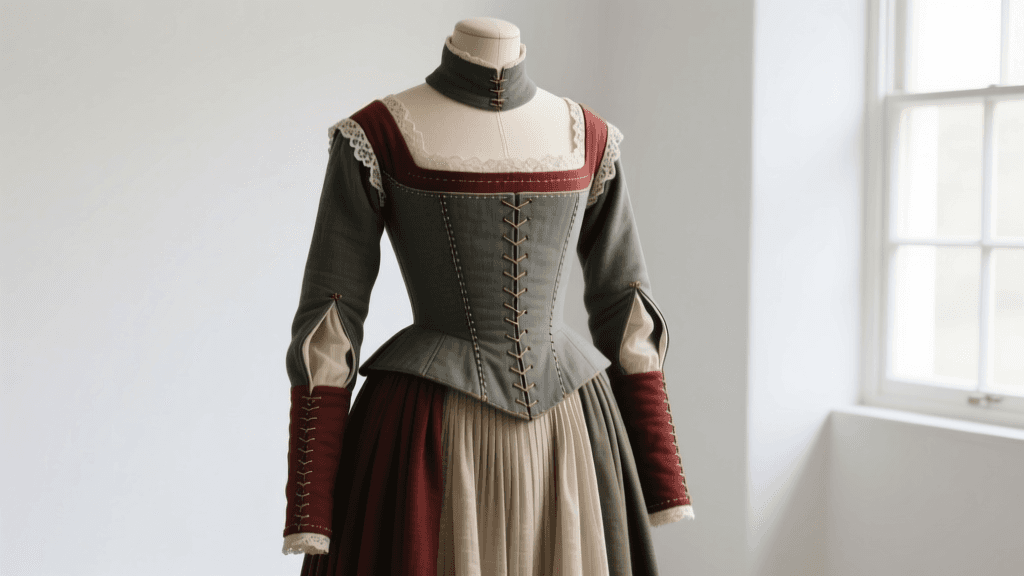
This tailoring revolution gave birth to the kirtle (a fitted base layer) and the cotehardie (a fashionable, tightly buttoned outer layer). Together, they created the sleek, elongated, and tailored look that defines late medieval Gothic fashion.
Drafting the Kirtle: The Foundation Layer
The kirtle is the structural foundation of your 14th-century wardrobe. It is a fitted, supportive garment worn over a linen chemise and beneath the cotehardie. In 2026, historical pattern drafters emphasize the use of the 'draping on the body' method rather than relying on modern slopers, as modern posture and undergarments drastically alter the natural drape of wool.
Key Measurements and Cutting Techniques
- The Four-Panel Base: The kirtle is typically constructed from four main panels (two front, two back) with triangular gores inserted into the side seams or center back to provide flare at the hem while maintaining a tight fit through the bust and waist.
- The Waist Seam: While some early 14th-century kirtles were cut in one piece from shoulder to hem, by the 1380s, a horizontal waist seam became common, allowing for an even tighter fit through the torso and a fuller, gathered skirt.
- Supportive Fitting: For female-presenting wearers, the kirtle acts as a supportive undergarment. The linen chemise beneath provides a moisture barrier, while the tightly fitted wool kirtle offers bust support through negative ease and strategic seam placement.
Constructing the Cotehardie: The Outer Layer
The cotehardie is the star of the 14th-century ensemble. Worn over the kirtle, it is characterized by its tight fit, low neckline (for women) or high collar (for men), and most importantly, its extensive use of buttons. The survival of textile fragments analyzed by the Textile Research Centre in Leiden highlights the intricate craftsmanship of medieval buttonholes, which were densely packed and reinforced with silk thread to withstand the tension of a skin-tight fit.
The Button and Buttonhole Technique
Authenticity in 2026 requires abandoning modern metal buttons in favor of self-stuffed cloth buttons. To create these, cut small circles of your fashion fabric, gather the edges, and stuff them tightly with scraps of the same wool. The resulting spherical buttons are then secured with a linen or silk core. Buttonholes must be hand-stitched using a dense buttonhole stitch or a reinforced running stitch, often bound with silk buttonhole twist to prevent the wool from fraying under stress. It is not uncommon for a high-status cotehardie to feature 30 to 40 buttons running from the neckline down to the hem, and another 15 buttons on each forearm.
The Grande Assiette Sleeve: A Masterclass in Mobility
One of the most defining and complex features of the 14th-century cotehardie is the grande assiette (great gusset) sleeve. Unlike modern sleeves that are set into a relatively small armhole, the grande assiette sleeve features an armhole that extends deeply into the bodice, often reaching the side seam or the center back. A large, diamond-shaped gusset is inserted under the arm.
The grande assiette sleeve is a marvel of medieval engineering. It allows the wearer to raise their arms completely overhead without the garment riding up, a crucial feature for both active labor and the martial pursuits of the nobility.
Drafting this sleeve requires precision. The gusset must be cut on the bias to allow for stretch and movement. When sewing by hand, use a tight backstitch for the armhole seams to ensure they can withstand the immense tension placed on them during movement.
2026 Textile Sourcing and EU Dye Regulations
Sourcing the correct fabric is arguably the most challenging aspect of historical reconstruction today. The European Union's updated 2025/2026 textile sustainability and chemical dye regulations have severely restricted the use of certain synthetic mordants and heavy-metal dyes in commercial textiles. While this is a victory for environmental sustainability, it has disrupted the supply chain for commercial 'reenactment wools' that previously relied on these chemicals for colorfastness.
Consequently, the 2026 market has seen a massive surge in heritage, naturally dyed wools. Mills in Italy, England, and Scandinavia are now producing museum-grade woad, madder, and weld-dyed wools that are not only historically accurate but fully compliant with the new EU eco-standards. According to the Victoria and Albert Museum's medieval collections, the subtle variations in color achieved through natural fermentation vats are exactly what is seen in surviving 14th-century tapestries and garments.
Material and Cost Comparison (2026 Market Rates)
| Material Type | 2026 Avg. Cost (per meter) | Historical Accuracy | Best Use Case |
|---|---|---|---|
| Heritage Woad-Dyed Wool Twill | €95 - €130 | Exceptional | High-status Cotehardie |
| Commercial Melton Wool (Undyed) | €45 - €65 | Moderate | Base Kirtle / Lower Status |
| Water-Retted Heritage Linen | €35 - €50 | Exceptional | Chemise and Veils |
| Silk Taffeta (Weighted) | €110 - €150 | High | Lining and Trims |
| Silk Buttonhole Twist | €12 per spool | Exceptional | Buttonholes and Edging |
Hand-Sewing vs. Machine Construction in Modern Reenactment
The debate between hand-sewing and machine-sewing continues in 2026, but the consensus among elite living history groups is clear: visible seams must be hand-finished. While using a sewing machine for the internal, hidden structural seams of the kirtle skirt is often tolerated in 'mid-tier' authenticity events, the cotehardie demands hand-sewing.
Use a period-accurate running stitch for long seams, and a backstitch for high-stress areas like the armholes and buttonholes. Finish the raw edges using a flat-felled seam or by binding them with narrow strips of linen. This not only prevents fraying but adds a beautiful, structured weight to the garment that modern serged edges completely destroy.
Accessories and Finishing Touches
No 14th-century cotehardie is complete without the proper accessories. The silhouette is elongated and emphasized by the use of a low-slung hip belt. For women, the hair must be concealed or styled according to marital status. The fillet and barbette (a linen band around the forehead and under the chin) remains a staple for married women, while unmarried women might wear their hair in braided temples adorned with silk ribbons.
Men's accessories include the chaperon (a hood that has been twisted and pinned into a sculptural hat) and a sturdy leather pouch suspended from the belt. Ensure all leatherwork is vegetable-tanned and dyed using natural oak bark or walnut husks, as chrome-tanned leather is strictly prohibited in high-level 2026 heritage events.
Conclusion
Reconstructing a 14th-century cotehardie and kirtle is a labor of love that bridges the gap between modern textile craftsmanship and medieval engineering. By embracing the complex tailoring of the grande assiette sleeve, mastering the art of self-stuffed cloth buttons, and navigating the 2026 landscape of sustainable heritage wools, you can create a garment that is not only historically flawless but a joy to wear. As the living history community continues to elevate its standards, the meticulous recreation of these foundational European garments ensures that the legacy of the 14th-century tailoring revolution remains vibrant and alive.