15th-Century Florentine Gamurra: 2026 Tailoring Guide
The Renaissance Revival: Why the Gamurra Matters in 2026
As we navigate the 2026 heritage textile market, the intersection of historical accuracy and sustainable fashion has never been more vibrant. For enthusiasts of European folk dress and historical recreation, the 15th-century Florentine gamurra remains the ultimate foundational garment of the Italian Renaissance. Unlike the heavily structured, boned bodices of the later 16th century, the gamurra relies on masterful geometric tailoring, precise fabric draping, and intricate layering to achieve its iconic silhouette. According to the FIT Fashion History Timeline, the gamurra was the basic, everyday dress for women across various social strata in Quattrocento Italy, serving as the canvas upon which wealth and status were displayed through overdresses and accessories.
In 2026, the shift away from synthetic poly-blends toward authentic, heritage-milled textiles has revolutionized how we approach Renaissance costuming. Modern tailors and historical costumers are now prioritizing zero-waste geometric cutting methods and plant-based dyes, mirroring the exact practices of 15th-century Florentine bottegas. This comprehensive guide will walk you through the anatomy, fabric sourcing, pattern drafting, and construction techniques required to create a museum-quality Florentine gamurra ensemble today.
Anatomy of the Florentine Gamurra
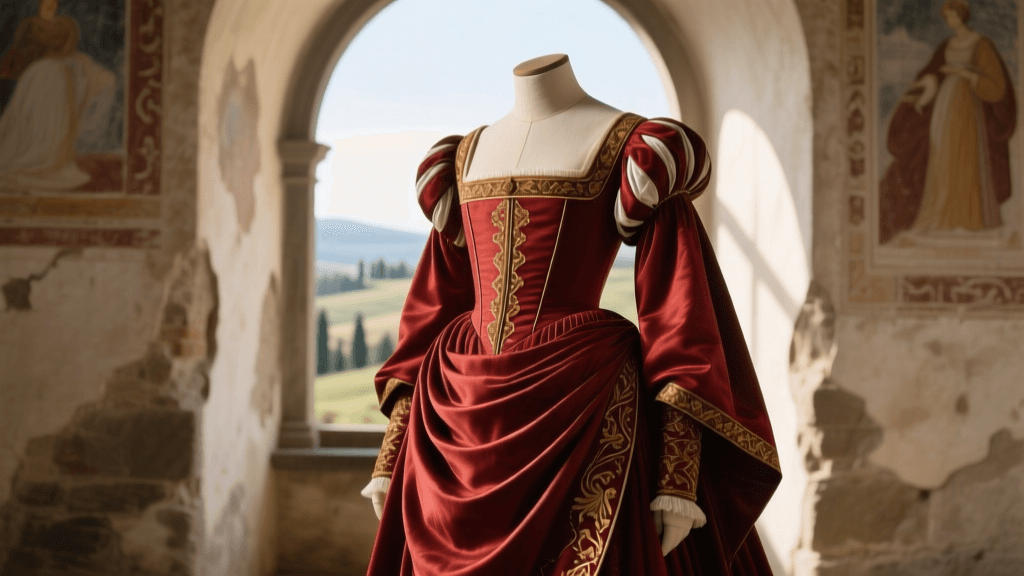
The gamurra (sometimes referred to as a zuparello or gonna) is characterized by its high-waisted bodice, square or rounded neckline, and a flowing skirt achieved through the insertion of triangular gores. The bodice is fitted but not rigidly boned; instead, it is lined with heavy linen or canvas to provide structural support through tension and tailoring. The most defining feature of the gamurra is its front-lacing system, which allows the wearer to adjust the fit of the bodice while deliberately revealing the pristine white linen of the camicia (undergarment) beneath.
The sleeves of the gamurra are perhaps its most versatile element. Rather than being permanently set into the armscye, they are tied on using laces and metal aglets (aiguillettes). This tie-on sleeve system allowed Renaissance women to swap out sleeves of different colors and fabrics to match their overdress or to adapt to changing seasons, a practical luxury that remains highly relevant in modern historical wardrobing.
2026 Fabric Sourcing: Wools, Silks, and Linens
Sourcing historically accurate fabrics in 2026 requires a blend of traditional knowledge and modern global supply chain awareness. The 2026 push for sustainable, plant-based dyes has made madder red, weld yellow, and woad blue more accessible than ever from artisanal weavers in Italy and Eastern Europe. When selecting textiles, you must consider the three distinct layers of the ensemble: the camicia, the gamurra, and the giornea (overdress).
For the gamurra itself, a medium-weight wool broadcloth or a high-quality wool-silk blend is ideal. Heritage mills in Biella, Italy, have recently released 2026 collections of lightly fulled wools that perfectly mimic the drape and finish of Quattrocento broadcloth. For the camicia, you must avoid modern, stiff linens; instead, seek out 'handkerchief weight' or medium-weight linen that has been enzymatically washed for a soft, flowing drape. The Encyclopædia Britannica notes that the stark contrast between the bleached white linen of the camicia and the richly dyed wool or silk of the outer garments was a primary visual marker of Renaissance cleanliness and wealth.
2026 Material Sourcing and Cost Guide
| Garment Layer | Recommended 2026 Fabric | Yardage Needed | Est. 2026 Cost (USD) |
|---|---|---|---|
| Camicia (Chemise) | 100% Bleached Linen (4.5 oz) | 5 yards | $140 |
| Gamurra (Base Gown) | Heritage Wool Broadcloth (12 oz) | 6 yards | $360 |
| Gamurra Bodice Lining | Heavyweight Natural Linen | 2 yards | $50 |
| Giornea (Overdress) | Silk Damask or Brocade | 5 yards | $450 |
| Tie-On Sleeves | Contrasting Silk Taffeta | 2 yards | $120 |
Drafting the Pattern: Gores, Gussets, and Geometry
Unlike modern patterns that rely on curved darts to shape the bodice and skirt, 15th-century tailoring is rooted in geometric zero-waste cutting. The gamurra pattern is drafted using straight lines, rectangles, and triangles. To draft the front and back panels, you begin with a rectangle that spans from the shoulder to the floor. The waist is shaped not by darts, but by angling the side seams and inserting wide triangular gores that flare out from the waist or hip to the hem.
In 2026, digital pattern-making tools can assist in calculating the exact hypotenuse of your gores to ensure the hem falls perfectly level. A standard Florentine gamurra requires at least four to six gores to achieve the lush, sweeping hem circumference seen in the period portraits analyzed by The National Gallery. When cutting your wool, always align the gores so that the bias edges meet straight grains, which prevents the skirt from warping or sagging over time.
The Bodice and Front-Lacing System
The bodice of the gamurra must be interlined with heavy linen. In 2026, many tailors are returning to the historical method of pad-stitching the interlining to the outer wool fabric, which creates a smooth, supportive curve over the bust without the need for synthetic boning. The front opening is reinforced with a facing strip of linen to prevent the eyelets from tearing under tension.
Historical accuracy demands that eyelets be created using a metal awl to push the warp and weft threads aside, rather than a hole punch that cuts and weakens the fibers. The lacing can be done in a spiral pattern (using one continuous lace) or a straight ladder pattern (using two separate laces). Spiral lacing is historically more common for the gamurra and allows for easier adjustment of the bodice tension.
Sleeve Construction and the Tie-On Technique
The armscye of the gamurra is cut relatively high and tight to allow for maximum arm mobility. The sleeves themselves are cut in two pieces (an upper sleeve and a lower sleeve) or as a single curved tube, depending on the desired volume. The top of the sleeve is finished with a sturdy linen binding, into which hand-bound eyelets are set. Corresponding eyelets are placed along the armscye of the bodice. The sleeves are then attached using silk laces tipped with brass or pewter aglets. This tie-on system is not merely decorative; it relieves stress on the bodice seams and allows the white camicia sleeves to puff elegantly through the shoulder and elbow slashes.
The Camicia and Giornea: Completing the Layered Look
No gamurra is complete without its supporting layers. The camicia is the foundational undergarment, constructed entirely of white linen using tiny, flat-felled seams and cartridge pleating at the neckline and cuffs. In 2026, the availability of high-quality, finely spun linen thread has made it easier for costumers to execute the microscopic running stitches required for authentic camicia construction. The neckline of the camicia is often gathered with a simple drawstring or permanently pleated to sit just above the square neckline of the gamurra.
Over the gamurra, a woman of means would wear a giornea. The giornea is a sleeveless overdress, often made of opulent silk damask or velvet, featuring a high waistline and an open front that reveals the gamurra beneath. The giornea is the primary vehicle for displaying family heraldry, intricate embroidery, or jeweled trims. When sourcing silk damask in 2026, look for mills that offer custom weave reproductions of 15th-century pomegranate or artichoke motifs, which are the hallmarks of authentic Florentine Renaissance textiles.
Historical Stitches and Seam Finishes
To achieve a truly authentic interior, the construction methods must match the exterior aesthetics. The vertical seams of the gamurra skirt are best finished using a flat-felled seam or a run-and-fell stitch, which encloses all raw edges and provides immense durability. For the bodice seams, a tight backstitch is recommended for strength, followed by pressing the seam allowances open and securing them to the interlining with a herringbone stitch. This prevents the wool from fraying and adds an extra layer of structural integrity to the bodice.
Cartridge pleating is the quintessential technique for attaching the voluminous skirt to the fitted bodice. This involves sewing parallel rows of thick running1/4 inch apart along the top edge of the skirt, then pulling the threads to create tight, uniform, tubular pleats. These pleats are then whipped directly to the bottom edge of the bodice, creating the distinct, rounded flare that defines the 15th-century silhouette.
2026 Cost Breakdown for a Complete Ensemble
Investing in a historically accurate Renaissance ensemble is a significant undertaking, but the 2026 market offers options for both luxury heritage,avers and budget-conscious historians. Below is a realistic cost breakdown for a complete, middle-to-upper-class Florentine ensemble, excluding the cost of a professional tailor if you are making it yourself.
- Camicia (Materials and Notions): $160
- Gamurra (Wool, Linen Interlining, Thread, Lacing): $450
- Giornea (Silk Damask and Trims): $600
- Tie-On Sleeves (Silk Taffeta and Aglets): $180
- Accessories (Leather Girdle, Brass Buckle, Silk Veil): $220
- Total Estimated Material Cost: $1,610
While the upfront cost of heritage textiles is higher than modern synthetics, the longevity, drape, and historical accuracy of these materials are unparalleled. Furthermore, supporting heritage mills and artisanal dyers ensures that these traditional textile techniques survive for future generations of historians and tailors.
Conclusion
Tailoring a 15th-century Florentine gamurra in 2026 is a deeply rewarding exercise in historical empathy and geometric precision. By understanding the interplay between the camicia, the gamurra, and the giornea, and by committing to authentic fabric sourcing and construction techniques, you can recreate a garment that is not just a costume, but a living piece of European folk dress history. Whether you are attending a Renaissance festival, participating in a living history event, or simply expanding your historical wardrobe, the Florentine gamurra remains a timeless testament to the elegance and ingenuity of Quattrocento tailoring.