Baltic Amber Folk Jewelry: 2026 Sourcing & Styling Guide
The Enduring Legacy of Baltic Gold
When discussing the intricate tapestry of European folk dress, the conversation often gravitates toward hand-woven textiles, elaborate embroidery, and regional headwear. However, in the Baltic states—specifically Lithuania and Latvia—the soul of the traditional costume is inextricably linked to its jewelry. Baltic amber, known locally as gintaras in Lithuanian and dzintars in Latvian, is not merely an accessory; it is a cultural cornerstone. Often referred to as 'Baltic Gold,' this fossilized tree resin has adorned the necks, wrists, and garments of Baltic women for millennia. As we navigate the heritage revival movements of 2026, traditional amber jewelry has experienced a massive resurgence, with modern enthusiasts and folkloric dancers seeking authentic, historically accurate pieces to complement their regional costumes.
Historical Roots and Solar Symbolism
Long before the establishment of modern borders, ancient Baltic tribes revered amber as a physical manifestation of the sun. Pagan traditions dictated that amber possessed protective qualities, capable of warding off evil spirits, curing ailments, and ensuring fertility. In the context of traditional folk dress, amber was the ultimate symbol of wealth and status. A woman's amber trousseau was typically accumulated over her lifetime, beginning in childhood, and was proudly displayed during major life events, particularly weddings and midsummer festivals. The warmth of the stone against the skin was believed to transfer vital solar energy to the wearer, making it an indispensable component of the festive folk ensemble.
Core Components of the Amber Trousseau
To accurately assemble a traditional Baltic folk jewelry set in 2026, one must understand the distinct categories of amber adornment. The traditional trousseau is generally divided into three main categories:
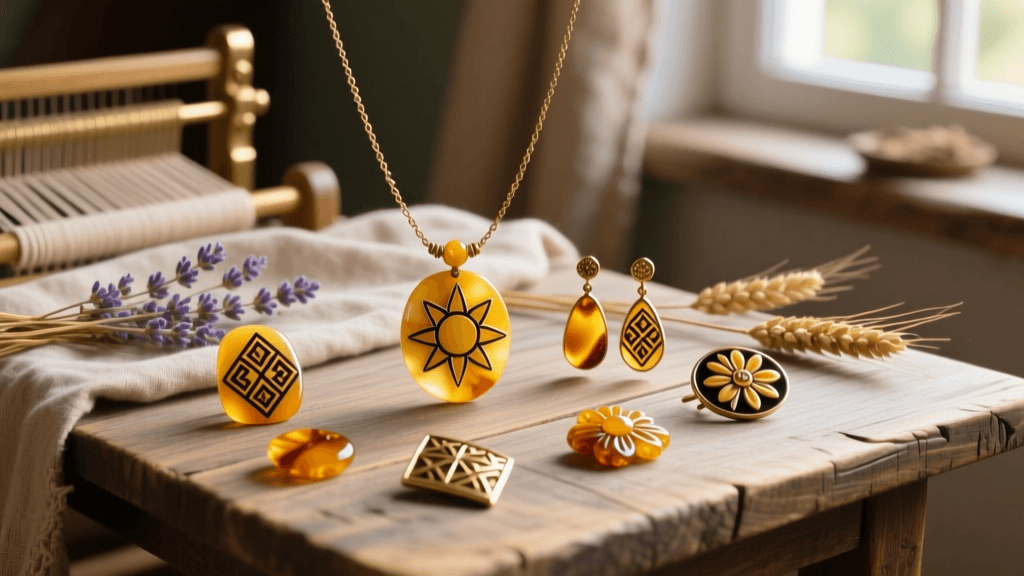
- Karoliai (Necklaces): The centerpiece of Baltic jewelry. Traditional necklaces are rarely uniform. Instead, they feature graduated beads, with the largest, most flawless teardrop or barrel-shaped nuggets resting at the center of the collarbone, tapering down to smaller seed amber near the clasp. In 2026, multi-strand necklaces featuring raw, unpolished nuggets are highly prized for their organic, ancient aesthetic.
- Sagės (Brooches): Essential for securing the heavy linen shawls (skara) and woolen wraps that are characteristic of Baltic folk dress. Traditional amber brooches are often set in silver or bronze, featuring intricate sun-burst motifs, filigree work, or simple bezel settings that allow the natural inclusions of the amber to take center stage.
- Auskarai (Earrings): Historically, Baltic amber earrings were simple and understated, designed not to compete with the elaborate woven headpieces and crowns (galionai or vainagai). Small, polished drops or raw chips suspended from silver hooks remain the most authentic choice for contemporary folk dress enthusiasts.
Regional Variations: Lithuanian vs. Latvian Styles
While both nations share a deep reverence for amber, the stylistic execution in their respective folk costumes differs noticeably. Lithuanian folk jewelry traditionally favors larger, highly polished beads, often combined with intricate silver filigree caps and clasps. The aesthetic leans toward refined elegance, reflecting the agricultural prosperity of the region's historical nobility and wealthy peasantry. Conversely, Latvian traditional jewelry, particularly from the Latgallian and Curonian regions, often incorporates smaller, raw amber nuggets interspersed with bronze rings, glass beads, and chainmaille weaves. This reflects older, archaeological influences and a more rugged, forest-dwelling heritage. Understanding these nuances is critical for collectors and costumers aiming for strict regional accuracy in 2026.
2026 Market Trends: The Raw Amber Renaissance
The 2026 market for Baltic amber has shifted dramatically. For decades, the industry standard was heavily heat-treated, perfectly round, cognac-colored amber. Today, driven by a younger generation of heritage enthusiasts and a broader cultural pivot toward sustainability and authenticity, the demand has skyrocketed for 'raw' and 'inclusion' amber. Buyers now actively seek out unpolished nuggets that retain their natural crust, as well as pieces containing prehistoric botanical inclusions like pine needles or ancient air bubbles. This trend aligns perfectly with the modern ethos of celebrating imperfections and honoring the natural origins of the material. Furthermore, ethical sourcing has become paramount; discerning buyers in 2026 are prioritizing amber harvested by certified coastal cooperatives in Lithuania and Latvia, rather than mass-market imports with opaque supply chains.
2026 Pricing and Sourcing Guide
Sourcing authentic Baltic amber requires navigating a market saturated with synthetics. Below is a comprehensive pricing guide for authentic, ethically sourced Baltic amber jewelry in the 2026 market.
| Jewelry Type | Description & Specifications | 2026 Estimated Price Range (EUR) |
|---|---|---|
| Raw Nugget Necklace (Karoliai) | Unpolished, graduated nuggets (15-40g total), natural crust, linen cord. | €180 - €450 |
| Polished Teardrop Necklace | Hand-polished, flawless cognac teardrops, silver filigree clasp. | €600 - €1,500+ |
| Traditional Sun Brooch (Sagė) | Cabochon amber set in oxidized silver or bronze sunburst motif. | €120 - €300 |
| Inclusion Pendant | Single large raw piece with visible botanical or insect inclusion. | €250 - €800+ |
| Simple Drop Earrings | Small polished chips or raw drops on sterling silver hooks. | €45 - €95 |
Authentication: Guarding Against Fakes in 2026
As the demand for heritage jewelry has surged, so has the proliferation of counterfeit amber. Copal (immature tree resin), epoxy resins, and dyed plastics are frequently sold as genuine Baltic succinite. According to the Gemological Institute of America (GIA), accurate identification requires a multi-step approach. Here are the most reliable, non-destructive tests you can perform when sourcing amber for your folk dress collection:
- The Saturated Saltwater Test: Genuine Baltic amber has a specific gravity slightly higher than water but lower than saturated saltwater. Mix one part table salt to two parts warm water. Authentic amber will float, while copal, glass, and most plastics will sink.
- UV Fluorescence: Under a standard ultraviolet flashlight, genuine Baltic amber will emit a distinct pale blue, green, or milky white fluorescence. Copal and plastics typically remain inert or glow a dull, artificial yellow.
- The Electrostatic Test: Vigorously rub the amber against a piece of natural wool or cotton. Genuine amber will develop a static charge and easily pick up small pieces of tissue paper. This is a hallmark of true succinite.
Always request certificates of authenticity from reputable Baltic jewelers, and avoid purchasing 'amber' from generic online marketplaces where supply chains cannot be verified.
Styling for Contemporary Heritage Festivals
Wearing traditional folk dress is a living, breathing practice, particularly during the massive Baltic Song and Dance Celebrations. These monumental events, which draw hundreds of thousands of participants and spectators, are deeply tied to national identity and are officially protected as a UNESCO Intangible Cultural Heritage tradition. When styling amber for these 2026 festivals, the goal is harmony between the jewelry and the textiles.
Amber should be paired with unbleached, heavy linen and naturally dyed wools. The warm, golden hues of the resin contrast beautifully against the crisp whites of linen blouses and the deep indigos, madder reds, and forest greens of woven woolen sashes (juostos). Avoid pairing traditional amber with modern synthetic fabrics or contemporary evening wear if your goal is strict folkloric accuracy. Let the amber rest directly against the skin or the linen collar to maximize its visual warmth and historical resonance.
Care and Preservation of Antique Amber
Baltic amber is an organic gemstone, meaning it is significantly softer and more sensitive to environmental factors than mineral stones like quartz or sapphire. On the Mohs hardness scale, amber ranks between 2 and 2.5, making it highly susceptible to scratching. To preserve your folk jewelry for future generations, store it in a soft linen pouch, separate from metal brooches or silver clasps. Never expose amber to modern perfumes, hairsprays, or harsh chemical cleaners, as the alcohol and solvents will permanently cloud the surface and degrade the resin. Clean your pieces gently with a soft, damp cloth and lukewarm water, allowing them to air dry naturally. With proper care, your Baltic amber will continue to capture the light of the sun for centuries to come, serving as a radiant bridge between ancient traditions and the vibrant folk dress revivals of 2026.