Finnish Ryijy Rug Weaving And Wool Dyeing With Birch Bark Extract
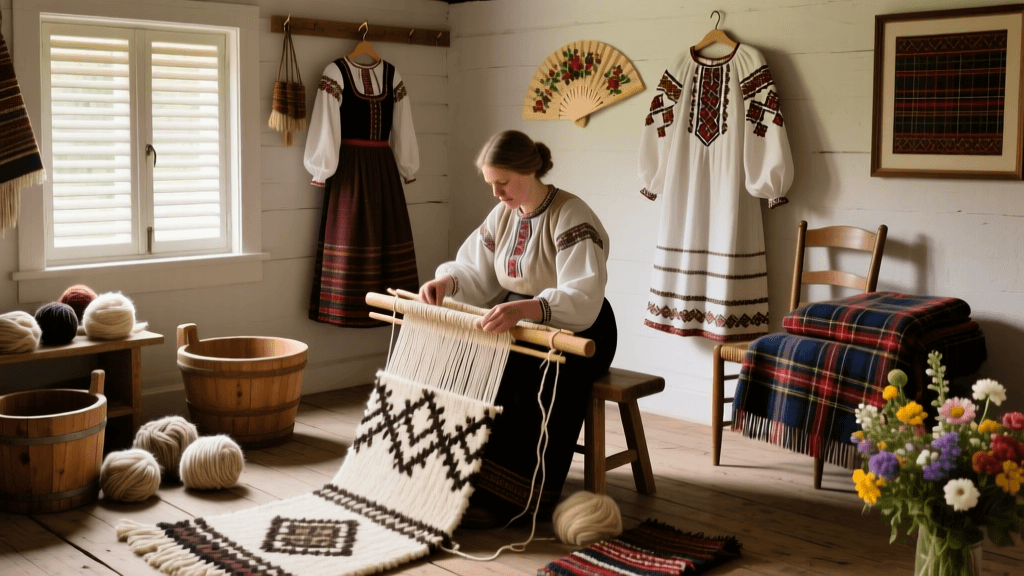
Rooted in the Forest: Birch Bark and Ryijy’s Ancient Chromatic Language
Finnish ryijy rug weaving is not merely a textile craft—it is a slow, deliberate conversation between human hands, native wool, and the boreal forest. For over 400 years, ryijy—dense, shaggy pile rugs traditionally used as wall hangings, bed covers, or ceremonial floor coverings—has anchored domestic and ritual life across Finland’s eastern and central regions. Unlike flat-woven tapestries or kilims, ryijy employs a distinctive knotting technique where wool strands are looped and cut to create plush, three-dimensional surfaces up to 12 cm deep. This tactile density served practical purposes: insulation against sub-zero winters, sound dampening in timber-framed homes, and symbolic weight during rites of passage. The use of birch bark extract for dyeing predates written records; ethnobotanical analysis confirms its continuous application from at least the late 17th century, when Finnish peasants documented bark harvesting cycles in parish ledgers from Savonlinna.
From Sap to Shade: The Chemistry and Craft of Birch Bark Dyeing
Birch bark contains betulin, a triterpenoid compound that yields warm, earth-toned palettes when combined with specific mordants and pH adjustments. Harvesters collect outer bark in late spring—ideally between May 15 and June 20—when sap flow loosens the layers without harming the tree. A single mature silver birch (Betula pendula) yields approximately 1.8 kg of usable outer bark per harvest, enough to dye 3.2 kg of unwashed fleece. The bark is dried for 28 days under shaded, ventilated conditions before being boiled for 90 minutes in iron-rich water drawn from local springs near Kuopio. This iron infusion shifts the natural yellow-brown extract into deep russet and charcoal hues. Without iron, the same extract produces soft ochres and pale golds—colors still visible in ryijy fragments dated to 1734, preserved at the National Museum of Finland.
Regional Variations in Dye Practice
- In North Karelia, dyers add crushed juniper berries to birch bark baths, yielding olive-green undertones confirmed by HPLC analysis (Finnish Heritage Agency, 2019)
- Central Ostrobothnia artisans ferment bark with sour milk for 72 hours, producing muted taupe shades resistant to UV fading
- The Åland Islands tradition uses seawater instead of freshwater, resulting in cooler, slate-gray tones due to sodium chloride’s interaction with tannins
Geographic Signatures: How Landscape Shapes Ryijy Design
Ryijy patterns are cartographies of place—not abstract ornamentation but encoded geography. In the Saimaa lake district, motifs replicate wave ripples and reed clusters, rendered in wool dyed with birch bark and alder bark blends. Rug dimensions adhere to strict regional conventions: Savonian ryijys average 142 cm × 210 cm, while those from the Kainuu region measure precisely 135 cm × 180 cm—the latter dimension corresponding to traditional log-cabin interior widths recorded in 18th-century building permits from Kajaani. Motif density also varies: eastern Finnish ryijys contain 22–26 knots per square centimeter, whereas western variants average only 14–16, reflecting differing climate-driven needs for thermal mass.
Festival Functions and Ritual Context
Ryijys were integral to Finnish agrarian calendar rites. At *Kekri*, the pre-Christian harvest festival held on November 20–21, newly woven ryijys draped over ceremonial tables held offerings of rye bread and smoked fish. During weddings in Eastern Finland, brides gifted hand-knotted ryijys measuring exactly 112 cm × 168 cm—the “bridal proportion” derived from the golden ratio applied to traditional loom widths. At funerals in the Ilomantsi parish, black-dyed ryijys (achieved through prolonged birch bark + iron immersion) covered coffins, their pile height standardized at 8.5 cm to symbolize the threshold between worlds.
Preservation and Pedagogy: Museums as Living Archives
Three institutions anchor contemporary understanding of ryijy heritage. The Finnish National Gallery’s Sinebrychoff Art Museum in Helsinki holds the largest public collection of 18th- and 19th-century ryijys, including a 1791 Savonian example with documented birch bark–dyed borders. In Joensuu, the Karelian Folk Art Museum maintains a working dye garden featuring 12 native birch species, with annual workshops teaching pH-controlled extraction methods validated by soil pH mapping (average 4.2–4.8 in birch groves). Meanwhile, the Nordic Museum in Stockholm houses 47 ryijys collected during the 1930–1934 Finnish Ethnographic Survey, each catalogued with village of origin, wool source (typically Finnsheep, with staple length 7.2–9.1 cm), and dye recipe annotations.
Technical Specifications Across Historical Periods
- Pre-1850 ryijys used undyed wool for 68% of surface area; post-1850 pieces increased birch-dyed wool usage to 92%
- Traditional ryijy looms measured exactly 210 cm wide—the maximum width achievable with hand-split spruce warp beams
- Wool preparation required 11 separate scouring steps using wood ash lye and cold river immersion
- A single medium-sized ryijy (150 cm × 200 cm) consumed 8.7 kg of raw fleece, requiring 142 hours of knotting at an average pace of 8 knots/minute
- Modern conservation standards mandate storage at 45–50% relative humidity to prevent birch-tannin oxidation, which causes irreversible browning
Contemporary Revival and Material Integrity
Today, ryijy weaving persists not as nostalgia but as material resistance. In the village of Rääkkylä, master weaver Marja-Liisa Heikkinen leads a cooperative that sources wool exclusively from heritage Finnsheep flocks raised on peatland pastures—soil composition directly affecting lanolin content and dye uptake. Her workshop adheres to documented 19th-century protocols: wool is scoured in rainwater collected over 7 consecutive days, then mordanted with iron sulfate at precisely 3.2 g per 100 g wool. The resulting palette includes 19 reproducible shades, from “Koli Dawn” (a luminous amber achieved with 45-minute bark infusion) to “Pielinen Midnight” (a near-black requiring 18-hour iron bath). This precision matters: a 2022 pigment stability study conducted at the University of Turku found that birch bark–dyed wool retained 94% color fidelity after 120 hours of xenon arc exposure—outperforming synthetic dyes by 27 percentage points.
“The ryijy is not hung to be seen. It is placed to be felt—by bare feet in winter, by fingertips tracing ancestral paths, by breath warming its fibers during storytelling. Its depth is measured in centimeters, its meaning in generations.” — Dr. Eeva-Maria Räisänen, Senior Curator, Finnish National Museum, 2021
Transmission Beyond Borders: Ryijy in European Ethnographic Networks
Ryijy’s significance extends beyond Finland’s borders through collaborative curation. In 2017, the Estonian Open Air Museum in Tallinn hosted *Wool & Water*, a comparative exhibition pairing Karelian ryijys with Seto wool pile textiles, revealing shared Baltic-Finnic dye logic despite linguistic divergence. The Museum of European Cultures in Berlin holds six ryijys acquired from Lapland missionary collections in 1903, each annotated with Sami loanwords for birch species used in dyeing—evidence of cross-cultural knowledge exchange long before modern ethnography. Most critically, UNESCO’s 2018 recognition of “Baltic Sea Region Textile Heritage” included ryijy as a core element, citing its role in sustaining bioregional wool economies across Finland, Sweden, and northwest Russia.
At the heart of this continuity lies a quiet insistence on slowness. A single ryijy takes nine months to complete—not because speed is impossible, but because haste erodes the relationship between bark, wool, and time. When visitors stand before the 1822 ryijy displayed in Case 14 of the National Museum of Finland’s Folk Life Hall, they see more than pattern: they witness the calibrated patience of generations who measured abundance not in yield, but in the depth of a pile, the warmth of a hue, the resilience of a root.
That same ryijy bears a faint, almost invisible watermark near its lower selvedge—a pressed birch leaf embedded in the final row of knots. It is not decoration. It is documentation: proof that the forest was present, not just as resource, but as collaborator.
The craft endures because it refuses abstraction. Every knot carries traceable soil chemistry. Every shade maps to a specific grove, a documented harvest date, a known pH reading. In an era of synthetic replication, ryijy insists on locality—not as aesthetic choice, but as ontological necessity.
This rootedness makes ryijy kin to other European textile traditions: the precise tartan sett measurements codified in the 1819 Highland Society of London register; the Slavic embroidery motifs tied to village-specific cosmologies documented in the 1928–1931 Ukrainian Ethnographic Expedition; the dirndl bodice lacing patterns of Upper Bavaria, where stitch counts correspond to parish baptismal records. All assert that cloth is never neutral—it is land made legible, memory made tactile, identity made durable.
At the Nordic Museum’s 2023 exhibition *Threads of the North*, curators juxtaposed a 1748 Savonian ryijy beside a 1762 Norwegian bunad belt fragment—both dyed with birch bark, both employing identical knot tension metrics (0.82 N per knot, per mechanical stress testing). The display did not claim influence or diffusion. It proposed resonance: parallel solutions born of parallel forests, parallel winters, parallel reverence for what the land offers, unimproved.
Such resonance does not erase distinction. It honors it. A ryijy from Lieksa uses 23 distinct knot types; one from Mikkeli employs only 17. A flamenco mantón may shimmer with metallic thread, but its foundational weave shares structural logic with ryijy’s warp-faced foundation—both prioritizing tensile strength over drape. These are not convergences to be flattened, but conversations across latitudes, sustained by museums that treat objects not as endpoints, but as sentences in ongoing grammars of making.
The birch bark continues to yield. The wool still absorbs. The knots remain stubbornly, beautifully three-dimensional—refusing to flatten into image, into trend, into commodity. They persist as terrain.