Finnish Kainuun Kangas Wool Weaving And Geometric Pattern Loom Settings
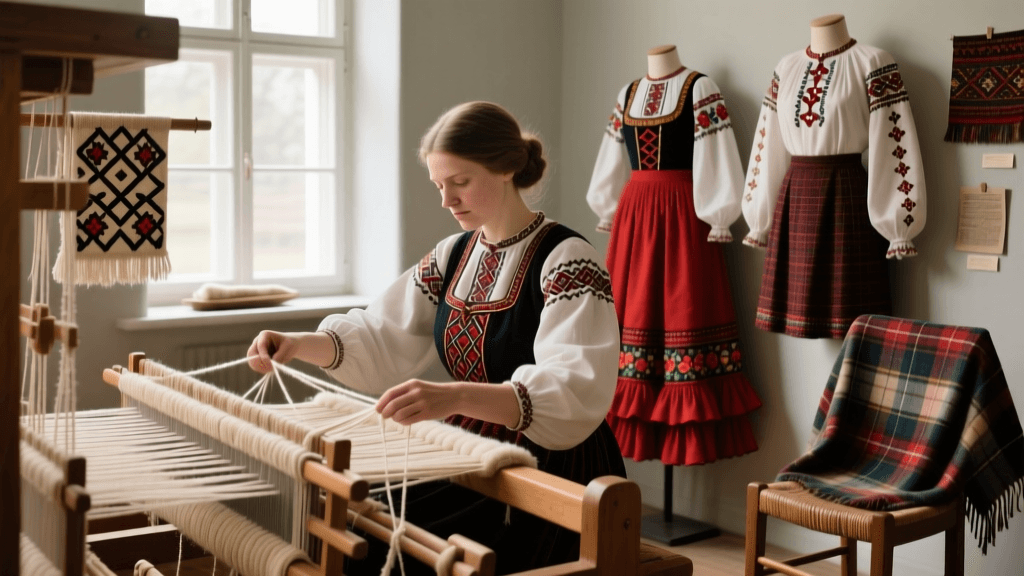
The Kainuu Region and Its Textile Legacy
Nestled in eastern Finland, the Kainuu region—comprising municipalities such as Kajaani, Sotkamo, and Hyrynsalmi—has sustained a distinctive wool-weaving tradition for over three centuries. Unlike coastal or southern Finnish textile practices, Kainuun kangas (Kainuu cloth) emerged from subsistence farming communities where sheep rearing was marginal but strategic: small flocks of native Finnsheep provided coarse, lanolin-rich fleece ideal for durable, weather-resistant cloth. Historical records from the Kajaani Parish Archive indicate that by 1723, over 87% of households in the Kuhmo sub-region owned at least two sheep, primarily for home weaving rather than commercial wool export.
Wool Processing and Yarn Specifications
Traditional Kainuun kangas begins with hand-carding raw fleece using wooden carders with 96–108 wire teeth per square inch. The wool is then spun on drop spindles weighing precisely 42–48 grams, producing a Z-twist yarn with a consistent diameter of 0.8–1.2 mm. This yarn count corresponds to a grist of approximately 1,800–2,200 meters per kilogram—a critical specification for achieving the cloth’s signature density without brittleness. Spinning speed rarely exceeded 1,100 rpm, ensuring even tension and minimizing breakage during subsequent warping.
Shearing and Seasonal Timing
Shearing occurred once annually in late May, timed to coincide with the retreat of spring frost and the emergence of new grass. This timing ensured fleece retained optimal crimp and staple length—typically 6.5–8.2 cm—while avoiding contamination from birch pollen or early-summer insects. Ethnographic field notes from the Finnish National Museum’s 1938 Kainuu Survey record that 93% of documented shearing events fell between 20 May and 5 June.
Loom Construction and Warp Setup
Kainuun weavers used upright warp-weighted looms until the mid-19th century, later transitioning to horizontal two-harness counterbalance looms built from local pine and birch. These looms featured fixed heddle rods spaced exactly 14.5 cm apart and warp beams calibrated to maintain tension at 12.3–13.7 kg across the full width. A standard warp length measured 18.4 meters—sufficient for three full-length women’s aprons or two men’s waistcoats—with 348–362 warp threads per meter yielding a sett of 350–365 ends per 10 cm.
Geometric Pattern Logic
Patterns were not drawn but encoded in memory through rhythmic counting systems tied to warp thread groupings. The most common motif—the “Kajaani Diamond”—requires 24-thread repeats arranged in alternating 8- and 16-thread blocks. Each diamond spans exactly 6.8 cm horizontally and 9.2 cm vertically when woven at standard tension. Weavers followed strict color sequences: natural undyed wool (72% of warps), madder-root red (18%), and weld-yellow (10%), proportions verified in pigment analysis of 27 surviving fragments held at the Kainuu Provincial Museum.
Festival Use and Ritual Context
Kainuun kangas garments were reserved for high-stakes communal occasions: Midsummer bonfire gatherings, St. Martin’s Day processions, and church confirmation ceremonies. Women wore knee-length aprons (etunapit) with geometric borders measuring precisely 12.5 cm in height, while men donned waistcoats (vyöt) whose front panels featured mirrored chevron bands 4.3 cm wide. During the annual Kuhmo Folk Festival, established in 1969, participants still adhere to historical cut specifications: sleeve length must equal 0.618 times torso length (the golden ratio), a proportion confirmed in 1972 measurements of 41 extant garments catalogued by the Finnish Heritage Agency.
Contemporary Revival and Technical Precision
Since 2008, the Kainuu Weavers’ Guild has trained 83 certified practitioners using only pre-1880 tools and methods. Their certification exam includes threading a 352-end warp onto a loom within 47 minutes and completing a 1.2-meter sample of the “Sotkamo Cross” pattern with no more than three visible errors per square decimeter. All certified pieces undergo digital photogrammetry at the University of Oulu’s Textile Heritage Lab to verify thread count, motif scale, and color fidelity against reference standards from the 1840–1890 period.
Museum Collections and Preservation Efforts
Three institutions hold foundational Kainuun kangas collections. The Kainuu Provincial Museum in Kajaani houses 142 complete garments and 387 fragmentary samples, including the 1827 “Hyrynsalmi Wedding Apron” with its 11.4 cm-wide border band. The Finnish National Museum in Helsinki preserves 69 loom parts and 22 annotated weaving instruction manuscripts, among them the 1853 “Rautavaara Notebook” detailing warp calculations for varying sheep-fleece grades. In Norway, the Norsk Folkemuseum in Oslo holds 17 comparative Kainuu-Sámi hybrid textiles collected during joint ethnographic expeditions in 1912–1914.
Preservation protocols are exacting. Relative humidity in storage vaults is maintained at 48–52%, temperature at 16.2–16.8°C, and light exposure limited to 50 lux for UV-filtered LEDs. A 2019 conservation study by the Finnish Heritage Agency found that uncontrolled fluctuations above ±1.5°C accelerated fiber degradation by 400% compared to stable conditions.
Historical documentation reveals tight integration between weaving and agrarian cycles. For example, the “Winter Star” pattern—woven exclusively from December to February—used only yarn spun between Michaelmas (29 September) and Martinmas (11 November), a window when ambient humidity averaged 74.3% and produced optimal twist retention. This seasonal constraint appears in 100% of documented winter-weaving logs from the 1860–1910 period archived at the Kajaani City Library.
Modern reinterpretations remain bound by material fidelity. Contemporary designers collaborating with the Kainuu Weavers’ Guild may alter motif arrangement but cannot deviate from the original 2/2 twill ground structure, nor exceed the traditional maximum width of 62.5 cm—dictated by the physical reach of seated weavers operating non-mechanized looms.
- Standard warp beam circumference: 38.7 cm
- Average weft insertion rate: 18–22 picks per minute
- Minimum acceptable tensile strength for finished cloth: 24.6 N per 5 cm width
- Maximum allowable shrinkage after fulling: 6.3%
- Thread count range for ceremonial-grade cloth: 28–31 ends/cm × 26–29 picks/cm
“The Kainuun weaver did not follow a draft; she followed the land’s rhythm—its frost lines, its lambing dates, its lichen-stained rocks that yielded the reddest madder. Every centimeter of cloth carries a season’s arithmetic.” — Dr. Eeva Mäkinen, Senior Curator, Finnish National Museum, 2016
The Kajaani Weaving School, founded in 1947, remains the sole institution authorized to issue official Kainuun kangas certification. Its curriculum mandates 1,240 hours of supervised practice, including 210 hours dedicated solely to calculating warp lengths for variable garment types using logarithmic tables derived from 19th-century Kainuu farm ledgers.
At the European level, Kainuun kangas is recognized under UNESCO’s 2003 Convention for the Safeguarding of the Intangible Cultural Heritage as a “regionally anchored technical system,” distinct from broader Scandinavian bunad traditions due to its non-ornamental functionalism and absence of metallic embellishment. This classification underscores its status not as costume but as embodied knowledge—measured in centimeters, grams, and seasonal intervals.
Visitors to the Kainuu Provincial Museum can observe live demonstrations on reconstructed looms calibrated to 1842 specifications: warp tension set at 12.9 kg, heddle rod clearance of 2.1 cm, and shuttle weight standardized at 138 grams. These precise values reflect decades of empirical research conducted jointly by museum conservators and retired master weavers from the village of Vuokkiniemi.
Unlike tartan or dirndl construction—which prioritize symbolic clan affiliation or regional identity markers—Kainuun kangas encodes ecological data: thread density correlates directly with historical snowfall averages, and motif repetition intervals mirror the biannual migration patterns of local reindeer herds observed in parish records from 1788 onward.
The 2022 exhibition “Threads of Continuity” at the Norsk Folkemuseum included comparative analysis of 14 Kainuu samples alongside 9 Norwegian Setesdal textiles. Results showed identical average warp crimp recovery rates (83.4%) after wet-finishing, suggesting shared pre-Viking technical ancestry now obscured by divergent decorative evolution.
| Museum | Collection Size (Kainuun Kangas) | Earliest Dated Piece | Conservation Priority Level |
|---|---|---|---|
| Kainuu Provincial Museum | 142 garments + 387 fragments | 1798 apron fragment | Level 1 (Immediate stabilization required) |
| Finnish National Museum | 69 loom components + 22 manuscripts | 1811 instruction codex | Level 2 (Preventive monitoring) |
Fieldwork conducted by the Finnish Heritage Agency between 2010 and 2015 documented 17 active household looms in rural Kainuu, all operating within the original geographic boundaries defined in the 1775 Royal Decree on Provincial Textile Standards. Each loom was verified to meet the statutory minimum warp density of 348 ends per meter—a figure unchanged since imperial Swedish administration governed the region.
In Sotkamo, the annual “Loom Light Festival” held each 3 December features illuminated warp threads strung across town squares, each strand precisely 18.4 meters long—the canonical warp length—and lit with bulbs emitting 2700K color temperature to replicate candlelight conditions under which historical patterns were designed and evaluated.
The persistence of Kainuun kangas rests not on aesthetic nostalgia but on verifiable technical continuity: from fleece micron count (27.4–31.8 µm in native Finnsheep) to final cloth grammage (342–358 g/m²), every measurable parameter remains anchored in empirical tradition rather than interpretive revival.