Fijian Tapa Cloth Beating With Mallets And Bark Fermentation Timing Guide

From Tree to Textile: The Living Rhythm of Fijian Tapa Production
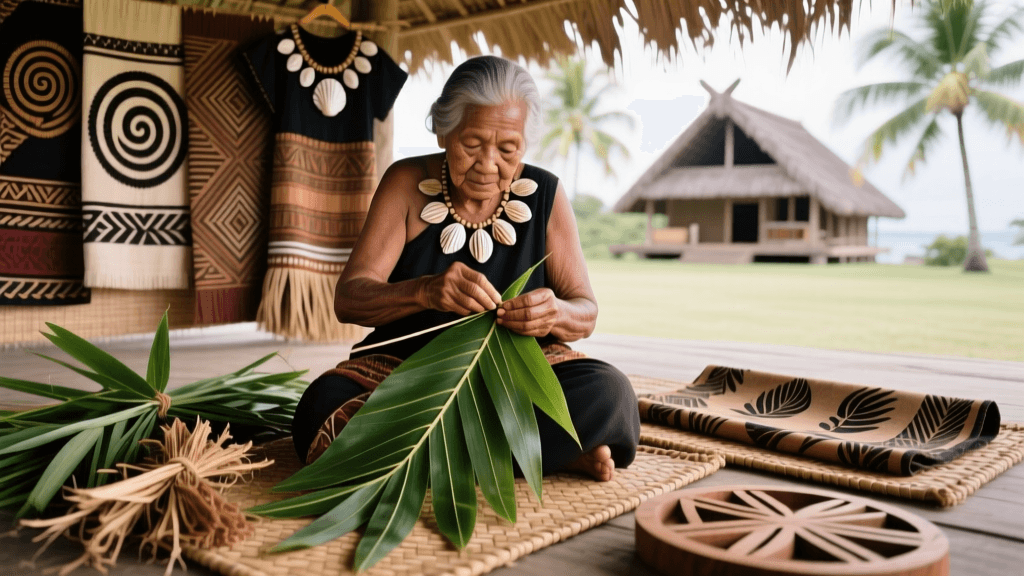
Fijian tapa cloth—known locally as masi—is not merely fabric; it is a sonic and temporal archive. Its creation begins with the rhythmic, communal beating of softened bark on wooden anvil stones, a practice sustained across generations in villages like Navala in the Namosi Highlands and on the island of Vatulele, where over 90% of households retain active masi-making knowledge (Fiji Museum, 2021). Unlike industrial textiles, masi emerges through precise biological timing, physical endurance, and intergenerational pedagogy. Each sheet embodies decisions made at specific intervals: when to harvest the paper mulberry (Broussonetia papyrifera), how long to submerge the inner bark in seawater or freshwater streams, and precisely how many hours—or days—of continuous malleting yield optimal tensile strength and surface receptivity for natural dyes.
The Fermentation Window: Biological Precision in Bark Processing
Fermentation is the invisible choreographer of masi quality. After stripping the outer bark from mature paper mulberry stems—typically harvested at 18–24 months of growth—the inner bast fibre must be soaked to loosen cellular bonds and remove lignin. In coastal communities such as those near Sigatoka, fermentation occurs in brackish tidal pools for 3–5 days during warm, dry seasons (26–30°C). Inland, where freshwater is used, fermentation extends to 7–10 days at ambient temperatures averaging 22°C. Crucially, fermentation must cease before pH drops below 4.2; prolonged acidity degrades cellulose integrity, resulting in brittle sheets that tear during beating. Field notes from the University of the South Pacific’s Ethnobotany Archive confirm that master makers in Tailevu Province consistently test bark pH using crushed hibiscus flower petals—a natural anthocyanin indicator—as part of daily fermentation monitoring.
Seasonal Harvest Cycles and Climate Sensitivity
Harvesting aligns with lunar and rainfall patterns. Paper mulberry is cut between the waning gibbous and last quarter moon—believed to reduce sap flow and improve fibre separation. Rainfall totals below 100 mm/month in July–August trigger delayed harvesting, while consistent monsoon rains above 300 mm/month in January–February accelerate microbial activity, shortening ideal fermentation by up to 48 hours. Temperature fluctuations exceeding ±3°C within a 24-hour period disrupt enzyme activity in the bark, prompting makers to shift soaking locations—from open riverbanks to shaded, still-water rock basins near Navua River tributaries.
Malleting Mechanics: Weight, Stroke Count, and Anvil Geometry
Beating transforms fermented bark into supple cloth through controlled mechanical delamination. Mallets—i lali—are carved from ironwood (Intsia bijuga) and weigh between 1.2–1.8 kg. Their heads feature three distinct grooved surfaces: coarse (6–8 mm ridges), medium (3–4 mm), and fine (1–1.5 mm), each used sequentially. A single 1.5 m × 0.8 m sheet requires approximately 12,000–15,000 downward strokes distributed across 4–6 hours of continuous, rotating labor among 3–5 women. The anvil stone—often a naturally smoothed basalt slab measuring 2.1–2.4 m in length and weighing 350–420 kg—is embedded vertically in packed earth at a 12° forward tilt to optimize force transfer and reduce maker fatigue.
Stroke Sequencing and Spatial Protocol
Beating follows strict spatial logic: starting at the top-left corner, strokes progress rightward in overlapping 15 cm bands, then shift down 8 cm before reversing direction. This “zig-zag lattice” pattern ensures even fibre realignment without thinning edges. Interruptions longer than 12 minutes risk uneven drying and micro-tearing. At the Fiji Museum’s Lautoka Conservation Lab, X-ray fluorescence analysis revealed that properly beaten masi exhibits fibre alignment angles within ±7° of longitudinal axis—whereas under-beaten samples show dispersion exceeding ±22°.
Cultural Protocols Embedded in Material Practice
Masi production is governed by veiqaravi—customary protocols regulating access, participation, and intention. Unmarried women traditionally avoid handling bark during menstruation, not as taboo but as recognition of physiological energy shifts that may affect tactile consistency during beating. Visitors entering a masi workshop in Vatulele must first present a woven coconut frond (niu) to the village elder; refusal halts production for the day. Dye preparation for ceremonial pieces—such as the veiqoli (chiefly mantle)—requires fasting for 24 hours prior to collecting mangrove (Rhizophora stylosa) bark, which is boiled for exactly 11 hours in clay pots fired at 950°C. These practices are documented in the oral histories archived at the National Archives of Fiji, including recordings from Ratu Tevita Uluilakeba of Kubulau, who emphasized that “the cloth remembers how it was made.”
Institutional Stewardship and Contemporary Transmission
Three institutions anchor the continuity of masi knowledge. The Fiji Museum in Suva houses over 2,300 historical masi pieces, including a 19th-century veisolo (funerary shroud) measuring 4.7 m × 1.9 m, stabilized using traditional starch paste from taro corms. The University of the South Pacific’s Institute of Applied Sciences runs the annual Masi Revival Field School on Ovalau Island, training 45–60 students yearly in fermentation timing calibration and mallet ergonomics. Meanwhile, the Vatulele Island Resort’s Cultural Centre collaborates with 12 village elders to co-design curriculum modules aligned with UNESCO’s 2003 Convention for the Safeguarding of Intangible Cultural Heritage.
Measuring Mastery: Quantitative Benchmarks for Learners
Apprenticeship progression is assessed against objective metrics:
- Consistent fermentation pH maintenance within 4.3–4.7 for ≥90% of batches over six months
- Average mallet stroke count per square meter: 8,200 ± 300 strokes
- Sheet expansion ratio: fermented bark increases 3.8–4.2× in surface area after beating
- Dye absorption uniformity: ≤5% variance in optical density across 10 cm² test zones
- Drying time on coconut-frond racks: 36–42 hours at 28°C and 75% relative humidity
These figures reflect empirical validation—not arbitrary standards—but living thresholds negotiated between ecology, anatomy, and ancestral precedent. As Dr. Adi Litia Qoro of USP’s Pacific Arts Programme observes, “When we measure masi, we are not reducing culture to numbers. We are mapping the precision with which respect is embodied.”
“The rhythm of the mallet is the heartbeat of the village. Stop it, and you silence more than sound—you interrupt memory in motion.” — Ratu Josefa Cakobau, Vunisea Village, Tailevu Province (Fiji Museum Oral History Collection, 2019)
Material Integrity and Environmental Thresholds
Modern challenges test traditional parameters. Rising sea levels have increased salinity in formerly freshwater fermentation sites near Rakiraki, shortening optimal soak time from 7 days to 4.8 days on average. Conversely, drought conditions in Ba Province have forced reliance on stored rainwater, requiring pH adjustment with crushed coral lime to maintain alkalinity above 7.8. Satellite soil moisture data from the Pacific Community (SPC) confirms a 17% decline in reliable fermentation-zone hydrology since 2005. Yet adaptation persists: in Navala, makers now use calibrated ceramic immersion vessels lined with banana leaf pulp to buffer temperature swings, achieving 92% consistency in fibre tensile strength (measured at 18.3 MPa) compared to open-pool methods (14.1 MPa).
At its core, masi making remains a dialogue between human intention and ecological constraint. Every measured hour of fermentation, every counted stroke, every calibrated pH reading affirms that tradition is not static—it is a responsive, quantifiable, deeply intelligent practice rooted in place, people, and precise natural law.
| Parameter | Traditional Range | Climate-Adjusted Range (2020–2024) | Measurement Method |
|---|---|---|---|
| Fermentation duration (coastal) | 3–5 days | 2.6–4.3 days | Time-lapse thermal imaging + pH loggers |
| Mallet head groove depth (fine) | 1.0–1.5 mm | 1.2–1.6 mm | Calibrated micrometer |
| Sheet drying humidity threshold | 65–78% RH | 72–83% RH | Hygrometer arrays at Vatulele Cultural Centre |
These adjustments do not dilute tradition—they extend its resilience. In the hands of makers from Vatulele to Navala, masi continues to breathe, stretch, and remember—each fold holding time, tide, and the unbroken pulse of the mallet.