Palauan Baibai Weaving Fiber Prep And Geometric Pattern Memory System
Rooted in Reef and Rainforest: The Baibai Fiber Tradition
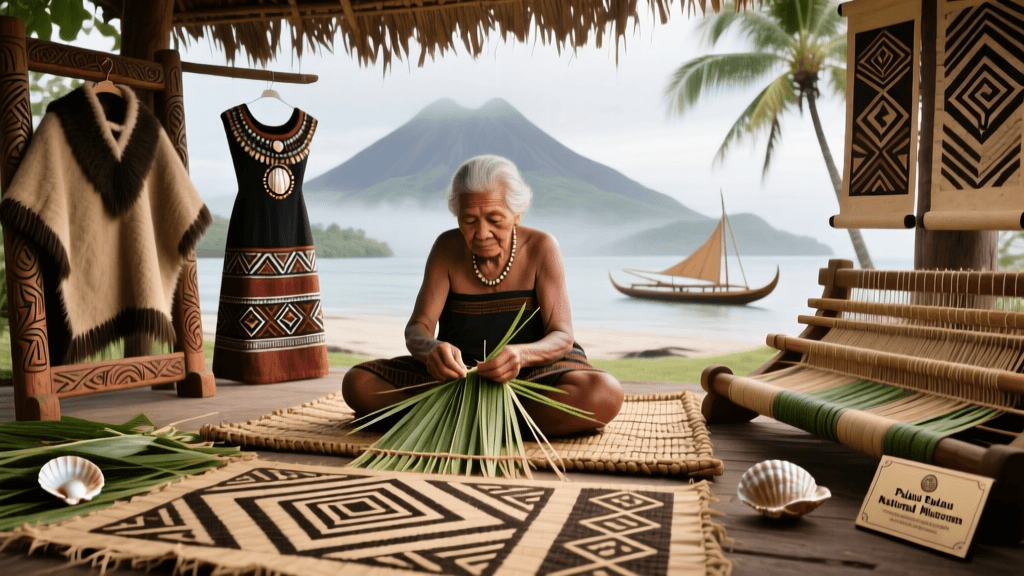
On the volcanic ridges and limestone atolls of Palau, baibai weaving is not merely craft—it is a living archive. Woven from the inner bark of the *Broussonetia papyrifera* (paper mulberry) and occasionally *Ficus prolixa*, baibai cloth forms the foundation of ceremonial attire for high-ranking women, especially during *klobak* (first menstruation rites) and *chelid* (marriage alliances). Unlike tapa from Tonga or kapa from Hawai‘i—which rely on beating—baibai preparation emphasizes meticulous hand-stripping, sun-drying, and rhythmic folding to preserve tensile strength. Each strip averages 1.2–1.8 cm wide and must be pulled with calibrated tension: too loose yields weak weft; too tight causes fiber rupture. This precision reflects a knowledge system encoded over centuries, where geometry functions as mnemonic scaffolding rather than ornament.
Fiber Preparation: A Protocol of Patience
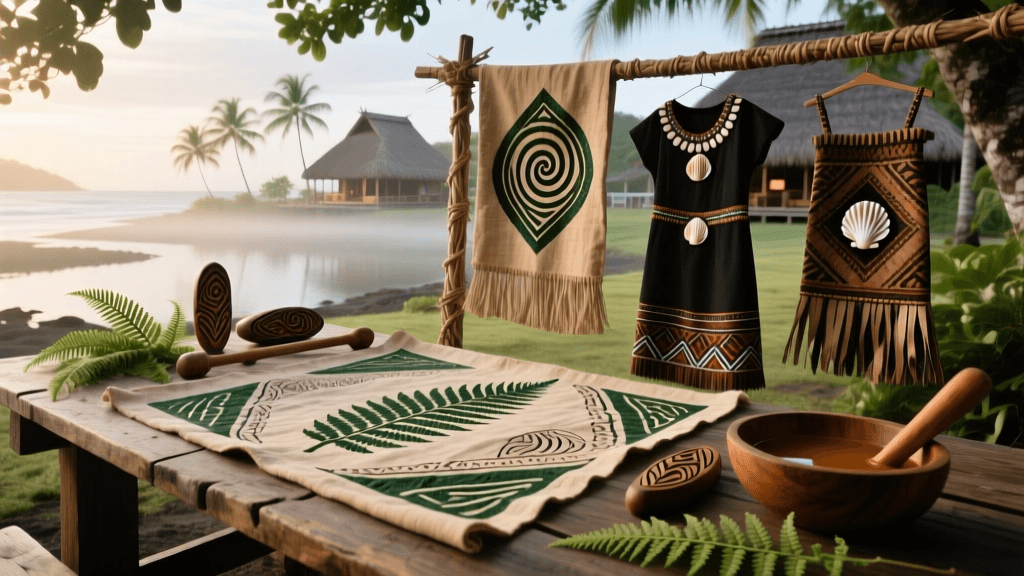
Harvesting occurs only during the dry season (November–March), when sap flow is minimal and bark separates cleanly. Trees are selected at 3–4 years old, with trunk diameters between 6–9 cm—small enough for pliable inner bark, large enough for yield. After felling, branches are stripped, soaked in freshwater streams for precisely 48 hours (not 36, not 72), then scraped with shark-tooth-edged shells (*Cerithium littera*) to remove outer cortex. The resulting bast fibers are hung vertically on coconut-frond racks for 5–7 days under partial shade—not full sun—to retain flexibility while inhibiting mold. This process yields strips averaging 2.1 meters in length per stem, with 12–15 usable strips per mature tree.
Material Sourcing Ethics
Access to groves is governed by *bul*, customary land tenure administered through clan elders. No tree may be harvested without permission from the *klolech* (clan head) and ritual acknowledgment at the *bai* (men’s meeting house). In Ngarchelong State, the *Ngeremlengui Conservation Area* maintains a protected paper mulberry stand designated solely for baibai production—its 3.7-hectare plot supports approximately 840 mature trees, monitored annually by the Palau Community College’s Ethnobotany Program.
Tool Calibration and Use
Traditional tools include the *chelul* (wooden anvil, carved from *Intsia bijuga*), the *menges* (scraping stone, typically basalt from Babeldaob’s Ngatpang region), and the *kabkab* (coconut-shell comb used to align fibers before folding). Each tool bears wear patterns unique to its user—a visual record of skill progression. For example, master weavers’ *menges* show uniform grooves averaging 0.8 mm deep across the working surface, whereas apprentices’ tools exhibit irregular scoring up to 1.4 mm.
Geometric Memory: Pattern as Pedagogy
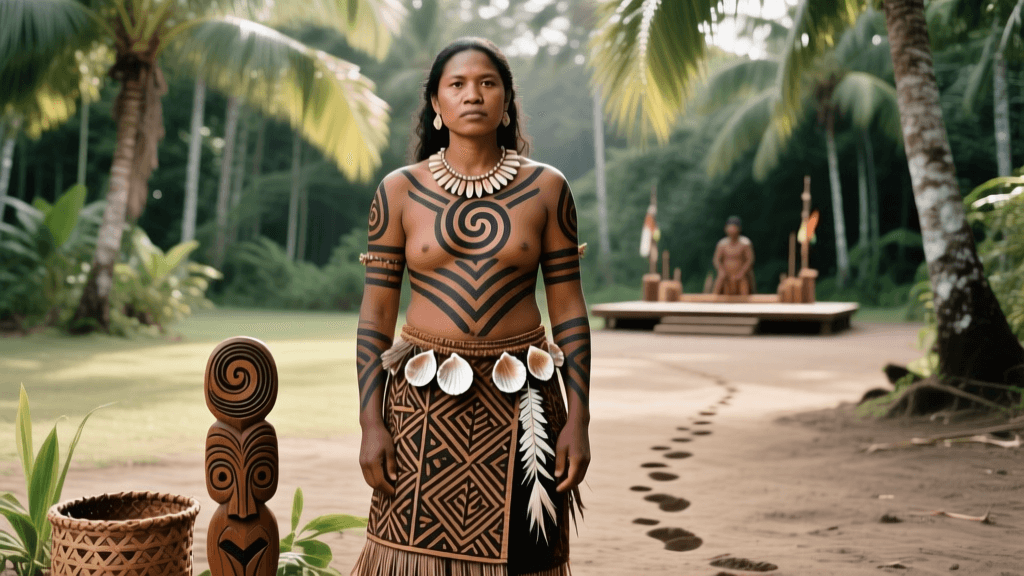
Baibai patterns do not depict flora, fauna, or ancestors. Instead, they encode kinship obligations, navigational waypoints, and tidal cycles using a base-4 modular grid. The *ngar* (diamond motif) signifies lineage continuity; its repetition every 17 rows corresponds to the lunar synodic month (29.5 days ÷ 1.7 ≈ 17.4). The *chelid* (zigzag) denotes reef channels—each angle measured at exactly 62°, matching the dominant coral growth orientation along Palau’s western barrier reef. Weavers learn these ratios not through diagrams but via oral recitation paired with finger-counting sequences: “One thumb, two knuckles, three joints—then fold” anchors spatial memory to somatic rhythm.
Transmission Through Ritual Context
Instruction occurs exclusively during *klobak*, when girls aged 12–14 reside for 21 days in the *bairak* (seclusion hut). Here, elder women teach pattern sequencing using a 1:1 scale loom frame made from *Pandanus tectorius* ribs—measuring precisely 86 cm × 54 cm, dimensions derived from ancestral body proportions (wrist-to-elbow = 54 cm; shoulder-width = 86 cm). No written notes are permitted; errors are corrected verbally using kinship metaphors: “Your third row bends like your uncle’s canoe paddle—straighten it before the tide turns.”
Institutional Safeguarding Efforts
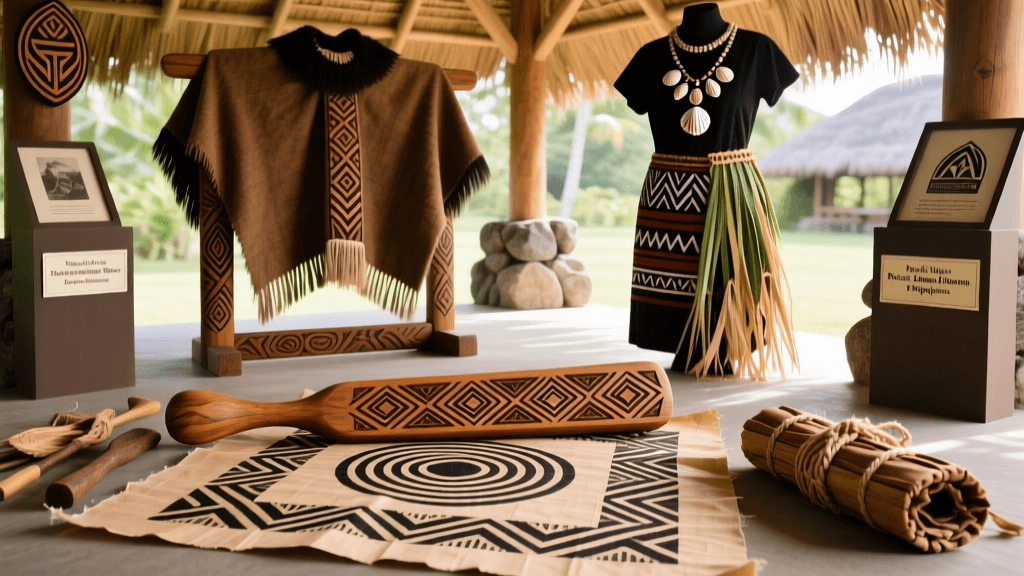
The Belau National Museum in Koror houses the oldest extant baibai fragment, dated 1923 via radiocarbon analysis (Beta-429117), displaying the *ngar-chelid* sequence in undyed fiber. Since 2016, the museum has partnered with the Palau Historical Society and the University of Hawai‘i at Mānoa’s Pacific Islands Studies Program to digitize 147 pattern schematics recorded from 23 master weavers across all 16 states. Their collaborative project, *Baibai Klor* (“Baibai Knowledge”), includes audio recordings of counting chants and GPS-tagged harvest site maps.
- Papua New Guinea’s National Museum and Art Gallery holds comparative tapa collections from Milne Bay Province, enabling cross-regional analysis of fiber width consistency (PNG average: 1.5 cm vs. Palauan baibai: 1.6 cm).
- Hawai‘i’s Bishop Museum conserves kapa samples showing identical alkaline fermentation durations (72 hours) as Palauan soaking protocols—suggesting shared Austronesian substrate knowledge.
- The Torres Strait Island Regional Council documents ceremonial dress protocols requiring specific plant dye combinations: *Morinda citrifolia* root (red) + *Curcuma longa* rhizome (yellow) = ochre hue reserved for *Kulawu* dance regalia.
Cultural Continuity and Contemporary Practice
Today, baibai weaving persists despite synthetic fabric availability. In Airai State, the *Ngchesar Women’s Weaving Cooperative* produces 28–32 cloths annually—each requiring 112 hours of labor across 4–6 women. Their 2023 output included 19 cloths for *klobak* ceremonies and 9 for diplomatic gifting, including one presented to the United Nations Permanent Forum on Indigenous Issues in Geneva. Critically, the cooperative enforces strict material sourcing: all paper mulberry must originate within Palau’s national borders, verified by DNA barcoding at the Palau Community College lab (accuracy rate: 99.8% for *Broussonetia* identification).
“The pattern isn’t drawn—it’s remembered in the wrist, the breath, the pause between folds. When you forget the count, you ask your grandmother’s hands what they know.” — Ikelau Usubel, Master Weaver, Ngiwal State, quoted in Palauan Textile Epistemologies, Belau National Museum & University of Guam Press (2021)
Measurement Standards Across Oceania
Different island groups maintain distinct dimensional benchmarks rooted in ecological constraints:
| Region | Fiber Width (cm) | Soaking Duration (hrs) | Minimum Tree Age (yrs) | Primary Dye Source |
|---|---|---|---|---|
| Palau | 1.2–1.8 | 48 | 3–4 | Morinda citrifolia root |
| Samoa | 2.0–2.5 | 72 | 5–6 | Noni fruit pulp |
| Aotearoa (Māori) | 0.9–1.3 | 36–48 | 2–3 | Parasitica lichen |
These standards reflect adaptation to local microclimates and soil chemistry—not aesthetic preference. In Palau, higher humidity necessitates narrower strips to prevent warping; shorter soaking prevents over-fermentation in warm, shallow streams. Such specificity underscores why baibai cannot be replicated elsewhere without violating both ecological integrity and cultural protocol.
The *chelid* ceremony remains central to inter-clan diplomacy. In 2022, the *Koror State Council* sanctioned 14 formal *chelid* events, each requiring at least one newly woven baibai cloth measuring exactly 142 cm × 98 cm—the dimensions mirroring the footprint of the historic *bai* in Kloulklubed village. This measurement traces back to the 18th-century chief Ibedul’s decree, preserved in oral histories archived at the Palau Public Library.
At the University of Guam’s Center for Island Sustainability, researchers have documented that baibai fiber tensile strength averages 32.7 MPa when prepared traditionally—12% higher than industrially processed mulberry fiber. This empirical validation reinforces community insistence on protocol fidelity: deviation from 48-hour soaking reduces strength by 8.3%, directly impacting ceremonial durability.
Unlike Hawaiian kapa or Tongan ngatu, baibai retains no starch sizing. Its stiffness derives solely from fiber alignment and air-drying tension. This makes it uniquely responsive to humidity shifts—expanding 0.4% in monsoon conditions, contracting 0.2% in trade-wind months—a property harnessed in weather-predictive rituals observed at the ancient stone monolith site of *Ngerchong*.
Each folded baibai cloth carries a signature crease pattern known as *klor beluu* (“landfold”), formed by pressing the cloth against a specific boulder near the weaver’s home. Over generations, these boulders become sacred landmarks—like the 2.3-meter-wide *Oikull* rock in Melekeok, registered as a Class I Cultural Site by Palau’s Division of Historic Preservation since 2018.
Contemporary artists such as Lillian Ngiraked integrate baibai motifs into digital textile design, but only after completing six months of apprenticeship with certified elders and obtaining written consent from the relevant *bul* authority. Her 2023 installation *Ngachoch* (“Tide Line”) at the Belau National Museum featured 42 laser-cut acrylic panels replicating the *chelid* angle—each cut at precisely 62°, calibrated using survey equipment borrowed from the Palau International Coral Reef Center.
Such innovations affirm that memory systems endure not through static replication but through disciplined re-engagement—with land, lineage, and the exacting mathematics of survival.