Ultimate 15th-Century Burgundian Gown Guide for 2026
Introduction to the Burgundian Court Fashion
The 15th-century Burgundian gown represents the absolute pinnacle of late medieval European fashion. Emerging from the courts of the Dukes of Burgundy, this striking silhouette replaced the voluminous, unstructured houppelande with a garment that emphasized a high, empire-style waist, a deep V-neckline, and dramatic, floor-sweeping sleeves. For historical costumers and reenactors navigating the 2026 season, achieving an authentic Burgundian silhouette requires a meticulous understanding of period tailoring, textile behavior, and accessory pairing.
According to the Victoria and Albert Museum's Medieval and Renaissance collections, the transition toward the structured Burgundian gown marked a pivotal moment in European tailoring, shifting focus from mere drapery to engineered garment construction. This guide will walk you through the exact steps to draft, source, and construct your own historically accurate Burgundian gown for the 2026 reenactment circuit.
Anatomy of the 15th-Century Burgundian Gown
The Bodice and V-Neckline
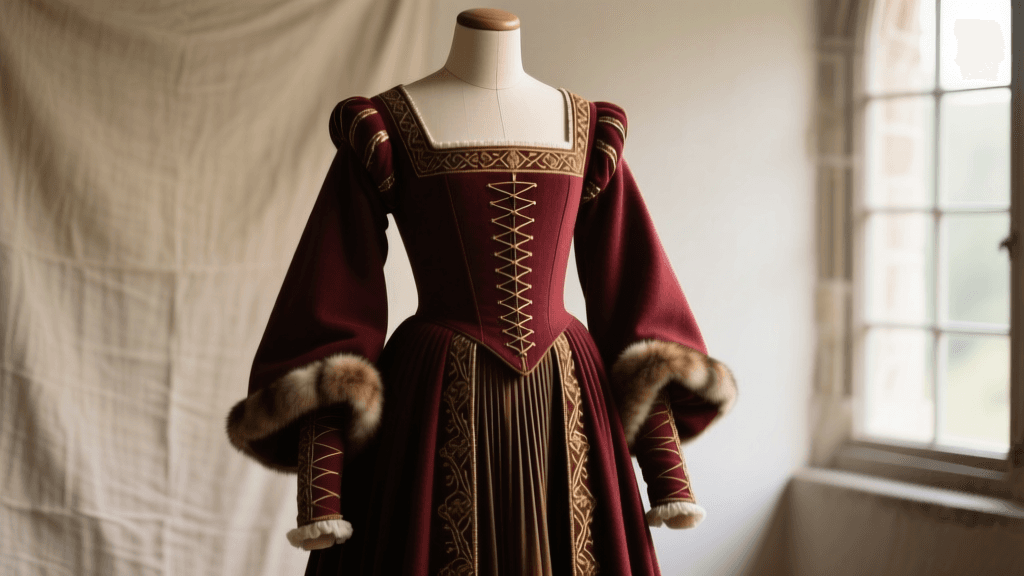
Unlike earlier medieval gowns that hung loosely from the shoulders, the Burgundian gown featured a fitted bodice that sat high on the natural waist, just beneath the bust. The most defining feature is the deep V-neckline, which was specifically designed to showcase the contrasting fabric of the underlying kirtle. The kirtle, a tightly fitted support garment made of wool or silk, provided the foundational bust support that the outer gown lacked. A sheer linen partlet or stomacher was often pinned into the V-neck to preserve modesty while allowing the rich colors of the kirtle to peek through at the edges. In 2026, modern reenactment standards emphasize that this V-neck should not be overly plunging by modern standards, but rather tailored to frame the collarbones and upper chest elegantly, relying on the kirtle beneath to provide structural integrity to the entire ensemble.
Skirt Gores and Cartridge Pleating
Extant garments and tapestries preserved in the Metropolitan Museum of Art's Medieval Art collection reveal the staggering volume of fabric used in these skirts. To achieve the heavy, conical drape characteristic of the era, the skirt is constructed using multiple triangular gores. These gores are attached to the bodice using cartridge pleating—a technique that gathers thick wool tightly into a small waistband, allowing the heavy fabric to spring outward away from the body.
Bombard Sleeves and Fur Collars
The sleeves of a Burgundian gown are notoriously dramatic. The 'bombard' sleeve is cut as a massive, sweeping curve that trails near the floor, while the inner arm is fitted to the wrist. To finish the neckline and cuffs, a wide collar of fur (historically ermine, vair, or letice) was sewn into the garment. Today, ethical sourcing is paramount; the 2026 International Reenactment Standards heavily favor high-pile, ethically manufactured faux furs that accurately mimic the guard-hairs and undercoat of historical pelts.
Sourcing Authentic Textiles in 2026
The success of your Burgundian gown relies entirely on the weight and drape of your textiles. Lightweight costume satins or thin cottons will completely ruin the historical silhouette. As of early 2026, the global textile market has seen a stabilization in the pricing of heritage European wools, making it more accessible for dedicated costumers to invest in museum-quality materials.
Recent analyses featured in the Textile Research Centre Leiden archives highlight the importance of wool broadcloth in late medieval dress. Broadcloth is heavily milled and fulled, giving it a dense, felt-like quality that resists fraying and holds deep, structured pleats beautifully.
| Material Component | Historical Equivalent | 2026 Sourcing Recommendation | Est. Cost (per yard) | Yardage Needed |
|---|---|---|---|---|
| Outer Gown | Wool Broadcloth | Heavyweight Melton or Heritage Broadcloth (70%+ wool) | $55 - $75 | 7 - 9 yards |
| Bodice Lining | Bleached Linen | Medium-weight (5.3 oz) European Flax Linen | $22 - $30 | 2 - 3 yards |
| Collar & Cuffs | Ermine / Vair | Premium Faux Fur with staggered guard-hairs | $40 - $60 | 1 - 1.5 yards |
| Undersleeves | Silk Damask | 100% Silk Jacquard or heavy Brocade | $35 - $50 | 2 yards |
Pattern Drafting and Measurements
Drafting a Burgundian gown requires abandoning modern princess-seam bodice blocks in favor of period-accurate geometric cutting. The bodice is typically drafted using a simple rectangle-and-gore method, or a slightly curved front-and-back panel that relies on the tension of the lining for support rather than rigid boning (which was not used in the 15th century).
- High Waist Measurement: Measure directly beneath the bust. This is where your bodice will terminate and your cartridge pleats will begin.
- Shoulder to High Waist: This determines the length of your fitted bodice front and back.
- Skirt Length: Measure from the high waist to the floor, then add 3 to 4 inches. Burgundian gowns were meant to pool slightly on the ground, requiring the wearer to kick the heavy wool forward when walking.
- Sleeve Drop: For bombard sleeves, measure from the shoulder point down to your ankle to ensure the dramatic 'tail' of the sleeve reaches the correct historical length.
Historical Construction Techniques
Bag-Lining the Bodice
To achieve a clean, boneless bodice that supports the heavy skirt, you must use the bag-lining method. Cut your outer wool and your linen lining identically. Sew them right-sides-together along the neckline and armholes, turn the garment right-side-out, and press. The side seams and shoulder seams are then folded inward and whip-stitched together by hand. This encases all raw edges and provides a double layer of fabric that naturally stiffens the bodice.
Hand-Finishing and Flat-Felling
While modern reenactors often use sewing machines for long structural seams, the 2026 standard for high-tier historical accuracy dictates that all visible seams and hems be finished by hand. Flat-felling the skirt gores ensures that the heavy wool lays completely flat without bulky ridges disrupting the conical drape. Use a heavy-duty linen thread (such as 35/2 line linen) waxed with beeswax for all structural hand-sewing to prevent tangling and increase tensile strength. For the hem, a deep 4-inch facing of heavy linen is applied using a catch-stitch (herringbone stitch), which allows the thick wool to flex and move without snapping the threads or pulling the fabric taut. This specific stitch is crucial for maintaining the fluid, sweeping motion of the gown's train when walking across uneven terrain.
Essential Accessories for the Complete Silhouette
The Hennin and Veils
No Burgundian gown is complete without the iconic steeple hennin. This towering conical headdress is constructed over a wire or buckram frame, covered in silk or velvet, and draped with a sheer, starched linen veil. In 2026, costumers are utilizing lightweight, 3D-printed buckram alternatives that offer the rigid structure of traditional paste-stiffened canvas without the susceptibility to humidity and rain at outdoor festivals.
Girdles and Pattens
A woven silk or leather girdle belt, often featuring decorative metal mounts, is worn just beneath the bust to further emphasize the high waistline. Finally, to protect your expensive wool hem from the mud and damp of outdoor reenactment sites, historical wooden pattens (leather-strap overshoes with wooden platforms) are essential. Modern cobblers specializing in historical footwear now offer custom-fit pattens with integrated rubber grips on the soles, a discreet but necessary 2026 safety upgrade for navigating slick cobblestones and grassy fields.
Final Thoughts for the 2026 Reenactment Season
Constructing a 15th-century Burgundian gown is a masterclass in late medieval tailoring. By prioritizing heavy, fulled wools, mastering the geometry of cartridge pleating, and committing to historical hand-finishing techniques, you will create a garment that not only looks authentic but moves and drape exactly as it did in the courts of Burgundy. As you prepare for the 2026 festival season, remember that the true magic of European folk dress lies in the intersection of rigorous historical research and masterful modern craftsmanship.