Extreme Climate Hanfu Guide 2026: Tropical, Desert & Cold Wear
The Global Hanfu Movement: Adapting Tradition to Extreme Climates in 2026
As we navigate through 2026, the global renaissance of Hanfu has transcended its origins in East Asia, becoming a staple in the wardrobes of cultural enthusiasts, travelers, and fashion-forward individuals worldwide. From the sweltering, high-humidity streets of Singapore to the arid, sun-baked dunes of Dubai, and the biting sub-zero winds of Harbin or Montreal, wearing traditional Chinese clothing requires more than just an appreciation for history—it demands a strategic approach to textile science and layering. Historically, the adaptation of Chinese dress to regional climates has always dictated fabric choice and silhouette, as noted in the Britannica overview of Chinese dress. Today, modern Hanfu enthusiasts are blending ancient tailoring with 2026's cutting-edge material innovations to ensure comfort without compromising historical accuracy.
This comprehensive guide explores how to authentically and comfortably wear Hanfu in extreme climates, detailing specific garment types, modern fabric blends, and essential layering techniques for tropical, desert, and freezing environments.
Tropical and Humid Climates: Beating the Heat and Moisture
Wearing Hanfu in tropical regions like Southeast Asia, the Caribbean, or the American South during summer presents a dual challenge: intense heat and suffocating humidity. The goal is to maximize airflow, wick moisture, and prevent the heavy, clinging sensation that synthetic fabrics often cause.
Optimal Garments: Qixiong Ruqun and Banbi
For women, the Qixiong Ruqun (chest-high skirt) remains a popular choice, but the key lies in the fabric. In 2026, the market is dominated by bio-engineered cooling yarns. Traditional Xia Bu (summer cloth), historically woven from ramie, has been modernized. Contemporary Hangzhou textile mills now produce ramie-modal blends that retain the crisp, structured drape of historical Hanfu while offering the soft, moisture-wicking properties of modern activewear. For men and women alike, the Banbi (half-sleeve vest) worn over a lightweight, sheer Zhongyi (inner garment) allows for maximum ventilation around the arms and torso.
The 2026 Tropical Fabric Matrix
When shopping for tropical Hanfu, avoid heavy brocades, thick cottons, and polyester linings. Instead, look for:
- Graphene-Infused Ramie: A 2026 breakthrough that enhances the natural cooling properties of ramie fiber, making it feel cool to the touch even in 95°F (35°C) heat.
- Ice Silk (Bing Si) Viscose: While not historically accurate for outer layers, modern ice-silk blends are widely used for inner skirts and linings to prevent sweat buildup.
- Open-Weave Luo Silk: A traditional gauze-like silk that provides a sheer, breathable barrier against the sun while allowing complete air circulation.
Desert and Arid Regions: Sun Protection and Microclimate Airflow
Desert climates, such as those found in the Middle East, North Africa, or the American Southwest, feature extreme solar radiation, high daytime temperatures, and a distinct lack of humidity. The primary objectives here are UV protection, preventing moisture loss from the skin, and utilizing the garment's architecture to create a cooling microclimate.
Optimal Garments: Daxiushan and Pifeng
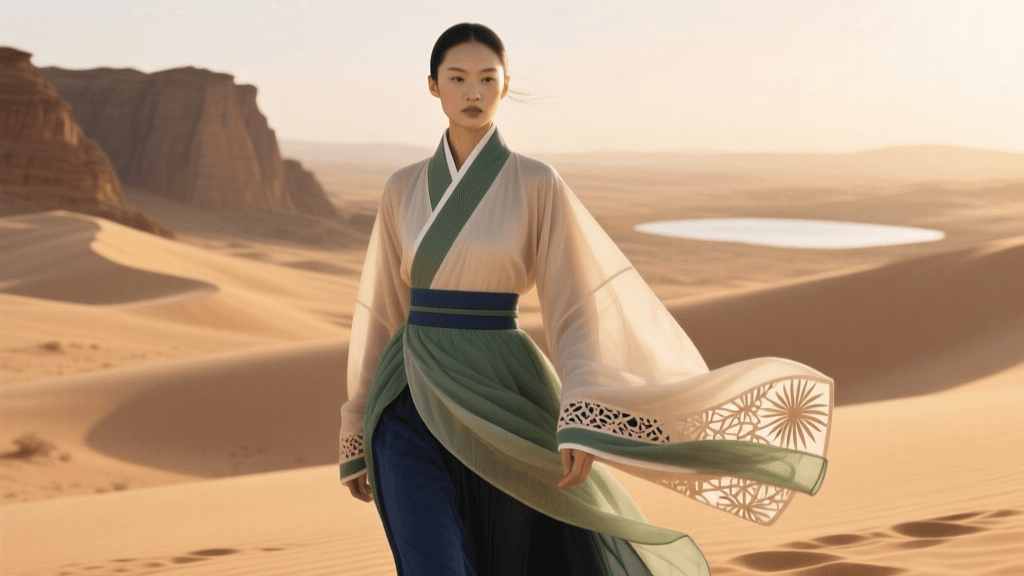
The Daxiushan (large-sleeve robe) from the Tang and Song dynasties is an engineering marvel for desert heat. The exceptionally wide sleeves act as natural bellows; as the wearer walks, the sleeves pump air across the body, evaporating sweat and cooling the skin. To protect the neck and shoulders from direct UV exposure, the Pifeng (a lightweight, draped cape or shawl) is essential. In 2026, many artisanal Hanfu brands offer Pifeng woven from Tussah silk treated with natural, plant-based UV inhibitors that do not alter the silk's historic sheen.
Reviving the Weimao for Modern Desert Safaris
Historically, the Weimao (a wide-brimmed hat with a sheer veil) was worn by nobles during the Tang dynasty to shield against dust and sun while traveling on horseback. Today, it has seen a massive resurgence among Hanfu travelers undertaking desert safaris in 2026. Modern iterations feature UPF 50+ sheer mesh veils that protect the face and neck from blowing sand and harsh sun glare, perfectly marrying historical aesthetics with extreme-weather utility. The structural properties of silk make it ideal for this type of temperature regulation and sun shielding, a fact detailed by the Metropolitan Museum of Art's Heilbrunn Timeline of Art History.
Freezing and Cold Regions: The Art of Invisible Insulation
Wearing Hanfu in freezing climates requires mastering the traditional art of layering while integrating modern thermal technology. The silhouette of winter Hanfu is inherently designed for volume, allowing for substantial hidden insulation.
Optimal Garments: Aoqun, Mamianqun, and Doupeng
The Aoqun (a lined, high-collared jacket paired with a skirt) is the foundation of Ming dynasty winter wear. In 2026, the outer shells are often crafted from heavy, wind-resistant wool-blend brocades, while the inner linings utilize ethical, ultra-thin shearling or aerogel-infused quilting. Aerogel, originally developed for space exploration, is now woven into traditional textile linings, providing the insulation of thick down without adding bulk that would ruin the elegant drape of the Hanfu.
For the lower half, the Mamianqun (horse-face skirt) is ideal. Its overlapping pleated panels trap warm air around the legs. Enthusiasts in 2026 frequently wear merino wool thermal leggings or fleece-lined tights beneath the skirt, completely hidden from view. The ultimate cold-weather statement piece is the Doupeng (a hooded, floor-length cloak). Modern Doupeng cloaks feature windproof outer shells and plush, faux-fur interior linings, secured at the neck with intricate jade or metal toggles.
Smart Layering: The Heated Zhongyi
The most significant innovation for cold-climate Hanfu in 2026 is the USB-C heated Zhongyi (inner garment). These ultra-thin, form-fitting base layers feature carbon-fiber heating pads integrated into the lower back and core zones. Powered by a discreet, pocket-sized power bank, they provide up to 12 hours of active heating, allowing wearers to attend outdoor winter festivals in Hokkaido or哈尔滨 (Harbin) without resorting to bulky, silhouette-destroying modern winter coats.
2026 Climate-Specific Hanfu Fabric and Layering Matrix
| Climate Zone | Core Garment | 2026 Fabric Innovation | Essential Accessory | Layering Strategy |
|---|---|---|---|---|
| Tropical / Humid | Qixiong Ruqun / Banbi | Graphene-Ramie Blend | Bamboo-weave Cooling Fan | Single-layer ice-silk Zhongyi; avoid waistbands that trap sweat. |
| Desert / Arid | Daxiushan / Pifeng | UPF-Treated Tussah Silk | Modern Weimao (Veil Hat) | Loose, flowing layers to create air bellows; light colors to reflect sun. |
| Freezing / Cold | Aoqun / Doupeng | Aerogel-Lined Brocade | Thermal Cloud Shoes | Heated Zhongyi base, merino leggings, windproof wool-blend outer shell. |
Footwear and Accessories for Extreme Weather
Traditional Yunxie (cloud shoes) and embroidered cloth boots are beautiful but inherently unsuited for modern extreme weather due to their lack of waterproofing and traction. The 2026 Hanfu accessory market has solved this with historically accurate uppers made of silk or brocade, mounted on modern EVA foam and vulcanized rubber outsoles. These provide the necessary arch support, waterproofing, and slip resistance required for navigating icy pavements or muddy tropical trails. For desert environments, ankle-wrapping techniques using breathable cotton puttees (Xing Teng) are being revived to keep sand out of footwear while providing ankle support on uneven dunes.
Garment Care in Extreme Environments
Maintaining delicate traditional textiles in harsh climates requires specific care routines:
- Humidity and Mold Prevention: In tropical climates, natural fibers like silk and ramie are susceptible to mildew. After wearing, Hanfu must be aired out in a well-ventilated, dehumidified space. Storing silk in airtight plastic bins in humid regions is a fatal error; use breathable cotton garment bags with silica gel desiccant packets instead.
- Desert Dry-Rot and Static: Arid climates strip natural fibers of their moisture, making silk brittle and prone to tearing. To combat this, lightly mist your silk Hanfu with a specialized textile conditioning spray before wearing, and store them with natural humidifying blocks like untreated cedar or specialized clay humidifiers in your wardrobe.
- Cold Weather Spot Cleaning: Heavy winter brocades and aerogel linings should rarely be machine washed. Rely on professional dry cleaning that specializes in historical garments, or use targeted steam-cleaning to remove odors and surface dirt without degrading the internal thermal insulation layers.
Conclusion
The beauty of Hanfu lies not just in its visual splendor, but in its inherent architectural versatility. By understanding the historical purpose of specific silhouettes and embracing the textile innovations of 2026, enthusiasts can confidently wear traditional Chinese garments in any environment on Earth. Whether you are utilizing the bellows-effect of a Daxiushan in the Sahara or relying on an aerogel-lined Doupeng in the snows of Northern Europe, adapting Hanfu to extreme climates ensures that this living tradition continues to thrive globally, unhindered by the elements.