Extreme Climate Hanfu 2026: Tropical, Desert & Cold Gear
The Evolution of Hanfu in Extreme Weather
As the global Hanfu movement matures in 2026, traditional Chinese garments are no longer confined to mild spring days, indoor photoshoots, or temperate urban environments. Enthusiasts and cultural travelers are increasingly taking their wardrobes into extreme environments—from the sweltering humidity of Southeast Asian tropics to the arid, sun-baked dunes of the Gobi Desert, and the freezing, wind-swept landscapes of northern winter festivals. Historically, ancient Chinese dynasties spanned vast and diverse climate zones, necessitating a highly adaptable approach to textile production and garment layering. Today, modern textile innovations combined with historical accuracy allow wearers to experience the elegance of Hanfu regardless of the weather. According to The Metropolitan Museum of Art's archives on Chinese silk, the historical mastery of sericulture and weaving allowed ancient artisans to create fabrics ranging from gossamer-thin summer gauzes to heavy, quilted winter brocades. In 2026, contemporary Hanfu makers are leveraging this historical knowledge alongside modern climate-control textiles to ensure comfort, safety, and aesthetic authenticity in the world's most unforgiving environments.
Tropical & Humid Climates: Breathability and Xiangyunsha Silk
Wearing Hanfu in tropical regions—such as Singapore, Hainan, or Malaysia—presents a unique challenge: extreme heat coupled with oppressive humidity. The primary goal in these environments is moisture-wicking, UV protection, and maximizing airflow. The traditional layering system must be stripped down to its lightest components without losing the structural elegance of the silhouette.
Recommended Styles: Song Dynasty Beizi and Camisoles
For tropical climates, the Song Dynasty aesthetic is unparalleled. The Beizi (a long, open-front jacket with side slits) worn over a lightweight Moxiong (tube top) or a thin silk camisole allows for maximum ventilation. The wide, straight sleeves of the Beizi act as natural bellows, pumping cool air against the skin as the wearer moves. In 2026, the most sought-after fabric for this style is Xiangyunsha (Gambiered Guangdong Silk). This intangible cultural heritage fabric is dyed using the juice of the Dioscorea cirrhosa plant and coated with iron-rich river mud. The resulting textile is naturally antimicrobial, highly resistant to UV degradation, and possesses a distinct cooling sensation against the skin. As noted by UNESCO's Intangible Cultural Heritage registry, the traditional sericulture and silk finishing techniques remain vital to creating textiles that interact harmoniously with the natural environment. A modern, ethically sourced Xiangyunsha Beizi set typically costs between $180 and $260 USD in 2026, reflecting the labor-intensive mud-dyeing process managed by cooperatives in Shunde.
Tropical Fabric Alternatives: Ramie and Xia Bu
For those seeking a more budget-friendly or vegan option, Xia Bu (summer cloth) woven from premium ramie fiber is the standard. Modern 2026 ramie weaves are significantly softer than their historical counterparts, offering a crisp, linen-like drape that dries almost instantly after exposure to sweat or sudden tropical downpours.
Desert & Arid Regions: Sun Protection and Moisture Retention
Desert environments require a completely different physiological approach. The challenge is not just heat, but intense solar radiation, extreme temperature drops at night, and abrasive wind-blown sand. The Tang Dynasty, which controlled vast stretches of the Silk Road, developed garments perfectly suited for these arid expeditions.
Recommended Styles: Tang Dynasty Banbi and Wide-Sleeve Ruqun
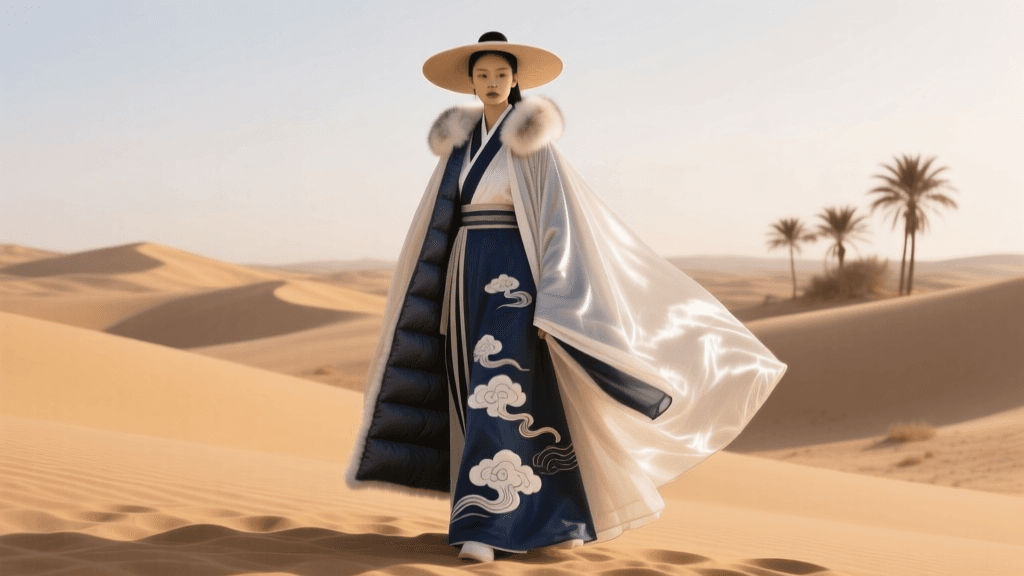
In the desert, covering the skin is actually cooler than exposing it, as it prevents direct UV radiation and slows the evaporation of sweat, thereby retaining bodily moisture. A long-sleeved, high-collared Ru (top) paired with a flowing Qun (skirt) is ideal. Over this, a Banbi (half-sleeve jacket) adds a layer of structural elegance and extra core insulation for when the desert sun sets. To protect the face and neck from sandstorms, modern travelers are reviving the Weimao—a wide-brimmed hat with a sheer, trailing veil. In 2026, textile labs in Hangzhou have introduced UPF 50+ treated Tussah silk, which maintains the historical matte texture and slubbed appearance of wild silk while offering medical-grade sun protection. According to research highlighted by the Victoria and Albert Museum's textile department, the historical use of wild silks and layered weaves provided ancient Silk Road travelers with essential environmental shielding, a principle that modern Hanfu designers have perfectly translated into contemporary desert travel gear.
Desert Color Palettes and Sand Mitigation
When selecting desert Hanfu, opt for tightly woven Tussah silk or heavy linen-silk blends. Avoid highly textured brocades (like Zhuanghua), as the raised patterns will trap fine desert sand and dust, making the garment heavy and difficult to clean. Earth tones, terracottas, and sand-colored garments not only reflect the historical Silk Road aesthetic but also show less dust accumulation.
Freezing & Cold Regions: Insulation and Layering
Winter Hanfu for sub-zero temperatures relies on the Ming Dynasty layering system, which is renowned for its voluminous, insulated silhouettes and wind-resistant closures. The key to surviving freezing climates in Hanfu is trapping dead air space between layers while sealing the extremities against wind chill.
Recommended Styles: Ming Dynasty Aoqun and Pifeng
The cornerstone of winter Hanfu is the Aoqun—a lined or quilted jacket (Ao) paired with a heavy skirt, most notably the Mamianqun (horse-face skirt). In 2026, the most advanced winter Ao jackets utilize ethically sourced shearling linings or cutting-edge aerogel-infused silk batting. Aerogel, originally developed for space exploration, provides immense thermal resistance with a fraction of the weight and bulk of traditional cotton padding, allowing the Ao to maintain its elegant, structured Ming silhouette without making the wearer look overly bulky. The high, standing collar (Liling) of the Ming Ao, fastened with traditional metal Zikou (interlocking buttons), acts as a built-in scarf, sealing warmth around the neck.
For outerwear, the Pifeng (cape or cloak) is essential. A 2026 winter Pifeng crafted from heavy wool-blend brocade and trimmed with eco-friendly faux-fox fur around the collar and hem provides a dramatic, historically grounded barrier against snow and wind. Expect to invest between $250 and $400 USD for a high-quality, aerogel-lined Aoqun set from premium heritage brands.
2026 Climate-to-Hanfu Fabric Comparison Chart
| Climate Zone | Ideal Hanfu Style | Recommended 2026 Fabric | Key Feature | Avg Price (USD) |
|---|---|---|---|---|
| Tropical / Humid | Song Beizi & Moxiong | Xiangyunsha (Mud-dyed Silk) | Naturally cooling, antimicrobial, UV resistant | $180 - $260 |
| Arid / Desert | Tang Ruqun & Banbi | UPF 50+ Tussah Silk | Moisture retention, sun shielding, sand-resistant | $120 - $190 |
| Freezing / Snow | Ming Aoqun & Pifeng | Aerogel-lined Wool Brocade | Extreme thermal insulation, windproof collar | $250 - $400 |
| Temperate / Windy | Jin Dynasty Yuanlingpao | Heavy Ramie-Cotton Blend | Wind-breaking structure, durable for travel | $90 - $140 |
Footwear and Accessories for Extreme Terrains
A Hanfu outfit is incomplete without appropriate footwear, which is especially critical in extreme climates. Traditional Yuntou Xie (cloud-head shoes) have been reimagined for 2026's rugged travelers. For desert and tropical treks, modern Hanfu brands are producing woven ramie uppers mounted on lightweight, shock-absorbing Vibram rubber soles, providing the historical aesthetic with the grip and durability required for uneven terrain. In freezing climates, insulated silk boots lined with merino wool and treated with modern hydrophobic nanocoatings ensure that feet remain dry and warm in deep snow, while hidden inner wedges provide elevation to keep the hem of the Mamianqun out of the slush.
Sourcing and Caring for Climate-Specific Hanfu
Maintaining extreme-weather Hanfu requires specialized care. Xiangyunsha silk must never be washed with alkaline detergents or machine-washed; it should be gently hand-washed in cool water with a pH-neutral silk wash and dried in the shade, as direct sunlight can alter the mud-dye's chemical finish over time. Desert Tussah silk garments should be shaken out vigorously to remove sand before being stored in breathable cotton garment bags. Winter wool-brocade and aerogel-lined Ao jackets should be professionally dry-cleaned at the end of the season to preserve the structural integrity of the interlocking buttonholes and the delicate brocade weaving. By understanding the profound relationship between traditional Asian textiles and the natural environment, modern enthusiasts can confidently wear Hanfu across the globe, honoring the ingenuity of ancient weavers while embracing the textile technologies of 2026.