Evolution of the Dragon Robe: Ming and Qing Court Fashion
The Zenith of Imperial Sartorial Power
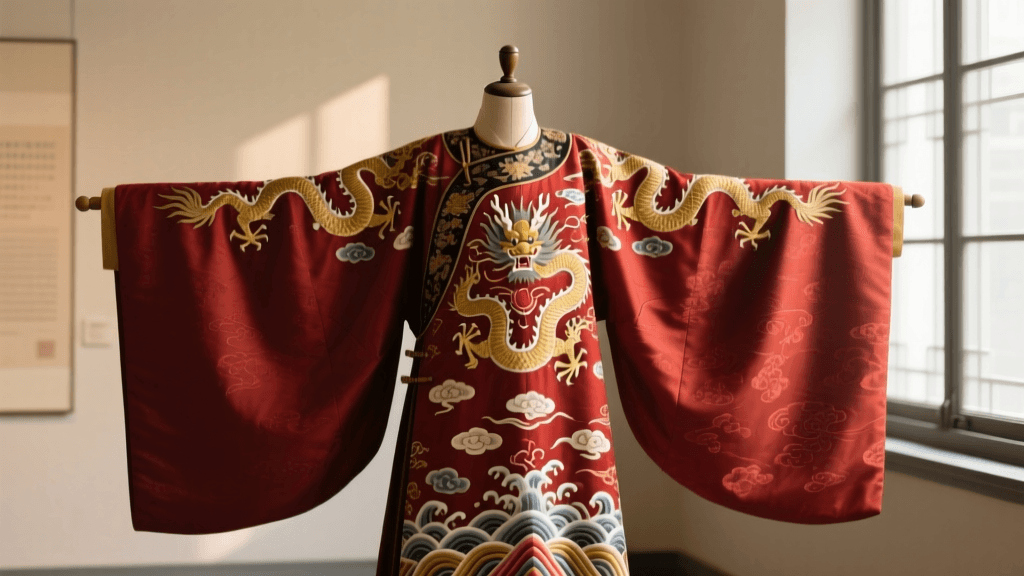
The Chinese dragon robe, known as the longpao, is arguably the most recognizable garment in the history of Asian court fashion. Far more than mere clothing, these robes served as a cosmological map and a strict indicator of imperial hierarchy. For modern historians, textile collectors, and traditional garment enthusiasts, understanding the evolution of the dragon robe from the Ming Dynasty (1368–1644) to the Qing Dynasty (1644–1912) provides profound insights into how political shifts dictate sartorial trends. According to the Metropolitan Museum of Art's Heilbrunn Timeline of Art History, the Ming era represented a resurgence of Han Chinese cultural norms, which heavily influenced the cut, drape, and philosophical underpinnings of court garments.
Ming Dynasty Court Fashion: The Round-Collar Silhouette
Following the expulsion of the Mongol-led Yuan Dynasty, the Ming emperors sought to restore traditional Han Chinese dress codes. The quintessential Ming dragon robe was the yuanlingpao, or round-collar robe. This garment featured a circular neckline that fastened at the right shoulder, adhering to the traditional Hanfu principle of jiaoling youren (crossing the collar to the right).
The silhouette of the Ming robe was expansive and flowing. Sleeves were exceptionally wide, often terminating in deep cuffs that could be tied back or left to drape elegantly over the hands. The fabric of choice was typically heavy silk damask or early brocade, woven with gold-wrapped threads. The dragons depicted on Ming robes were often shown chasing flaming pearls amidst stylized clouds, with the motifs carefully placed to align with the wearer's body. The front and back panels featured large, forward-facing or profile dragons, while the hem was bordered by the lishui (standing water) motif, representing the universal ocean. As noted by the Victoria and Albert Museum's Asian Collections, Ming textiles are celebrated for their understated elegance and masterful use of negative space compared to later periods.
Qing Dynasty Court Fashion: The Manchu Synthesis
The transition to the Qing Dynasty marked a radical shift in court fashion. The Manchu rulers, originating from the harsh climates of Northeast Asia, mandated a dress code that reflected their equestrian heritage. The Qing dragon robe retained the Han Chinese symbolic motifs—such as the five-clawed dragon and the cosmic landscape—but adapted them to a radically different tailoring structure.
The Qing longpao featured a Mandarin collar, a straight front opening with right-side fastenings, and most notably, horse-hoof cuffs (matixiu). These cuffs were designed to be folded back during daily activities and extended over the hands during formal court audiences as a sign of respect. Furthermore, the skirt of the robe was divided into four slits (front, back, and both sides) to facilitate horseback riding. The Metropolitan Museum of Art's overview of the Qing Dynasty highlights how this era saw an explosion of surface decoration. The negative space of the Ming era was filled with intricate bats, ruyi clouds, and Buddhist and Daoist symbols, creating a highly saturated, visually dense garment that required thousands of hours of embroidery or complex draw-loom weaving.
Comparative Analysis: Ming vs. Qing Dragon Robes
To fully grasp the dynasty evolution of court fashion, one must examine the structural differences side-by-side. The following table outlines the key tailoring and stylistic divergences between the two imperial eras.
| Feature | Ming Dynasty (1368–1644) | Qing Dynasty (1644–1912) |
|---|---|---|
| Collar Style | Round collar (yuanling) | Standing Mandarin collar |
| Sleeve Shape | Wide, flowing, draped cuffs | Fitted arms with horse-hoof cuffs (matixiu) |
| Skirt & Slits | Unslit or side-slits only | Four slits (front, back, left, right) |
| Fastenings | Concealed ties or metal buttons | Decorative knotted buttons (pankou) |
| Motif Density | Moderate, emphasizing negative space | Highly saturated, edge-to-edge patterns |
| Cultural Origin | Han Chinese agrarian court | Manchu equestrian and hunting heritage |
Practical Guide: Commissioning a Historical Reproduction
For collectors, historical reenactors, and traditional garment enthusiasts, acquiring a historically accurate dragon robe requires navigating the modern landscape of Chinese textile artisans. Whether you are commissioning a Ming-style yuanlingpao or a Qing-style longpao, precise specifications are critical to achieving historical fidelity.
Fabric Selection and Material Costs
Authentic court robes were woven using specialized techniques. For a Ming reproduction, seek out Song Brocade (Songjin) from Suzhou or heavy silk damask. For a Qing reproduction, the gold standard is Nanjing Yunjin (Cloud Brocade). Yunjin is woven with peacock feather filaments and gold leaf threads using a supplementary weft technique. When sourcing materials, you must differentiate between genuine hand-loomed textiles and modern power-loom imitations, which lack the structural integrity and historical accuracy required for museum-grade pieces.
- Nanjing Yunjin: Costs between $400 and $800 per meter. A full robe requires 5 to 7 meters.
- Suzhou Songjin: More affordable, ranging from $150 to $300 per meter, ideal for Ming-style robes.
- Lining: Use 100% mulberry silk habotai or crepe de chine. Budget $40 to $60 per meter for high-grade lining.
Measurements and Tailoring Specifications
Traditional Chinese tailoring relies on flat-pattern cutting without darts, meaning the garment's fit is dictated by the drape of the fabric and the placement of the seams. When providing measurements to an artisan, especially older masters in Suzhou or Nanjing who may still reference the traditional Chinese chi and cun system, include the following precise metric specifications:
- Robe Length: Measure from the prominent vertebra at the base of the neck down to the ankle bone. For an average adult male, this is typically 135cm to 145cm.
- Sleeve Span (Ming): Measure from wrist to wrist with arms extended. For the dramatic Ming drape, the total sleeve span should be at least 220cm to 240cm.
- Sleeve Length (Qing): Measure from the shoulder seam to the knuckles, adding 15cm to account for the folded horse-hoof cuff.
- Hem Circumference: The bottom hem should measure no less than 120cm in circumference to allow for a natural walking stride, especially for unslit Ming styles.
Timing, Artisan Sourcing, and Total Costs
Commissioning a bespoke, historically accurate robe is an exercise in patience. Hand-loomed Yunjin brocade is woven on traditional wooden draw-looms by two artisans working in tandem, producing only 5 to 6 centimeters of fabric per day.
- Fabric Weaving Time: 2 to 4 months for custom-woven yardage.
- Tailoring and Embroidery: 4 to 8 weeks, depending on the complexity of hand-embroidered accents (such as adding metallic couching to woven motifs) and the creation of traditional silk-floss padding.
- Total Lead Time: Expect a 4 to 6 month turnaround from initial deposit to final delivery.
- Estimated Total Cost: A museum-grade Ming reproduction in Song Brocade will cost between $2,500 and $4,000. A Qing-style robe in authentic Nanjing Yunjin with hand-finished pankou knots and silk floss padding will range from $6,000 to $12,000+.
Preserving the Legacy of Imperial Silk
The evolution of the dragon robe from the flowing, philosophical lines of the Ming Dynasty to the structured, ornate majesty of the Qing Dynasty mirrors the broader historical narrative of China. Today, the revival of these garments is not merely an exercise in costume design, but a vital preservation of intangible cultural heritage. By understanding the historical context, structural tailoring, and material requirements of these garments, modern enthusiasts can ensure that the legacy of Asian court fashion continues to be woven into the future.