Everyday vs Ceremonial Hanbok: 2026 Fabric & Styling Guide
The global appreciation for Asian traditional garments has reached remarkable new heights in 2026, driven by a renewed interest in cultural heritage and sustainable fashion. At the forefront of this movement is the Korean hanbok, a garment celebrated for its elegant lines, vibrant colors, and deep historical roots. However, as contemporary consumers and designers embrace this traditional dress, a distinct dichotomy has emerged: the grand, heavily structured ceremonial hanbok versus the practical, modernized everyday hanbok. Understanding the differences between these two categories is essential for anyone looking to invest in, wear, or study Korean traditional clothing today.
According to the Encyclopædia Britannica, the fundamental structure of the hanbok—comprising the jeogori (upper garment) and chima (skirt) for women, or baji (trousers) for men—has remained conceptually consistent for centuries. Yet, the application of these garments varies wildly depending on the occasion. In 2026, the contrast between ceremonial and everyday wear is defined by textile innovations, silhouette adaptations, and shifting consumer habits.
The Grandeur of Ceremonial Hanbok
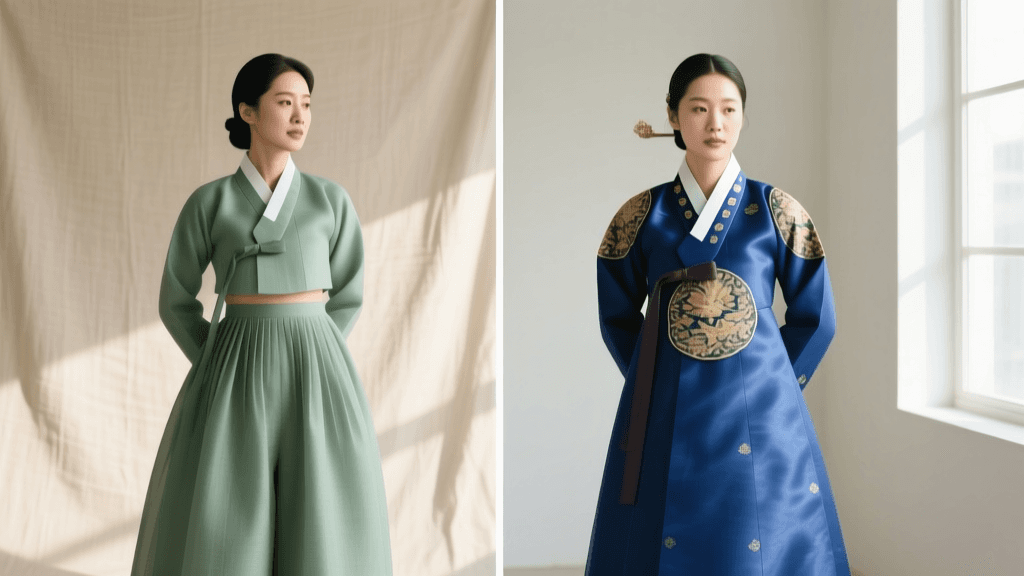
Ceremonial hanbok is designed for life’s most significant milestones: weddings, major ancestral rites (jesa), and high-level cultural festivals. The most iconic of these is the Hwarot, a traditional bridal robe, and the Wonsam, a court ceremonial robe. Historical context from the Metropolitan Museum of Art highlights how Joseon-era court dress established the strict color codes and voluminous silhouettes that still influence modern ceremonial wear.
In 2026, authentic ceremonial hanbok remains a masterpiece of artisanal craftsmanship. These garments are typically constructed from heavy, pure silk brocades and feature extensive geumbak (gold leafing) applied by hand to the jeogori and sleeves. The embroidery is dense and highly symbolic, featuring motifs like peonies for wealth, bats for good fortune, and phoenixes for prosperity. The skirts are exceptionally voluminous, often requiring multiple inner layers (sokchima) to achieve the desired bell-like shape. Because of the heavy textiles and intricate hand-stitching, a complete ceremonial bridal set can weigh upwards of four kilograms.
The financial investment for ceremonial wear is substantial. As of 2026, a custom-tailored, authentic silk Hwarot set from a master artisan in Seoul typically ranges from $3,500 to $8,500. Due to the cost and weight, these garments are rarely purchased outright by individuals; instead, they are most commonly rented from specialized bridal boutiques or inherited as family heirlooms.
The Practicality of Everyday Hanbok (Saenghwal Hanbok)
On the opposite end of the spectrum is Saenghwal hanbok, which translates to 'living hanbok' or everyday hanbok. The evolution into modern daily wear, often termed Saenghwal hanbok, represents a massive shift in how traditional garments integrate into contemporary urban life. Everyday hanbok is designed for mobility, comfort, and ease of care, making it suitable for office wear, casual outings, and modern tea ceremonies.
The structural modifications in everyday hanbok are significant. The chima (skirt) is dramatically shortened, typically falling to the midi or knee-length rather than pooling at the ankles. The voluminous pleats are often replaced with streamlined A-line cuts or subtle gathers. The traditional goreum (the long chest tie) is sometimes retained for aesthetic purposes, but many 2026 designs incorporate hidden hooks, magnetic snaps, or elasticized waistbands to accommodate the fast-paced lifestyle of modern commuters.
Everyday hanbok is also far more accessible. Ready-to-wear collections from popular contemporary brands offer cotton, linen, and advanced poly-blend sets ranging from $80 to $250. These garments are designed to be machine-washable and wrinkle-resistant, removing the intimidation factor often associated with traditional silk garments.
2026 Comparison Chart: Ceremonial vs. Everyday Hanbok
| Feature | Ceremonial (Hwarot / Wonsam) | Everyday (Saenghwal Hanbok) |
|---|---|---|
| Primary Fabrics | Heavy silk brocade, pure satin, hand-applied gold leaf | Cotton, linen, peace silk, wrinkle-resistant poly-blends |
| Skirt Length & Volume | Floor-length, extreme volume requiring inner petticoats | Knee to midi-length, streamlined A-line or subtle gathers |
| Fasteners | Traditional long ties, intricate inner layering | Hidden zippers, magnetic snaps, elastic waistbands |
| Care & Maintenance | Professional dry cleaning only, cedar box storage | Machine washable (gentle cycle), standard wardrobe hanging |
| 2026 Price Range | $3,500 - $8,500+ (Custom / Artisan) | $80 - $250 (Ready-to-wear / Boutique) |
Fabric Innovations and Textile Care in 2026
The year 2026 has brought remarkable textile innovations to the hanbok industry, particularly concerning sustainability. For everyday wear, designers are heavily utilizing Hanji (traditional Korean paper) blended with organic cotton. Hanji-blend fabrics are naturally antibacterial, highly breathable, and possess a unique, textured drape that mimics raw silk without the environmental toll or delicate care requirements. Furthermore, temperature-regulating linings are now standard in premium everyday sets, ensuring comfort during Seoul's humid summers and biting winters.
Ceremonial garments have also seen eco-conscious updates. The rise of 'peace silk' (Ahimsa silk), where the silkworm is allowed to emerge from the cocoon before the silk is harvested, has become a popular choice for modern brides who want the luxurious sheen of traditional silk without compromising their ethical standards. Natural dyeing techniques using indigo, gardenia, and persimmon tannin are being revived, offering rich, colorfast hues that synthetic dyes struggle to replicate.
Garment Care Guidelines
- Ceremonial Silk: Never attempt to spot-clean gold-leafed (geumbak) areas. Always consult a specialist in traditional Asian textiles for dry cleaning. Store flat in a breathable cotton garment bag with natural camphor or cedar blocks to deter pests.
- Everyday Blends: Wash on a gentle cycle with cold water and a pH-neutral detergent. Avoid the tumble dryer; instead, reshape the garment while damp and hang dry in the shade to prevent UV fading.
- Ironing: Use a low-heat steam setting for everyday cottons and linens. For ceremonial silks, use a pressing cloth to avoid direct heat contact, which can scorch the fibers and melt gold leafing.
Sourcing and Shopping in 2026
For international buyers and local enthusiasts alike, sourcing the right hanbok requires knowing where to look. For everyday Saenghwal hanbok, online boutiques and specialized K-fashion platforms offer the widest variety of sizes and contemporary cuts. When shopping online, pay close attention to the jeogori sleeve length and the chima waist measurements. Unlike Western dresses, the hanbok skirt sits high on the ribcage, just below the bust. Measuring this high-waist circumference accurately is the most critical step in ensuring a proper fit.
For ceremonial wear, the process is highly personalized. It requires an in-person consultation with a master tailor (hanbok jangin). During this session, the artisan will take over a dozen specific measurements, assess the client's posture, and discuss the symbolic color combinations based on the traditional Obangsaek (five cardinal colors) system. Because of the intricate handwork involved, lead times for custom ceremonial hanbok in 2026 typically span three to six months.
Accessorizing for the Modern Era
The transition between ceremonial and everyday wear is often dictated by accessories. For ceremonial occasions, the styling is maximalist. Brides wear elaborate jokduri (coronal headpieces) adorned with pearls and jade, and heavy norigae (decorative pendants) are tied to the goreum or skirt waist. Footwear consists of traditional hwa (embroidered silk shoes) with upturned toes.
Conversely, everyday hanbok styling in 2026 embraces minimalism and cross-cultural fusion. It is increasingly common to see the traditional jeogori paired with modern high-waisted denim or tailored trousers, completely bypassing the chima. When the full skirt is worn, accessories are kept subtle: a simple, modernized binyeo (hairpin) in matte metal or carved wood, and a minimalist tassel. For footwear, modern wearers frequently swap traditional silk shoes for leather Mary Janes, sleek loafers, or even clean white sneakers, grounding the historical silhouette in contemporary street style.
Ultimately, whether you are investing in a breathtaking, gold-leafed Hwarot for a wedding or purchasing a breathable cotton Saenghwal set for a weekend stroll, the hanbok in 2026 remains a vibrant, living tradition. By understanding the distinct purposes, fabrics, and styling rules of ceremonial versus everyday garments, wearers can honor the rich heritage of Korean culture while seamlessly integrating its beauty into modern life.