Drafting the 15th-Century Burgundian Houppelande: 2026 Guide
The Resurgence of the Houppelande in 2026
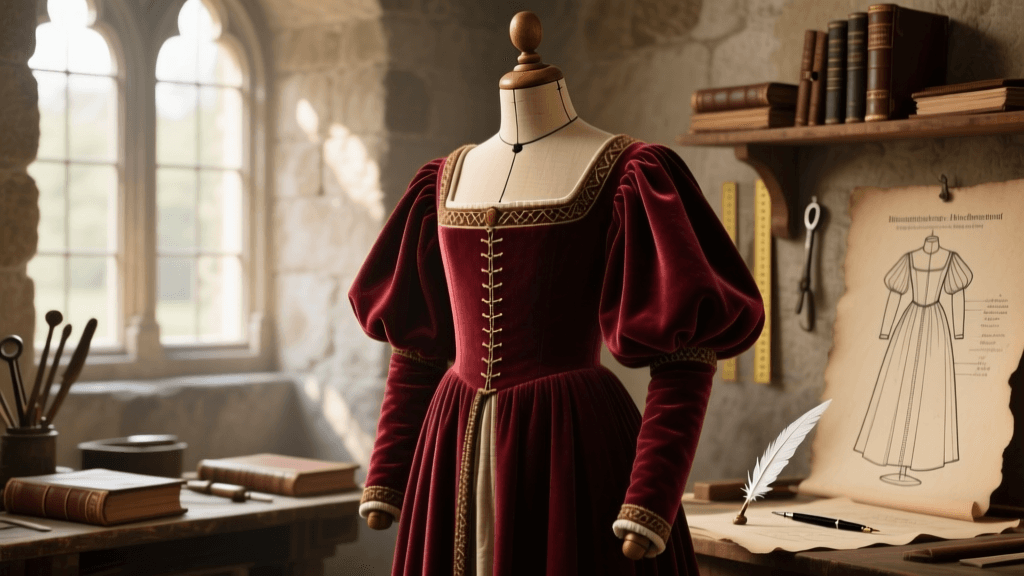
As we navigate the 2026 historical reenactment and European folk dress season, the demand for hyper-authentic medieval garments has reached an all-time high. Modern makers and historical tailors are moving away from the synthetic, mass-produced costumes of the past decade, focusing instead on meticulous, research-backed construction. At the forefront of this movement is the 15th-century Burgundian houppelande. Characterized by its voluminous sleeves, high collar, and heavily belted waist, this iconic outer garment remains a cornerstone of late medieval and early Renaissance European clothing. Whether you are preparing for a high-level historical European martial arts (HEMA) event, a Renaissance festival, or a living history exhibition, mastering the draft and construction of the houppelande is an essential skill for any serious garment maker in 2026.
Understanding the 15th-Century Silhouette
The houppelande emerged in the late 14th century and reached its zenith in the courts of Burgundy and France during the 15th century. Unlike the tightly fitted cotehardie that preceded it, the houppelande was a garment of excess and drape. It was designed to showcase the wearer's wealth through the sheer volume of expensive fabric required to make it. According to the manuscript illuminations housed at The Morgan Library & Museum, the voluminous sleeves and floor-sweeping hems were visual markers of nobility, as only the elite could afford to restrict their movement with such heavy, trailing textiles.
The defining features of the classic Burgundian houppelande include:
- The High Collar: Often stiffened and standing up to the jawline, sometimes adorned with dagged edges or embroidery.
- The Bombard Sleeve: A massive, curved sleeve that hangs down to the hem or floor, creating a dramatic, wing-like silhouette when the arms are raised.
- The High Belt: A wide, ornate leather or woven belt worn just under the bust or ribs, which pulls the excess fabric into deep, vertical organ pleats.
- Dagged Edges: Decorative scalloping or leaf-shaped cutting along the hems and sleeve cuffs, made possible by the use of heavily fulled wool that does not fray.
Sourcing Authentic and Sustainable Textiles
The foundation of any accurate medieval garment is the textile. In 2026, the historical tailoring community has heavily embraced sustainable, heritage-milled fabrics that replicate historical weaves without the environmental toll of fast fashion. For a winter or mid-season houppelande, you must source a heavily fulled wool twill or Melton wool. The fabric should weigh between 14oz and 18oz per square yard (approximately 475 to 610 g/m²). This weight is crucial; lighter wools will not hold the deep, structural pleats required at the waist, nor will they support the heavy bombard sleeves without collapsing.
Heritage mills in Yorkshire and Biella have recently released 2026 collections specifically targeting the historical reenactment market, offering historically accurate madder reds, woad blues, and weld yellows using natural dyes. Expect to pay between $35 and $55 per yard for premium, naturally dyed heritage wool this year. For the lining, avoid modern poly-blends. Instead, source a medium-weight, unbleached linen (around 5.3oz to 7oz) or, for high-status impressions, a lightweight silk taffeta. For primary source visual evidence of 14th and 15th-century dress and textile draping, the British Library's Luttrell Psalter remains an indispensable resource for understanding how these heavy wools behaved in motion.
Drafting the Pattern: Measurements and Geometry
Medieval tailoring was fundamentally geometric. Rather than using complex, curved multi-piece patterns like modern tailoring, the houppelande is constructed from large rectangles, triangles, and half-circles. This method minimized fabric waste, which was a critical economic consideration even for the wealthy, as hand-woven broadcloth was immensely expensive.
To draft your pattern, you will need the following measurements:
- Shoulder to Floor: Measure from the base of the neck, over the shoulder, down to the floor while wearing your historical turnshoes or pattens.
- Chest Circumference: Measure around the fullest part of the chest.
- Belt Placement: Measure from the shoulder down to where the belt will sit (usually just under the bust or high ribcage).
- Arm Length: Measure from the shoulder point to the wrist, then add 12 to 24 inches depending on how dramatic you want the sleeve drape to be.
The body of the houppelande is typically cut as a large half-circle or a series of rectangular panels with massive triangular gores inserted at the sides and back to create the hem circumference. The front is usually left open or closed with a few hidden hooks or ties, as the belt secures the garment.
Fabric Yardage and Cost Estimation
Because the houppelande relies on massive geometric cuts, calculating yardage can be tricky. The table below provides a baseline for a standard floor-length houppelande with bombard sleeves, assuming you are using 60-inch wide wool fabric. Prices reflect the 2026 average market rate for heritage milled wool.
| Garment Height | Hem Circumference | Fabric Width | Required Yardage | Estimated 2026 Cost |
|---|---|---|---|---|
| 5'4" (162 cm) | 120" (305 cm) | 60" (152 cm) | 5.5 Yards | $192 - $302 |
| 5'8" (172 cm) | 130" (330 cm) | 60" (152 cm) | 6.5 Yards | $227 - $357 |
| 6'0" (182 cm) | 140" (355 cm) | 60" (152 cm) | 7.5 Yards | $262 - $412 |
Note: Always add an extra half-yard to your order to account for fabric shrinkage and pattern matching, especially if your wool features a prominent twill line.
The Bombard Sleeve Construction
The sleeve is the most complex and visually striking element of the houppelande. The bombard sleeve is not a standard set-in sleeve. It is cut as a massive, sweeping curve that attaches to the armhole but extends far beyond the wrist. To draft this, draw a line equal to your arm length plus the desired drape. From the shoulder point, draw a deep, convex curve down to the hemline of the sleeve. The back of the sleeve remains relatively straight to attach to the back of the armhole, while the front features the dramatic curve.
When cutting the sleeves, ensure the grainline runs vertically down the center of the arm. This allows the bias edges of the curve to drape softly and elegantly. If you plan to dagge (scallop) the edges of the sleeve, do so only after the garment is fully assembled and hemmed, using sharp, high-carbon steel shears to ensure clean, precise cuts through the heavy wool.
Historical Construction and Sewing Techniques
While modern sewing machines can speed up the process of sewing long side seams, the 2026 authenticity standards for high-level living history require hand-finished visible seams. The most historically accurate method for joining the heavy wool panels is the flat-felled seam. This involves sewing the panels together with a running stitch, trimming one seam allowance, folding the other over it, and stitching it down to the fabric. This creates an incredibly strong, clean-finished seam that requires no modern sergers or zig-zag stitches.
For structural areas like the armholes and the collar, use a backstitch with heavy, waxed linen or wool thread. The collar must be interlined with a stiff canvas or heavy linen to maintain its upright posture. When attaching the collar, baste it heavily before the final stitch, as the thickness of the wool layers can easily shift and cause puckering.
Mastering the Belt and Pleating
The magic of the houppelande happens when the belt is applied. Without the belt, the garment looks like a shapeless, overwhelming tent. The belt is worn high, compressing the excess fabric of the bodice into deep, vertical folds. To achieve the iconic look seen in period illuminations, you must carefully arrange the pleats before tightening the belt. Start at the center back, creating deep, inverted box pleats that stack neatly on top of one another. Move toward the sides, transitioning into softer knife pleats. Once the pleats are arranged to your liking, tighten the heavy leather or tablet-woven belt. The fabric above the belt will blouse out slightly, creating the characteristic pigeon-breasted silhouette of the 15th century.
Essential Accessories: Chaperons and Pattens
No houppelande is complete without its accompanying accessories. The most iconic headwear for this garment is the chaperon. Originally a simple hood, by the 15th century, it had evolved into a complex, turban-like headdress made from a long strip of fabric called a liripipe, wrapped intricately around the head and shoulders. Mastering the draping of a chaperon takes practice, but it instantly elevates the historical accuracy of your ensemble.
For footwear, your floor-sweeping hem will inevitably drag through mud and damp grass. Protect your delicate leather turnshoes by wearing wooden pattens—overshoes with wooden soles and leather straps that elevate your feet an inch or two off the ground. In 2026, several specialized historical cobblers offer custom-fit pattens carved from sustainable hardwoods, ensuring both historical accuracy and modern ergonomic comfort.
Final Fitting and Care
Before your first event, do a full dress rehearsal. Wear your foundational linen chemise, your hose, and your turnshoes. Put on the houppelande, arrange the pleats, and fasten the belt. Walk, sit, and raise your arms. The bombard sleeves will naturally pull the fabric forward; ensure the back hem is long enough that it doesn't ride up above your ankles when your arms are extended. Finally, store your houppelande flat or loosely rolled. Hanging a heavy, fully pleated wool garment on a modern hanger will distort the shoulder seams and ruin the carefully arranged drape over time. With proper care and meticulous construction, your Burgundian houppelande will be a masterpiece of European folk dress that lasts for decades.