2026 Guide to Authentic Chiton and Roman Toga Dress
The Classical Revival of 2026: Elevating Historical Accuracy
As we navigate the 2026 European heritage festival season, the standard for historical reenactment and cultural representation has reached unprecedented heights. Gone are the days when a simple bedsheet wrapped around the torso sufficed for portraying ancient Mediterranean cultures. Today, textile historians, museum curators, and dedicated reenactors demand rigorous authenticity in the reconstruction of classical garments. Whether you are preparing for a major Hellenic cultural festival in Athens, a Roman reenactment in Trier, or a university theater production, understanding the precise construction, draping, and material culture of the Greek chiton and the Roman toga is essential.
The shift toward sustainable, historically accurate textiles in 2026 has also revolutionized how we source materials. Reenactors are increasingly collaborating with artisan weavers to produce heritage-loom linens and wools that mimic the hand-spun, hand-woven fabrics of antiquity. According to The Metropolitan Museum of Art's Heilbrunn Timeline of Art History, the drape, weight, and opacity of ancient garments were intrinsically linked to the specific fibers and weaving techniques available in the Mediterranean basin. This guide will walk you through the exact specifications, draping techniques, and 2026 material sourcing strategies needed to create flawless classical garments.
Deconstructing the Greek Chiton: Doric vs. Ionic
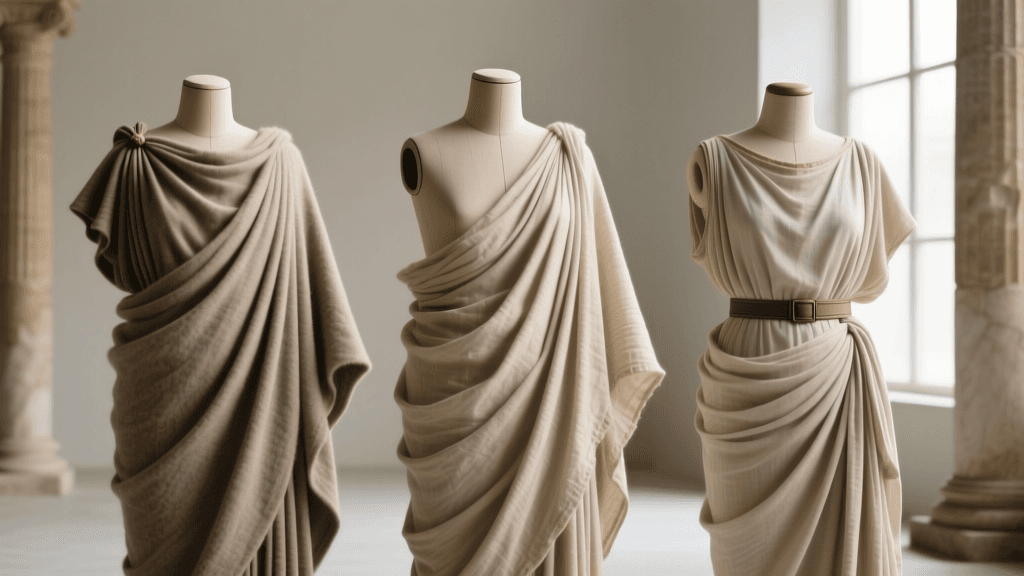
The chiton was the foundational garment of ancient Greece, worn by both men and women. However, it was not a single, uniform piece of clothing. It evolved into two distinct styles: the Doric and the Ionic. Understanding the difference is critical for any serious reconstruction.
The Doric Chiton (Peplos)
The Doric chiton, often referred to as a peplos when worn by women, is the older and more structured of the two styles. Originating in the Peloponnese, it was traditionally made from heavy, rectangular woolen fabric. The defining feature of the Doric chiton is the apoptygma—an overfold created by folding the top edge of the fabric down to the waist or hips before draping.
To construct a historically accurate Doric chiton for a woman in 2026, you must measure the wearer's height from the shoulder to the floor, and then add an additional 12 to 18 inches to allow for the apoptygma. The width of the fabric should equal the wearer's wingspan. The garment is pinned at the shoulders using peronai (straight bronze or iron pins) and belted at the waist. The heavy wool provides a structured, columnar silhouette that is iconic to the Archaic and early Classical periods. As noted by the World History Encyclopedia's overview of Greek Clothing, the Doric peplos was heavily associated with the goddess Athena and remained a staple for ceremonial dress long after everyday fashion shifted.
The Ionic Chiton
By the late 6th century BCE, the Ionic chiton gained prominence. Made from lightweight, finely woven linen, it required significantly more fabric than its Doric counterpart. The width of an Ionic chiton is typically twice the wingspan of the wearer, allowing for deep, luxurious folds and the creation of sleeves.
Instead of a single heavy pin at each shoulder, the Ionic chiton is secured along the arms using a series of small pins or brooches called fibulae. This creates a false sleeve that drapes elegantly. The excess fabric is then bloused over a woven belt or cord, creating a pouch-like fold known as the kolpos. For 2026 reenactments, sourcing high-thread-count, semi-sheer linen is crucial to achieving the fluid, cascading drape seen in Hellenistic sculpture.
The Roman Toga and Stola: Status and Structure
While Greek dress relied on the elegant draping of rectangular fabric, Roman clothing was deeply tied to civic identity, social status, and complex tailoring. The Roman wardrobe was a visual language of power and citizenship.
The Toga: A Masterclass in Draping
The toga is perhaps the most misunderstood garment in classical history. It was not a simple wrap, nor was it comfortable. It was a massive, semi-circular piece of heavy wool that required the assistance of a slave or servant to drape correctly. According to the World History Encyclopedia's guide on Roman Clothing, the toga was the exclusive right of the Roman male citizen, serving as a symbol of peace and civic duty.
A full toga virilis (the plain white toga of an adult male) measured approximately 18 feet in length and 7 feet in width at its broadest point. The draping process involves creating the sinus (a deep, sweeping fold that draped across the chest and could be used as a pouch) and the umbo (a decorative, twisted knot of fabric at the center of the chest that helped anchor the heavy wool). In 2026, historical costumers have largely abandoned the outdated 'rectangular bedsheet' method, opting instead for precision-cut semi-circles with weighted hems to ensure the sinus hangs correctly without constantly slipping off the left shoulder.
The Stola and Palla for Roman Women
Roman citizen women did not wear the toga; instead, their formal public dress consisted of the stola and the palla. The stola was a long, sleeveless dress worn over a basic tunica interior. Its defining characteristic was the instita—a decorative, often brightly colored or gold-embroidered band sewn along the bottom hem. The stola was gathered at the shoulders with small straps and belted high under the bust.
Over the stola, women draped the palla, a large rectangular mantle. When stepping outside the home, a respectable Roman woman would pull the palla over her head as a veil. For modern reconstructions, using a medium-weight linen or lightweight wool crepe for the palla ensures it stays in place over the hair without requiring excessive pinning.
2026 Fabric Sourcing and Material Guide
The success of your classical garment relies entirely on the fabric. The 2026 textile market offers excellent options for reenactors, provided you know what to look for. Avoid modern synthetic blends, as they do not drape correctly and trap heat dangerously during summer festivals.
| Material | Historical Accuracy | 2026 Avg Cost/Yard | Drape Quality | Best Used For |
|---|---|---|---|---|
| 100% Medium-Weight Linen (IL020 or similar) | High (Ionic) | $18 - $24 | Fluid, crisp, breathable | Ionic Chiton, Palla, Tunics |
| Lightweight Wool Crepe | High (Doric/Toga) | $28 - $35 | Heavy, structured, matte | Doric Peplos, Toga Virilis |
| Heritage Breed Wool (e.g., Soay) | Extreme (Artisan) | $45 - $60 | Textured, rustic, warm | Cloaks (Chlamys), Winter wear |
| Cotton-Linen Blend | Low (Modern Sub) | $12 - $15 | Soft, less historical drape | Budget theater props, extras |
Step-by-Step Draping Guide: The Basic Ionic Chiton
To achieve a flawless Ionic chiton for the 2026 reenactment season, follow these precise steps:
- Step 1: Preparation. Lay your lightweight linen rectangle flat on a large surface. Ensure the top and bottom hems are finished with a period-appropriate blanket stitch or tablet-woven trim.
- Step 2: The Armholes. Have the wearer hold their arms out horizontally. Pin the top edge of the fabric at intervals of 3 to 4 inches along the arms, leaving the center neck opening wide enough to slip over the head. Use replica bronze or silver fibulae.
- Step 3: Securing the Side. Sew or pin the side seam from the bottom hem up to the armpit, leaving the sleeve area open.
- Step 4: Belting and the Kolpos. Tie a woven wool cord or leather belt around the natural waist. Pull the excess fabric up and over the belt until the hem of the chiton grazes the ankles. This creates the kolpos (bloused fold).
- Step 5: The Cross-Belt (Optional). For a more complex, Hellenistic look, add a second belt or ribbon crossed over the chest and back, pulling the fabric taut to create a tailored bodice effect.
Accessories and Footwear: Completing the 2026 Look
No classical garment is complete without the proper accessories. Footwear in antiquity was highly specific to the environment. For Greek settings, the krepides (strappy leather sandals with thick soles) are mandatory. Roman citizens in the city would wear calcei (closed leather shoes), while soldiers and travelers opted for caligae (hobnailed sandals).
Jewelry should be crafted from bronze, silver, or gold. Avoid modern polished gemstones; instead, opt for cabochons, carnelian, glass paste, and engraved signet rings. Women should incorporate intricate hairstyles using replica bone hairpins (acus) and woolen hair nets (snoods), which have seen a massive resurgence in accuracy standards across European festivals in 2026.
Conclusion
Reconstructing the chiton, toga, and stola is an exercise in patience, geometry, and historical empathy. By abandoning modern shortcuts and embracing the authentic weights, weaves, and draping techniques of the ancient Mediterranean, you honor the incredible textile traditions of the past. As the 2026 festival season unfolds, let your garments speak to the artistry and complexity of the classical world, ensuring that history is not just remembered, but vividly worn.