Ancient Greek Chiton & Roman Stola Draping Guide 2026
The Resurgence of Classical Antiquity in 2026
The revival of classical Mediterranean textiles has reached new heights in the 2026 historical reenactment, theatrical costuming, and heritage fashion seasons. Whether you are preparing for a university production, a museum exhibition, or an immersive historical festival, understanding the precise construction and draping of ancient Greek and Roman garments is essential. Unlike modern tailored clothing, the chiton, peplos, and stola rely entirely on the geometric manipulation of rectangular woven fabrics, secured by pins, belts, and gravity.
According to the Metropolitan Museum of Art's Heilbrunn Timeline of Art History, the fundamental principle of ancient Greek dress was the draping of uncut, rectangular pieces of cloth. This philosophy not only conserved valuable textiles but also allowed for a fluid, dynamic silhouette that moved elegantly with the wearer. In 2026, modern weavers and heritage textile mills have made it easier than ever to source historically accurate linens and wools, allowing reenactors to move beyond synthetic costume blends and embrace authentic drape and weight.
Decoding the Greek Chiton: Doric vs. Ionic
The term 'chiton' is often used broadly to describe the basic tunic of ancient Greece, but historians and textile experts divide it into two primary categories: the Doric and the Ionic. Understanding the distinction is critical for achieving an accurate silhouette.
The Doric Chiton (Peplos)
The Doric chiton, frequently referred to as a peplos when worn by women, is the older and heavier of the two styles. It is constructed from a single, large rectangular piece of woolen fabric. The defining feature of the Doric style is the apoptygma—an overfold at the top of the garment that drapes down over the chest and back. This overfold not only provides warmth but also creates a visually striking, layered silhouette that is iconic in classical Greek sculpture.
For a modern reconstruction in 2026, the fabric width should be equal to the wearer's wingspan plus 12 inches, while the length should be the distance from the shoulder to the floor, plus an additional 18 inches to account for the apoptygma and the blousing (kolpos) over the belt.
The Ionic Chiton
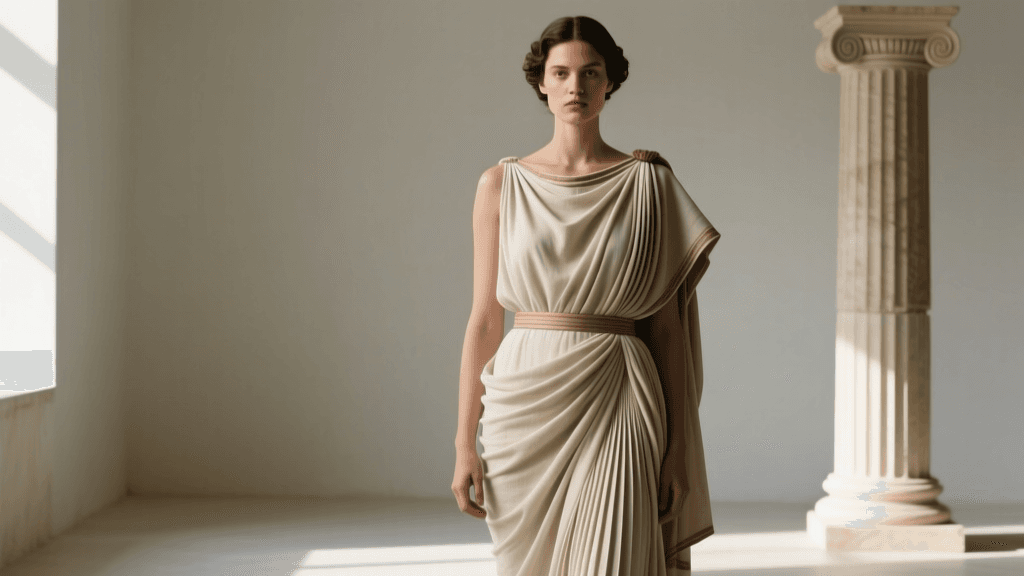
In contrast, the Ionic chiton is made from a much wider, lighter piece of fabric, traditionally linen. Rather than relying on a heavy overfold, the Ionic chiton creates sleeves through a series of small pins (fibulae) or stitches along the upper arms. The Metropolitan Museum of Art notes that the introduction of lighter linens allowed for more intricate, voluminous draping that became highly fashionable in the later classical and Hellenistic periods.
The Ionic chiton requires a fabric width that is at least twice the wearer's wingspan. The excess material is gathered and pinned at intervals along the arms, creating a graceful, cascading sleeve effect that remains highly popular in contemporary theatrical adaptations of Greek tragedies.
The Roman Matron's Wardrobe: Stola and Palla
While Roman men are famous for the toga, the garment of the respectable Roman matron was the stola. Worn over a basic tunica, the stola was a long, sleeveless dress suspended from the shoulders by small straps or fibulae. The most critical identifying feature of the stola was the instita—a decorative woven band or flounce at the hem, which signaled the wearer's social status and virtue.
Over the stola, Roman women draped the palla, a large rectangular mantle. The palla was highly versatile, functioning as a wrap, a head covering, or a protective layer against the elements. In 2026, historical costumers emphasize the importance of the palla's weight; a fabric that is too light will not hold the dramatic, sculptural folds seen in Roman portraiture, while a fabric that is too heavy will pull uncomfortably on the shoulders.
2026 Fabric Sourcing and Weight Guide
Selecting the correct fabric weight, measured in Grams per Square Meter (GSM), is the most common pitfall for modern reenactors. Below is a comprehensive guide to sourcing and selecting materials for your classical garments this year.
| Garment Type | Historical Material | Recommended GSM | 2026 Sourcing & Prep Tips |
|---|---|---|---|
| Doric Chiton (Peplos) | Wool | 220 - 280 GSM | Source merino-wool blends from heritage mills. Pre-wash in cold water to allow for slight fulling, which improves the drape and prevents fraying at the raw edges. |
| Ionic Chiton | Linen | 140 - 180 GSM | Opt for medium-weight European flax linen. Avoid stiff, heavily sized linens; wash repeatedly with pumice stones to soften the fibers before draping. |
| Roman Stola | Linen or Fine Wool | 160 - 200 GSM | Look for tightly woven tabby weaves. The fabric must be crisp enough to hold the institua hem band without sagging. |
| Roman Palla | Wool or Silk Blend | 180 - 240 GSM | A lightweight wool crepe or a wool-silk blend provides the necessary body to stay draped over the head without constant readjustment. |
Step-by-Step Draping Techniques
Mastering the drape requires patience and an understanding of how gravity interacts with woven fibers. Here is a practical guide to draping the Doric chiton, the foundational garment of the Greek wardrobe.
1. Preparation and Hemming
Begin with a rectangular piece of wool measuring approximately 60 inches wide and 75 inches long (adjust based on your height). While ancient Greeks often left the vertical edges raw, modern 2026 reenactors usually prefer to weave a decorative border (clavi) or hem the sides to prevent excessive wear during festivals.
2. Creating the Apoptygma (Overfold)
Lay the fabric flat. Fold the top edge down by 12 to 18 inches, depending on how deep you want the chest drape to be. This folded section will hang on the outside of the garment.
3. Wrapping the Body
Wrap the fabric around your body, starting at the left side. The open edge of the fabric should fall on your right side. Ensure the folded apoptygma is on the outside, hanging down over your chest.
4. Pinning the Shoulders
Gather the front and back layers of the fabric at your left shoulder. Pin them together using a historically accurate bronze or silver fibula (brooch). Repeat this process on the right shoulder. The distance between the pins should be roughly 6 to 8 inches, allowing the neckline to drape gracefully.
5. Belting and Blousing (Kolpos)
Tie a woven wool or leather belt around your waist, over the apoptygma. To create the kolpos (the characteristic bloused effect), pull the fabric up and over the belt until the hem of the garment falls just above your ankles. The overfold should now hang down over the belt, concealing it entirely and creating a layered, peplum-like effect at the waist.
Accessories and Footwear
No classical garment is complete without the proper accessories. For Greek ensembles, a himation (a heavy woolen cloak) can be draped over the chiton for cooler weather. Footwear should consist of leather sandals with multiple straps wrapping around the calf, or soft leather krepides. In 2026, custom shoemakers specializing in historical footwear offer vegetable-tanned leather options that perfectly match the natural dye palettes of ancient textiles.
Roman ensembles require careful attention to jewelry. Gold bullae (lockets), cameo brooches, and intricate hairpins are essential for completing the look of a Roman matron. Hair should be styled in the complex, braided updos characteristic of the specific century you are portraying, often secured with bone or ivory pins.
Caring for Your Historical Garments
Proper maintenance of natural fibers is crucial. Wool chitons should be aired out in the sun and spot-cleaned with a mild lanolin-based soap to preserve the natural water-resistant properties of the fleece. Linen Ionic chitons and Roman stolas can be hand-washed in lukewarm water, but they must be ironed while slightly damp using a high-heat steam setting to achieve the crisp, pleated look favored in classical antiquity. Store your garments flat or rolled around acid-free tubes to prevent permanent creasing and fiber stress.
By adhering to these historical principles and utilizing the advanced textile resources available in 2026, you can create ancient Greek and Roman garments that are not only visually stunning but also deeply authentic in their movement, drape, and construction.