Authentic Greek Chiton & Roman Stola Draping Guide 2026
The Timeless Elegance of Classical Mediterranean Garments
The elegance of classical Mediterranean garments continues to captivate historians, reenactors, and avant-garde fashion designers in 2026. Unlike modern tailored clothing, which is cut and sewn to fit the body's exact contours, ancient Greek and Roman garments were defined by their drape. The art of wrapping, pinning, and belting rectangular pieces of woven fabric created a silhouette that was both deeply functional and highly symbolic. Whether you are preparing for a historical reenactment, designing a theatrical production, or simply integrating classical draping into a modern sustainable wardrobe, understanding the structural nuances of the Greek chiton and the Roman stola is essential.
In this comprehensive 2026 guide, we will explore the anatomical differences between classical garments, provide exact mathematical formulas for cutting your fabric, and detail where to source historically accurate, sustainably produced textiles in today's market.
The Anatomy of the Greek Chiton
The chiton was the foundational garment of ancient Greece, worn by both men and women. It was essentially a large rectangle of fabric draped around the body and fastened at the shoulders. However, the chiton was not a monolith; it evolved significantly over the centuries, resulting in two primary variations: the Doric and the Ionic.
Doric vs. Ionic: A Structural Breakdown
The Doric chiton (often referred to as a peplos when worn by women) was the older, heavier style. Typically woven from wool, it featured an apoptygma—an overfold at the top of the garment that draped down over the chest and back. It was pinned at the shoulders with heavy bronze or iron fibulae (brooches) and left open on one side, allowing for freedom of movement.
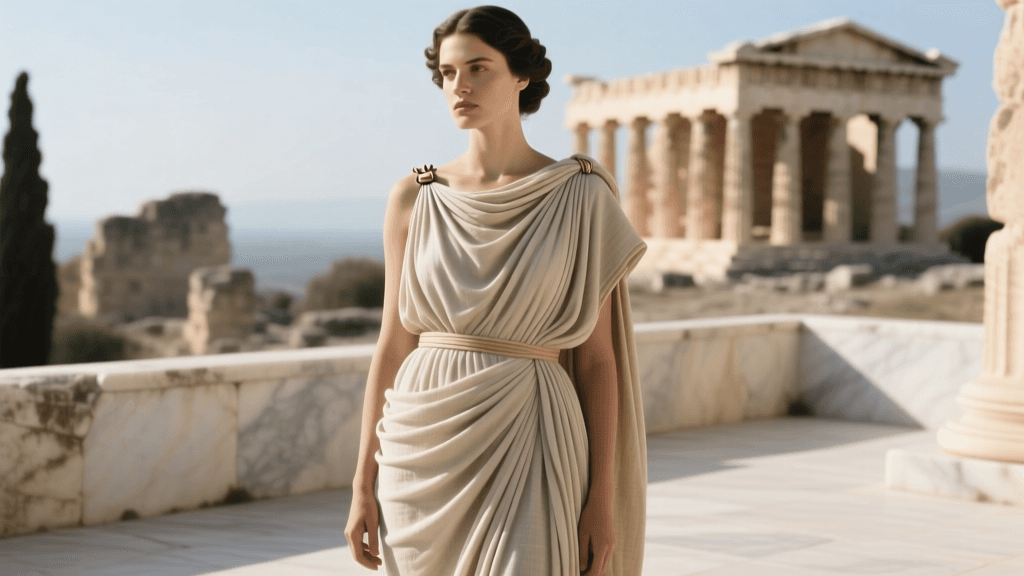
The Ionic chiton, which gained prominence later and was favored in warmer climates, was constructed from much lighter, finely woven linen or even silk for the ultra-wealthy. It lacked the heavy overfold of the Doric style and instead featured multiple fastening points along the upper arms, creating a series of elegant, sleeve-like drapes. According to the World History Encyclopedia's comprehensive guide on Greek Dress, the Ionic chiton's intricate pinning allowed for a wider range of stylistic expression and was often belted high under the bust to create a bloused effect known as a kolpos.
The Roman Stola and Toga: Symbols of Status
While the Greeks favored the chiton, Roman society developed a highly codified dress system where garments served as immediate visual indicators of citizenship, gender, and social rank. The toga was the undisputed symbol of Roman male citizenship, but it was notoriously difficult to drape and maintain. For Roman women, however, the stola was the ultimate marker of respectability and marital status.
The stola was a long, sleeveless overdress worn over a basic tunic (the Roman equivalent of the Greek chiton). It was suspended from the shoulders by small straps or brooches and featured a distinctive instita—a flounce or border at the hem. Crucially, the stola was paired with a vitta, a woolen headband that bound the hair, signaling a woman's virtue and legal standing as a matron. As detailed in the extensive archives on Roman Clothing, the stola was strictly reserved for married citizen women; wearing one without the proper social standing was a severe cultural taboo.
2026 Fabric Sourcing: Authenticity Meets Sustainability
As we navigate the textile landscape of 2026, the demand for historically accurate, sustainably produced fabrics has peaked. Modern synthetic blends or heavily processed cottons will completely ruin the drape of a classical garment. To achieve an authentic silhouette, you must source natural fibers with the correct weight and weave structure.
- For the Doric Chiton (Wool): Look for lightweight, open-weave Merino or Shetland wool. In 2026, traceable, regenerative wool farms in New Zealand and the UK offer undyed, naturally shed wool fabrics that mimic the ancient tabby weave perfectly. Aim for a fabric weight of 150-200 GSM (grams per square meter).
- For the Ionic Chiton & Roman Stola (Linen): Seek out 100% European flax linen with a visible 'slub' texture. Avoid chemically softened or laser-cut linens. The best historical reenactment suppliers in 2026 provide OEKO-TEX certified, loom-state linen that softens beautifully after the first wash while retaining the structural stiffness needed for sharp pleats.
Garment Comparison Chart
| Garment | Primary Fabric | Fastening Method | Key Characteristics |
|---|---|---|---|
| Doric Chiton (Peplos) | Lightweight Wool | Single or double heavy fibulae at shoulders | Features an apoptygma (overfold); open on the left side. |
| Ionic Chiton | Fine Linen or Silk | Multiple small pins or buttons along the arms | Creates a sleeve effect; often belted to form a kolpos (blouse). |
| Roman Stola | Linen or Fine Wool | Shoulder straps or small clasps | Worn over a tunic; features an instita (hem flounce) and paired with a vitta. |
| Roman Toga | Heavy White Wool | Draped entirely (no pins) | Semi-circular cut; highly complex draping reserved for male citizens. |
Step-by-Step Draping Guide: The Doric Chiton
Draping a classical garment requires precision in your initial measurements. Do not cut your fabric to arbitrary lengths; base your cuts on your own body proportions to ensure the hem falls correctly.
Step 1: Calculate Your Measurements
To create a standard Doric chiton, you need a single rectangle of fabric.
Width: Measure your wingspan (fingertip to fingertip with arms outstretched) and add 12 inches for ease and folding.
Height: Measure from your shoulder to your ankle, then add 12 inches to account for the apoptygma (the top overfold) and the kolpos (the blousing over the belt).
Step 2: Create the Overfold
Lay the fabric flat. Fold the top edge down by about 12 inches. This folded section will rest against your chest and upper back, providing structure and modesty.
Step 3: Pin the Shoulders
Wrap the fabric around your body so the open edge falls on your left side (the historical standard). Gather the top layer and the back layer at your right shoulder and secure them with a bronze penannular fibula. Repeat on the left shoulder. Ensure the pins are spaced evenly to allow the neckline to drape naturally.
Step 4: Belt and Blouse
Tie a woven wool or leather cord around your waist. Pull the fabric above the belt up and over the belt itself until the hem grazes your ankles. This creates the kolpos, a hallmark of classical Greek styling that allows for adjustable length and a graceful, voluminous silhouette.
Hardware, Fibulae, and Footwear
No classical garment is complete without the proper hardware. In 2026, museum-quality replica hardware is more accessible than ever, but you must avoid cheap, mass-produced zinc alloys. Invest in cast bronze or hand-forged iron fibulae. The penannular brooch (a ring with a small gap and a sliding pin) is the most historically accurate choice for securing heavy wool chitons. For the delicate linen of an Ionic chiton, small rosette-shaped pins or even fabric ties are more appropriate to prevent tearing the warp threads.
Footwear is equally critical. The classical Greek krepis (a leather sandal with a woven thong wrapped around the calf) and the Roman calceus (a fully enclosed leather shoe for outdoor civic wear) ground the outfit. Current 2026 pricing for bespoke, historically lasted leather sandals from artisan cobblers ranges from $180 to $350, a worthwhile investment for serious reenactors.
Conclusion
Mastering the drape of the Greek chiton and the Roman stola is an exercise in understanding the geometry of cloth and the social fabric of the ancient Mediterranean. By sourcing sustainable, historically accurate textiles and utilizing precise mathematical proportions, you can recreate these magnificent garments with striking authenticity. Whether you are stepping onto a reenactment field or curating a classical fashion editorial, the principles of ancient draping remain as powerful and relevant in 2026 as they were in the agoras of Athens and the forums of Rome.