Doric Chiton Draping Guide: 2026 Historical Reenactment
The 2026 Revival of Ancient Mediterranean Textiles
The landscape of European living history and heritage festivals has evolved significantly by 2026. As reenactment groups, museum educators, and Hellenic cultural organizations adopt stricter authenticity standards, the demand for historically accurate ancient Mediterranean garments has never been higher. At the forefront of this revival is the chiton, the foundational garment of ancient Greek dress, alongside its Roman counterparts, the tunica and stola. Whether you are preparing for the 2026 Athens & Epidaurus Festival, participating in a university classics symposium, or engaging in high-tier historical reenactment, mastering the geometry, draping, and material culture of the chiton is essential. This comprehensive guide explores the structural differences between the Doric and Ionic styles, provides exact mathematical formulas for cutting and draping, and outlines where to source authentic textiles in today’s market.
Understanding the Chiton: Doric vs. Ionic
The chiton was not a single, static garment, but rather a versatile textile tradition that evolved over centuries. According to the World History Encyclopedia, the transition from the heavier Doric peplos to the lighter Ionic chiton reflected not just changing aesthetic fashions, but shifting trade routes and the increased availability of imported flax and silk. To accurately reconstruct these garments for 2026 living history events, one must first understand their structural divergence.
| Feature | Doric Chiton (Peplos) | Ionic Chiton |
|---|---|---|
| Era of Prominence | Archaic to Early Classical | Classical to Hellenistic |
| Primary Fabric | Heavy, fulled Wool | Lightweight Linen or Silk |
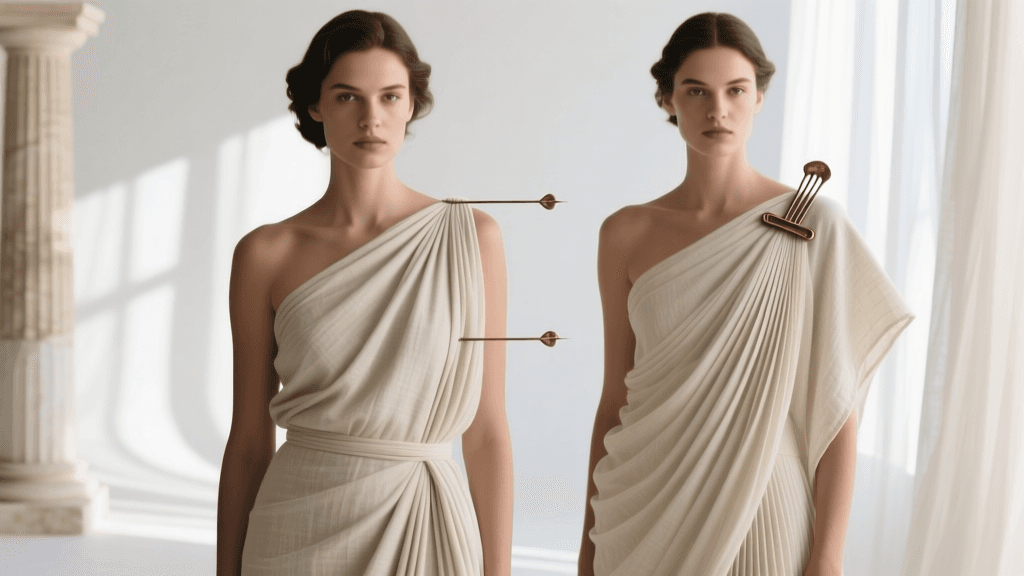
| Fastening Method | Large peronai (pins) at shoulders | Multiple small fibulae or buttons |
| Sleeve Formation | None (cap-like drape) | Elbow or wrist-length sleeves |
| Overfold (Apoptygma) | Pronounced, often pinned | Absent or minimal |
Sourcing Authentic Materials in 2026
The most common mistake modern reenactors make is utilizing the wrong fabric weight. The drape of a chiton is entirely dependent on the mass and weave of the textile. For the Doric chiton (or peplos), you require a heavy, fulled wool. In 2026, heritage weaving mills in the UK and Scandinavia produce excellent tabby-weave wools in the 250 to 300 GSM (grams per square meter) range, which provide the necessary structural rigidity for the iconic apoptygma (overfold).
Conversely, the Ionic chiton demands fluidity. You must source lightweight, tightly woven linen or, for elite Hellenistic portrayals, raw silk. The 2026 European Living History Federation guidelines strongly recommend medium-weight linens (150-180 GSM) that have been enzyme-washed or traditionally beetled to soften the drape. Avoid modern, heavily sized linens that stiffen the fabric and ruin the classical silhouette. When purchasing, always request unbleached or naturally dyed yardage. Natural dyes have seen a massive resurgence this year; weld is highly prized for achieving classical saffron yellows, while madder root provides the deep reds seen in Pompeian frescoes. Synthetic aniline dyes are strictly prohibited in high-authenticity encampments.
The Mathematics of the Apotygma and Kolpos
Unlike modern tailored clothing, the chiton relies on zero-waste rectangular geometry. The Metropolitan Museum of Art notes that the fundamental geometry of the chiton remained a masterclass in zero-waste garment construction, utilizing the entire width of the loom without cutting. To calculate the exact dimensions for your fabric, use the following 2026 standard formulas:
- Width Calculation: Measure the wearer's shoulder circumference. Add the desired depth of the sleeve (typically 8 to 12 inches per side for an Ionic chiton). Multiply this total by two. For a Doric chiton, the width is generally twice the wearer's total arm span to allow for deep, sculptural folds.
- Height Calculation: Measure from the hollow of the neck to the floor. To this, add the depth of the apoptygma (the overfold at the chest), which is traditionally 18 to 24 inches. Finally, add an additional 6 to 8 inches to allow for the kolpos—the bloused effect created when the garment is belted.
- Hemming and Finishing: While the side seams can be left open or sewn shut depending on the specific regional variant, the top and bottom edges must be finished. For 2026 authenticity standards, machine-stitched hems must be hidden or replaced with hand-rolled whipstitches using waxed linen thread.
Draping Techniques: The Zone and the Fibulae
The art of the chiton lies in the draping. Once the rectangular fabric is prepared, it is folded in half horizontally. The top edge is then folded down to create the apoptygma. The garment is pinned at the shoulders using fibulae (brooches) or peronai (straight pins). For the Doric peplos, a single, large, ornate pin at each shoulder is historically accurate. For the Ionic chiton, multiple smaller fibulae or even sewn buttons are used along the upper arm to create a false sleeve.
The zone (girdle) is tied around the waist or under the bust. The critical step is the creation of the kolpos: the wearer must pull the fabric up and over the belt, allowing it to blouse outward. This not only hides the belt but adjusts the hemline to the correct ankle length and provides freedom of movement. In 2026, many theatrical costumers use hidden internal cotton tapes to secure the kolpos, but for strict historical accuracy, the friction of the wool or linen against the woven tablet-woven belt is sufficient to hold the drape in place throughout a day of festival activities.
When venturing outdoors or participating in evening symposiums, the chiton was often paired with a himation—a heavy woolen cloak draped diagonally across the body. The himation requires an entirely separate drape, usually measuring at least 4 yards in length, and is held in place purely by gravity and the weight of the fabric, without the use of pins.
Roman Adaptations: The Tunica and Stola
While the Greek chiton influenced Mediterranean fashion, the Roman Empire developed its own distinct sartorial identity. The basic Roman tunica was structurally similar to the Ionic chiton but was typically woven to shape rather than cut from a larger bolt, featuring a narrower profile. For Roman matrons, the stola was the defining garment of 2026 reenactment portrayals. Worn over the tunica, the stola was suspended by shoulder straps (anadesma) and featured a distinctive border called the instita.
When reconstructing Roman garments this year, pay special attention to the clavus—the purple stripe denoting social rank. With genuine Tyrian purple remaining inaccessible, the 2026 consensus among textile historians is to use a double-dye process of madder root and indigo to achieve the deep, colorfast violet required for senatorial and equestrian rank portrayals. The precise width of the clavus (the latus clavus for senators and the angustus clavus for equestrians) must be strictly adhered to, as modern living history judges heavily scrutinize these details.
Conclusion
Reconstructing the chiton, tunica, and stola requires a departure from modern pattern-making and an embrace of ancient geometric draping. By sourcing the correct GSM textiles, applying precise mathematical formulas for the apoptygma, and utilizing historically accurate fibulae, you can achieve a silhouette that honors the classical world. As the 2026 heritage festival season approaches, these techniques will ensure your garments are not merely costumes, but accurate, living continuations of Europe’s oldest and most influential textile traditions.