Doric vs Ionic Chiton Reconstruction & Draping Guide 2026
The Foundations of Classical European Garments
When tracing the lineage of European folk dress and historical textiles, all roads eventually lead back to the classical antiquity of the Mediterranean. The chiton, a foundational garment of ancient Greece and later adapted by the Romans, remains one of the most iconic and structurally fascinating pieces of historical clothing. As we navigate the historical costuming and reenactment landscape of 2026, the demand for museum-quality accuracy has never been higher. Modern enthusiasts, theatrical costumers, and living history practitioners are moving away from the simplistic, Hollywood-style 'toga' stereotypes and embracing the complex, mathematical beauty of authentic draping.
This comprehensive guide explores the structural differences between the two primary variants of the Greek chiton—the Doric and the Ionic—while providing actionable, up-to-date advice on fabric sourcing, measurement ratios, and accessory integration for your 2026 reconstruction projects.
The Doric Chiton: Structure, Weight, and the Apoptygma
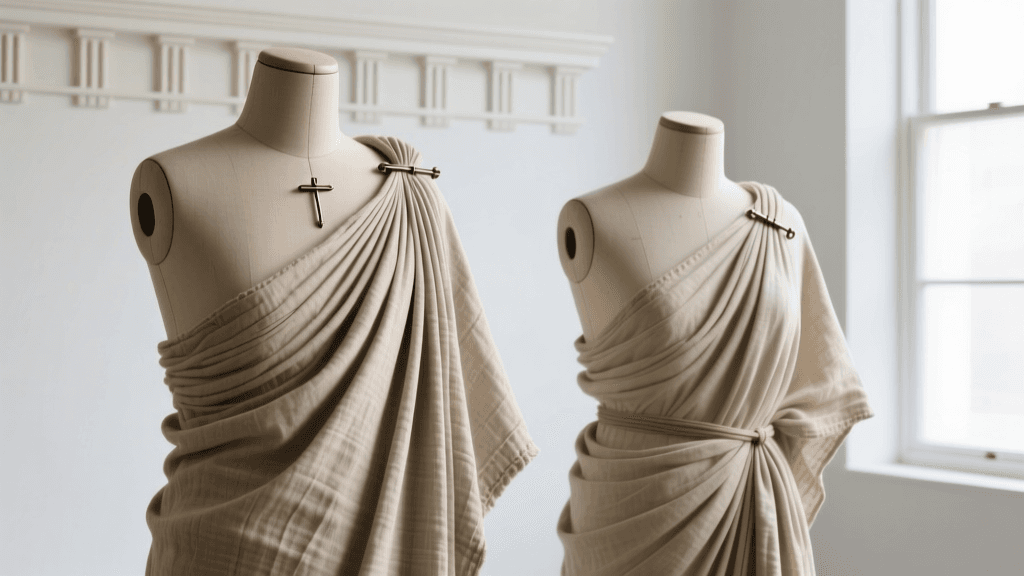
The Doric chiton (often associated with the heavier peplos) is the older and more austere of the two styles. Originating in the mountainous, rugged regions of the Peloponnese, it was designed to provide warmth and structure. Historically, the Doric chiton was constructed from a single, large rectangular piece of heavy wool or densely woven linen.
The defining feature of the Doric style is the apoptygma—an overfold created by folding the top edge of the fabric down to the waistline before draping. This overfold not only provided an extra layer of insulation across the torso but also created a visually striking, structured silhouette. According to the Metropolitan Museum of Art's Heilbrunn Timeline of Art History, the heavy, columnar folds of the Doric garment heavily influenced the architectural fluting seen in Doric columns, demonstrating the profound intersection of textile and stone in classical design.
In 2026, reconstructing a Doric chiton requires a departure from modern, lightweight fabrics. Reenactors are increasingly turning to heritage European wool mills that have revived ancient, coarse spinning techniques to replicate the 250-300 GSM (grams per square meter) textiles required to make the apoptygma hang correctly without looking flimsy.
The Ionic Chiton: Lighter Linens and Sewn Seams
As trade routes expanded and Greek culture interacted more deeply with the East, the Ionic chiton emerged. Lighter, more fluid, and infinitely more complex in its draping, the Ionic style was typically made from fine, sheer linen or imported silk. Unlike the Doric chiton, the Ionic variant often featured sewn side seams, transforming the fabric from a simple wrap into a cylindrical tube.
The true genius of the Ionic chiton lies in its sleeve construction. Rather than being pinned at a single point on each shoulder, the top edges of the fabric were pinned at multiple intervals along the arm, creating a series of delicate, flowing sleeves. The World History Encyclopedia notes that these sleeves were never cut or sewn; they were entirely engineered through the strategic placement of small brooches or knots, allowing the wearer to adjust the fit and ventilation based on the Mediterranean climate.
For modern costumers, the Ionic chiton presents a delightful challenge. Mastering the kolpos—the blousing effect created by pulling the fabric up through a belt (zona)—requires a deep understanding of fabric drape and gravity. In 2026, costumers are using 120-140 GSM wet-spun linen to achieve the translucent, cascading folds depicted in classical marble sculpture.
Roman Adaptations: The Tunica and Stola
As Roman culture absorbed and adapted Greek traditions, the chiton evolved into the Roman tunica for men and the stola for women. While the basic rectangular geometry remained, the Romans introduced distinct social signaling through the clavus—woven vertical stripes indicating the wearer's political and social rank. A broad purple stripe (latus clavus) denoted a senator, while a narrow stripe (angustus clavus) indicated an equestrian.
When reconstructing Roman garments today, it is vital to remember that the tunica was not merely an undergarment; for the working classes and soldiers, it was the primary outerwear. Modern historical groups in 2026 are placing a heavy emphasis on the correct length of the Roman tunica, which for active men should fall just above the knees, allowing for unrestricted movement.
2026 Fabric Sourcing and Natural Dyeing Techniques
The success of any historical reconstruction hinges on the textile. The global supply chain shifts of the mid-2020s have actually benefited historical costumers, as smaller, artisanal weaving cooperatives in Belgium, Ireland, and Greece have gained international reach, offering historically accurate, shuttle-woven linens and wools.
When sourcing fabric for your chiton, consider the following 2026 standards for historical accuracy:
- Doric Weight Linen/Wool: Look for unbleached, half-bleached, or naturally pigmented flax. A slubby, irregular weave is highly desirable, as ancient looms could not produce the perfectly uniform threads of modern industrial mills.
- Ionic Weight Linen: Seek out 'handkerchief weight' or 'sheer' linen. If you cannot find historically accurate sheer linen, a high-quality, tightly woven cambric can serve as a modern substitute, provided it is pre-washed to soften the drape.
- Natural Dyes: The 2026 resurgence in bio-mordanting has made natural dyes more accessible than ever. Use madder root for deep terracotta reds, weld for vibrant yellows, and woad for authentic indigo blues. Avoid synthetic aniline dyes, which reflect light in a way that instantly breaks the historical illusion on camera and in person.
The Mathematics of the Drape: Measurements and Ratios
A common mistake among beginners is cutting the fabric to modern body measurements. The chiton is not tailored; it is draped. The fabric must be significantly wider than the wearer's body to allow for the deep, cascading folds that characterize classical art.
Width Calculation: For an authentic Doric chiton, the width of the fabric rectangle should be at least 1.5 times the distance between your outstretched elbows (your wingspan). For an Ionic chiton with multiple sleeve pins, the width should be 2 to 2.5 times your wingspan. This excess fabric is what creates the beautiful, vertical pleats when the garment is belted.
Height Calculation: Measure from the floor to your shoulder, then add 15 to 20 centimeters to account for the kolpos (the blousing over the belt). If you are constructing a Doric chiton, you must add an additional 30 to 40 centimeters to the top edge to create the apoptygma overfold.
Fastening the Garment: Fibulae and Zonae
No chiton is complete without its hardware. The fibula (brooch) and the zona (belt) are not mere accessories; they are the structural engineering that holds the garment together.
For the Doric chiton, large, heavy bronze or iron omega-shaped pins or simple straight pins with decorative heads are used to secure the thick layers of the apoptygma at the shoulders. In 2026, artisan blacksmiths and bronze casters on specialized historical marketplaces offer museum-grade replicas based on archaeological finds from the Acropolis.
The Ionic chiton requires smaller, more numerous fasteners. Tiny rosette pins or simple fabric knots were historically used along the arms. The zona, typically a woven wool or leather cord, is tied tightly around the natural waist or just under the bust, allowing the wearer to pull the fabric up to the desired length and create the signature bloused effect.
Comparison Chart: Doric vs. Ionic Chiton
| Feature | Doric Chiton | Ionic Chiton |
|---|---|---|
| Primary Era | Archaic to Early Classical (c. 600–450 BCE) | Classical to Hellenistic (c. 450–31 BCE) |
| Standard Fabric | Heavy Wool, Dense Linen | Fine Sheer Linen, Silk |
| Side Seams | Open (wrapped and pinned) | Often sewn closed |
| Shoulder Fastening | Single large pin (fibula) per shoulder | Multiple small pins or knots creating a sleeve |
| Overfold (Apoptygma) | Yes, deep and structured | Rare or very shallow |
| Drape Profile | Columnar, heavy, geometric | Fluid, translucent, cascading |
Outerwear and Footwear: Completing the Silhouette
The chiton was rarely worn entirely alone in public. To complete your 2026 historical impression, you must incorporate appropriate outerwear. The himation was a large, heavy rectangular cloak worn by both men and women, draped diagonally across the body and over one shoulder. For men engaged in military or active pursuits, the chlamys—a shorter, woolen cloak fastened at the right shoulder with a large brooch—was the standard.
Footwear should consist of krepides (leather sandals with intricate strapping up the calf) or simple leather turnshoes for colder climates. Ensure that all leather is vegetable-tanned and dyed with natural pigments, as chrome-tanned leathers possess an artificial sheen that ruins the historical aesthetic.
Conclusion: Embracing the Art of the Drape
Reconstructing the ancient chiton is an exercise in geometry, material science, and historical empathy. Whether you are drawn to the austere, architectural lines of the Doric peplos-style chiton or the fluid, wind-swept elegance of the Ionic variant, the key to success lies in respecting the original proportions and materials. By utilizing heritage textiles, mastering the mathematics of the drape, and sourcing accurate bronze hardware, modern costumers and reenactors in 2026 are keeping the textile traditions of classical Europe alive with unprecedented authenticity.