Chiton Draping Guide 2026: Doric vs Ionic Greek Garments
The Resurgence of Classical Antiquity in 2026
As we navigate the historical reenactment and slow fashion landscape of 2026, the ancient Greek chiton remains a cornerstone of European textile studies and classical wardrobe reconstruction. Far from being a simple bedsheet wrapped around the body, the chiton is a masterclass in zero-waste garment construction, relying entirely on draping, folding, and strategic pinning rather than cutting and sewing. According to The Metropolitan Museum of Art's Heilbrunn Timeline of Art History, the elegance of ancient Greek dress lay in its fluid relationship with the human form, a concept that modern sustainable fashion designers and historical interpreters are heavily revisiting this year.
Whether you are preparing for a Hellenic festival, designing for a theatrical production, or simply integrating classical silhouettes into a contemporary zero-waste wardrobe, understanding the structural differences between the Doric and Ionic chiton is essential. This comprehensive 2026 guide will walk you through fabric sourcing, precise measurements, and the step-by-step draping techniques required to master these iconic garments.
Doric vs. Ionic Chiton: A Structural Comparison
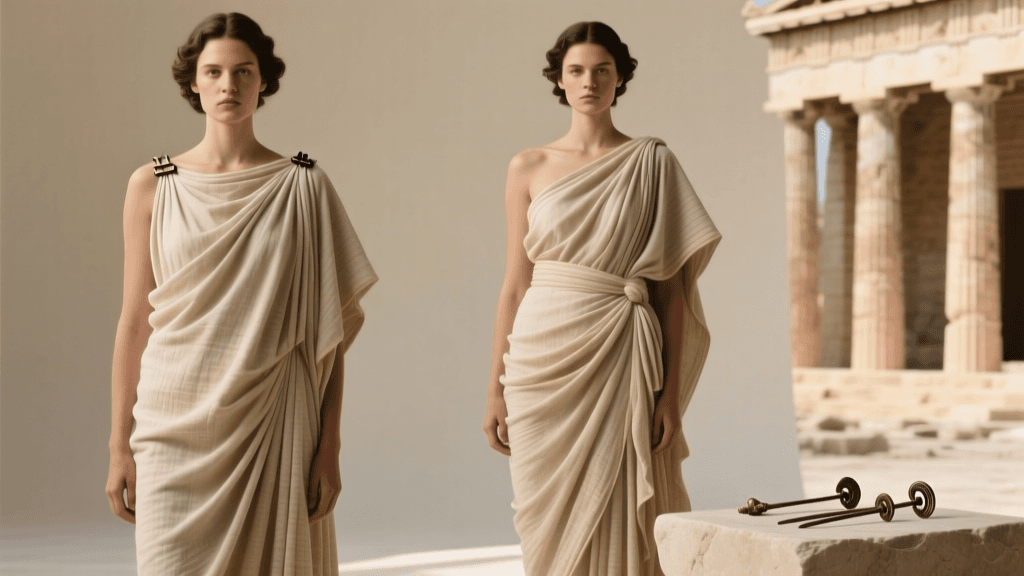
While both garments serve the same fundamental purpose, their construction, fabric weight, and draping methodologies differ significantly. The Doric chiton (often associated with the heavier peplos) and the Ionic chiton represent two distinct regional and temporal approaches to classical dress.
| Feature | Doric Chiton | Ionic Chiton |
|---|---|---|
| Primary Fabric | Heavyweight linen or wool | Lightweight linen, silk, or fine cotton |
| Silhouette | Structured, columnar, with a deep overfold | Fluid, voluminous, with flowing sleeves |
| Fastening | Pinned at one or both shoulders (fibulae) | Buttoned or pinned along the entire arm |
| Overfold (Apoptygma) | Prominent and structural | Rarely used, or very shallow |
| Historical Peak | Archaic to Early Classical (c. 600–450 BCE) | Classical to Hellenistic (c. 450–30 BCE) |
As noted by the World History Encyclopedia, the transition from the heavier Doric styles to the lighter, more elaborate Ionic styles reflected not only changing aesthetic preferences but also the expansion of Greek trade networks, which brought finer, more translucent textiles into the Mediterranean market.
Sourcing Authentic Textiles for Historical Accuracy
In 2026, the European flax cooperatives have released exceptional heritage-weave linens that closely mimic the warp and weft of antiquity. When sourcing fabric for your chiton, avoid modern synthetic blends. The drape of polyester or poly-blend fabrics will ruin the classical silhouette, causing the garment to cling awkwardly rather than cascading in natural, sculptural folds.
Fabric Weight Guide
- For the Doric Chiton: Source a medium-to-heavyweight linen (7 to 9 oz per square yard). This weight is necessary to hold the deep folds of the apoptygma (overfold) and to ensure the garment hangs with architectural precision.
- For the Ionic Chiton: Opt for a lightweight, semi-sheer linen or a linen-silk blend (3.5 to 5 oz per square yard). The lighter fabric allows for the intricate gathering and multiple pinning points required to create the characteristic Ionic sleeves.
Always pre-wash and press your linen before draping. Modern reenactment standards in 2026 strictly require pre-shrunk textiles to ensure that the hemline does not shift after the garment's first wash.
Step-by-Step Draping: The Doric Chiton
The Doric chiton is defined by its simplicity and its striking overfold. It is typically worn by women in a full-length style, while men historically wore a shorter, knee-length version for mobility.
Measurements and Cutting
Because the chiton is a zero-waste garment, you will not be cutting complex patterns. Instead, you will work with a single rectangular piece of fabric. Width: Measure your chest circumference and add 12 to 18 inches for ease and gathering. Height: Measure from your shoulder to the floor (or knee, for men), and add 12 to 15 inches to accommodate the kolpos (the bloused overhang created by the belt) and the apoptygma.
The Draping Process
- Create the Apoptygma: Fold the top edge of the fabric down by 10 to 12 inches. This creates the double-layered overfold that provides structure to the bodice.
- Wrap the Body: Wrap the fabric around your body, ensuring the folded edge is at the top. The open edge of the fabric should fall along your left side.
- Pin the Shoulders: Gather the front and back layers (including the overfold) at your right shoulder and fasten them securely with a bronze fibula (brooch). Repeat on the left shoulder, leaving enough space in the center for your head to pass through.
- Belt and Blouse: Tie a woven wool or linen cord (the zone) around your waist. Pull the fabric up and over the belt to create the kolpos, adjusting the overhang so that it falls elegantly and obscures the belt entirely.
Step-by-Step Draping: The Ionic Chiton
The Ionic chiton is wider, lighter, and far more complex in its fastening. It abandons the heavy overfold in favor of voluminous sleeves created by pinning the fabric at intervals along the arm.
Measurements and Cutting
The width of an Ionic chiton is significantly greater than the Doric. You will need a rectangle of fabric that is at least twice your wingspan (fingertip to fingertip with arms outstretched). The height should be your shoulder-to-floor measurement plus 8 inches for the kolpos.
The Draping Process
- Wrap and Secure the Side: Wrap the wide fabric around your body. The open edge should fall on your left side. Stitch or pin the open edge closed from the hem up to the waist, leaving the armhole open.
- Pin the Shoulders and Arms: Instead of a single pin at the shoulder, the Ionic chiton uses multiple pins. Pinch the front and back layers together at the right shoulder, then continue pinching and pinning at 3-inch intervals down the length of your arm to the elbow or wrist. This creates a beautiful, flowing sleeve. Repeat on the left side.
- Adjust the Neckline: The multiple pins create a wide, draped neckline. Adjust the gathers so the fabric sits comfortably across the collarbones.
- Belting: Cinch the waist with a thin leather or braided linen belt. As with the Doric style, pull the fabric up to create a graceful kolpos overhang.
Fastening and Accessories: Fibulae and the Himation
No chiton is complete without its accompanying accessories. The fibula is not merely a decorative element; it is the structural anchor of the garment. In 2026, museum-grade replica foundries offer highly accurate bronze and silver annular and bow fibulae. Avoid modern safety pins for public reenactments, as they break the historical illusion and can damage delicate heritage linens.
Furthermore, the chiton was rarely worn alone in public. It was typically layered with a himation (a large rectangular cloak). According to primary texts archived in the Perseus Digital Library at Tufts University, the draping of the himation was a mark of social status and rhetorical skill; a well-draped cloak that allowed for expressive gesturing without exposing the body was considered the height of classical elegance. To drape a himation, throw one end over your left shoulder, wrap the bulk of the fabric across your back, under your right arm, and toss the remaining end back over your left shoulder or arm.
Garment Care and Maintenance in 2026
Maintaining historical garments requires specific care to preserve the textile's integrity. Modern enzyme-based detergents can degrade natural linen fibers over time. When washing your chiton, use a pH-neutral, plant-based soap designed for delicate natural fibers. Never tumble dry your linen; instead, lay it flat or hang it in the shade while damp. The natural weight of the water will help pull the wrinkles from the fabric, mimicking the ancient practice of stretching textiles on wooden frames in the sun.
Conclusion
The chiton is a testament to the ingenuity of ancient European textile traditions. By mastering the distinct draping techniques of the Doric and Ionic styles, you are not just putting on a costume; you are participating in a living history of zero-waste design, geometric precision, and classical aesthetics. Whether you are sourcing heavy heritage linens for a structured Doric peplos or fine silks for a flowing Ionic tunic, the principles of classical draping remain as relevant and beautiful in 2026 as they were in the agoras of ancient Athens.