Authentic Doric Chiton & Roman Toga Guide for 2026
The Resurgence of Classical Garments in 2026
The year 2026 has seen an unprecedented renaissance in historical textile reconstruction, particularly within the realm of ancient Mediterranean and European folk dress. As experimental archaeology and historical reenactment communities grow more sophisticated, the demand for accurate, historically grounded garments has skyrocketed. Gone are the days of relying on theatrical stereotypes or simplified costume patterns. Today’s reconstructionists, classicists, and theater costumers demand precision, utilizing recent 2026 archaeological textile analyses to understand the exact drape, weight, and weave of ancient fabrics. Whether you are preparing for the 2026 Mediterranean Heritage Festival or outfitting a university classical theater production, understanding the structural nuances of the Greek chiton and the Roman toga is essential.
This comprehensive guide breaks down the construction, sourcing, and draping techniques for the foundational garments of antiquity, ensuring your historical wardrobe meets the rigorous standards of the modern reenactment community.
Decoding the Greek Chiton: Doric vs. Ionic Variations
The chiton was the quintessential garment of ancient Greece, worn by both men and women. However, it was not a monolithic design. The two primary variations—the Doric and the Ionic—differed significantly in material, construction, and draping style. According to World History Encyclopedia, the evolution of these garments reflects broader shifts in Greek trade, culture, and textile technology.
The Doric Chiton (Peplos)
The Doric chiton, often associated with the heavier woolen peplos, was the older and more traditional style. It was typically crafted from a single large rectangular piece of heavyweight wool. The defining feature of the Doric style is the apoptygma—a deep fold-over at the top of the garment that draped over the chest and back. This fold was secured at the shoulders using large, ornate straight pins or fibulae. In 2026, authentic reconstruction requires sourcing wool with a high lanolin content and a loose tabby weave to replicate the heavy, structured drape seen in classical marble statuary. The sides were often left open or loosely sewn, allowing for freedom of movement and a distinctive fluttering effect in the wind.
The Ionic Chiton
Introduced later and heavily influenced by Eastern Mediterranean and Asian Minor trade routes, the Ionic chiton was made from much lighter, finely woven linen or thin silk. Unlike the Doric version, the Ionic chiton was wider and featured multiple fastening points along the arms, creating the illusion of short sleeves. Instead of heavy pins, the shoulder seams were often sewn or secured with small, delicate buttons or brooches. The lighter fabric allowed for intricate pleating, a hallmark of high-status Ionic dress. Modern reconstructions of the Ionic chiton often utilize hand-loomed European linen, which in 2026 costs approximately €35 to €50 per meter for museum-grade historical accuracy.
The Roman Toga: Engineering a Status Symbol
Pop culture has long misrepresented the Roman toga as a simple bedsheet wrapped around the body. In reality, the toga was a complex, highly engineered semi-circular garment that served as the ultimate marker of Roman citizenship and social status. As detailed by The Metropolitan Museum of Art, the toga's evolution from a simple woolen wrap to a massive, cumbersome status symbol mirrors the political shifts of the Roman Republic and Empire.
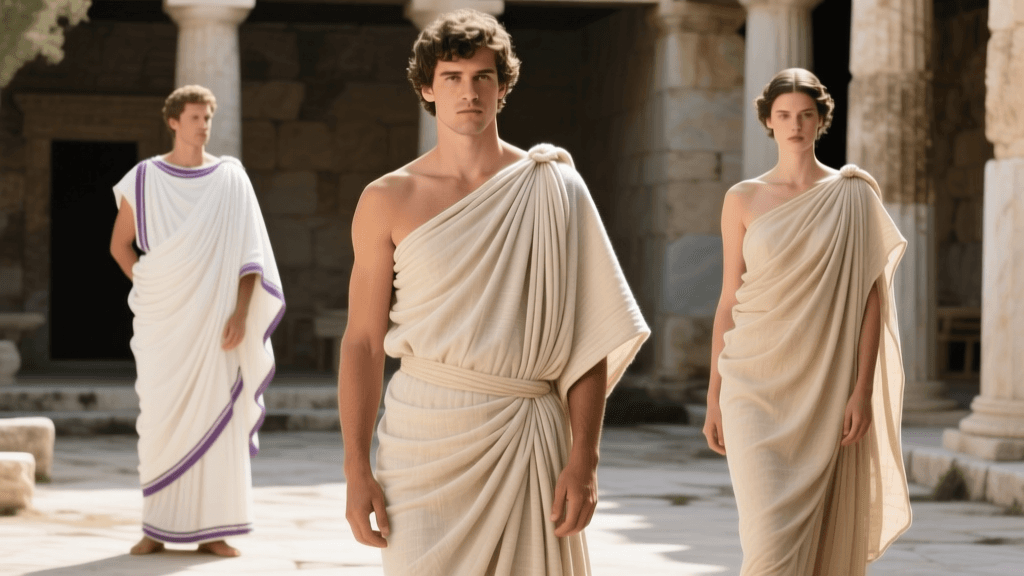
By the Imperial period, the toga was an enormous semi-circle of white wool, measuring up to 18 to 20 feet in length and 10 to 12 feet in width. Draping it correctly required the assistance of a slave and a deep understanding of its structural folds. The two most critical features of the imperial toga are the sinus (a deep, pouch-like fold across the chest that could be used to carry small items) and the umbo (a decorative knob of fabric pulled up from the sinus to anchor the heavy drapes over the left shoulder). In 2026, historical tailors use lightweight, heavily fulled wool flannel to replicate the toga's massive volume without causing the wearer to suffer from heat exhaustion during summer reenactment events.
The Stola and Palla: Dress of the Roman Matron
While the toga was strictly reserved for male citizens (with the tragic exception of women exiled for adultery), the respectable Roman matron wore the stola. The stola was a long, sleeveless, or short-sleeved tunic worn over the tunica intima (undergarment). It was characterized by the instita, a contrasting colored band or flounce sewn along the lower hem, which signaled the wearer's modesty and high social standing.
Over the stola, women draped the palla, a large rectangular mantle that could be pulled over the head when outdoors. The palla functioned similarly to the Greek himation and was secured with brooches or simply held in place by the friction of the woolen weave. According to World History Encyclopedia, the color of the stola and palla communicated vast amounts of information regarding a woman's wealth, as dyes like Tyrian purple, madder red, and saffron yellow were heavily regulated and highly taxed.
Comparison Chart of Classical Mediterranean Garments
| Garment | Culture | Primary Material | Key Structural Feature | Fastening Method |
|---|---|---|---|---|
| Doric Chiton | Greek | Heavy Wool | Apoptygma (fold-over) | Large straight pins (fibulae) |
| Ionic Chiton | Greek | Fine Linen / Silk | Multiple shoulder pins / sleeves | Sewn seams, small buttons |
| Toga Virilis | Roman | Fulled White Wool | Sinus (pouch) and Umbo (knot) | Friction and tension draping |
| Stola | Roman | Linen or Wool | Instita (hem band) | Shoulder straps (anaxyrides) |
| Palla | Roman | Wool / Linen | Large rectangular mantle | Draped, occasionally pinned |
Sourcing Authentic Materials in 2026
Creating a historically accurate garment in 2026 requires moving away from modern, machine-loomed fabrics. The drape of a chiton or toga relies entirely on the weight and friction of the textile. Modern cotton is entirely inappropriate for these garments, as it lacks the structural memory and historical precedent of wool and linen.
- Wool: Seek out 'fulled' or 'boiled' wool with a high lanolin content. Mills in Italy and Greece have recently revived ancient Roman fulling techniques, using natural clays to clean and thicken the wool, resulting in a fabric that holds the complex folds of a toga without slipping.
- Linen: For the Ionic chiton, source 'slub' linen or hand-loomed linen with an uneven thread count. This mimics the ancient drop-spindle and warp-weighted loom techniques, providing a beautiful, organic texture that catches the light similarly to classical depictions.
- Natural Dyes: The 2026 standard for high-end reenactment strictly forbids synthetic aniline dyes. Utilize madder root for reds, weld for yellows, and woad or indigo for blues. The clavus (the purple stripe on a Roman tunic or toga) should be dyed using a lichen-based orchil or a high-quality madder-indigo over-dye to simulate the prohibitively expensive Tyrian purple.
Step-by-Step: Draping the Doric Chiton
Mastering the drape of the Doric chiton is a fundamental skill for any classical reenactor. Follow these steps to achieve an authentic silhouette:
- Measure the Fabric: Cut a rectangle of heavyweight wool. The width should be equal to your arm span (fingertip to fingertip), and the height should be your full height plus 18 inches for the fold-over and blousing.
- Create the Apoptygma: Fold the top edge of the fabric down by about 12 to 18 inches. This creates the signature chest fold.
- Wrap the Body: Wrap the fabric around your body, starting under the right arm and bringing the edges together over your left shoulder.
- Pin the Shoulders: Gather the front and back layers (including the fold-over) at the shoulders. Secure them with historically accurate bronze or iron fibulae, placing one pin at the edge of the shoulder and another closer to the neck if the fabric is wide.
- Belt and Blouse (Kolpos): Tie a woven wool or leather belt around your waist. Pull the fabric up and over the belt to create the kolpos—a bloused effect that allows the hem to fall at the appropriate length (ankle-length for women, knee-length for men) while hiding the belt entirely beneath the overhang.
Fasteners and Accessories: The Finishing Touches
No ancient garment was complete without its functional accessories. The fibula (brooch) was not merely decorative; it was the structural linchpin of the chiton. In 2026, artisan metalworkers specializing in classical antiquity use lost-wax casting to recreate bronze and silver fibulae based directly on museum artifacts. Ensure your fibulae feature a functional coil spring and a secure catchplate to handle the heavy tension of woolen garments.
Additionally, the zonē (belt) was crucial for managing the volume of fabric. While leather belts were common, woven tablet-woven bands made of brightly dyed wool were highly prized and frequently mentioned in Homeric texts. Investing in a custom tablet-woven belt from a specialist weaver will instantly elevate the historical accuracy of your ensemble.
Conclusion
Reconstructing the garments of ancient Greece and Rome is a profound exercise in material culture. By respecting the engineering of the Roman toga and the elegant simplicity of the Greek chiton, modern enthusiasts can bridge the gap between antiquity and the present day. As we move through 2026, the commitment to authentic textiles, natural dyes, and precise draping techniques ensures that the legacy of European folk and classical dress continues to be honored with the dignity and accuracy it deserves.