Ancient Greek Chiton & Roman Toga Guide 2026: Drape & Wear
Introduction to Classical Antiquity Garments in 2026
The resurgence of interest in classical antiquity has reached new heights in 2026, with European heritage festivals, historical reenactment societies, and avant-garde theater productions embracing the elegant simplicity of Ancient Greek and Roman dress. Unlike the highly tailored and heavily structured garments of later European folk traditions, the foundational clothing of the Mediterranean relied entirely on the art of draping, folding, and pinning. Understanding how to properly construct and wear a chiton or a toga is not merely an exercise in historical costume design; it is a study in textile engineering, body geometry, and ancient cultural identity. This comprehensive guide will walk you through the precise measurements, authentic fabric sourcing, and step-by-step draping techniques required to master the Doric chiton and the Roman toga for modern revival and educational purposes.
The Anatomy of the Ancient Greek Chiton
The chiton was the fundamental garment of ancient Greece, worn by both men and women, though the length and styling varied significantly by gender, age, and social status. According to the World History Encyclopedia, the chiton was essentially a large rectangle of fabric that was folded, pinned at the shoulders, and belted at the waist. Unlike modern clothing, it was rarely cut or sewn into complex shapes, relying instead on the natural drape of the textile to create volume and movement.
Doric vs. Ionic Chiton
There are two primary classifications of the Greek chiton that you must understand before beginning your reconstruction:
- The Doric Chiton (Peplos): Typically made of heavier wool or medium-weight linen, the Doric chiton was folded over at the top to create an overfold called the apoptygma. It was pinned at the shoulders with a single large fibula (brooch) on each side and often left open along the right side seam. This style is most frequently associated with Spartan and early Athenian women.
- The Ionic Chiton: Constructed from much lighter, finer linen or silk, the Ionic chiton was wider and featured multiple small pins or sewn seams along the top edge to create a series of intricate, flowing sleeves. It did not typically feature the heavy apoptygma overfold and was worn with a more relaxed, flowing silhouette.
Step-by-Step Draping Guide for the Doric Chiton
To achieve an authentic silhouette for the 2026 festival season, you must abandon modern tailoring habits and embrace the mathematical precision of ancient folding. Here is how to drape a traditional women's Doric chiton.
Step 1: Sizing the Fabric
The width of your fabric should be equal to your arm span (fingertip to fingertip) plus an additional 12 to 18 inches for ease and blousing. The height of the fabric should be equal to your height from the floor to your shoulder, plus 18 inches for the apoptygma (overfold) and hem allowance.
Step 2: Creating the Apoptygma
Lay the fabric flat on a clean surface. Fold the top edge down by 12 to 18 inches, depending on how deep you want the overfold to rest on your torso. This folded section will hang over the chest and back, providing structural weight and a layered aesthetic.
Step 3: Wrapping the Body
Wrap the fabric around your body, starting from the back and bringing the two front edges together. The garment should be worn with the fold line on the left side of your body, leaving the right side open or loosely tacked. Step into the center of the fabric so it wraps evenly.
Step 4: Pinning the Shoulders
Gather the front and back layers of the fabric at your shoulders. Using authentic bronze or iron replica fibulae (readily available from specialized historical smiths in 2026), pin the layers together approximately two to three inches from the edge of your neck. Ensure the pins are secure, as they bear the entire weight of the garment.
Step 5: Belting and Blousing (Kolpos)
Tie a woven wool or leather belt around your waist over the apoptygma. To create the kolpos—the characteristic bloused effect—pull the fabric up and over the belt until the hem reaches your desired length (usually the ankles for women, knees for men). The overfold should now cascade gracefully over the belt, hiding it entirely and creating a rich, layered hip silhouette.
The Roman Toga and Stola: Transitioning to Rome
While the Greeks favored the practical elegance of the chiton, the Romans elevated draped clothing into a complex marker of civic identity and social hierarchy. As detailed by the Metropolitan Museum of Art's Heilbrunn Timeline, Roman dress was strictly regulated by law and custom, with the toga serving as the ultimate symbol of Roman citizenship.
The Complexity of the Toga
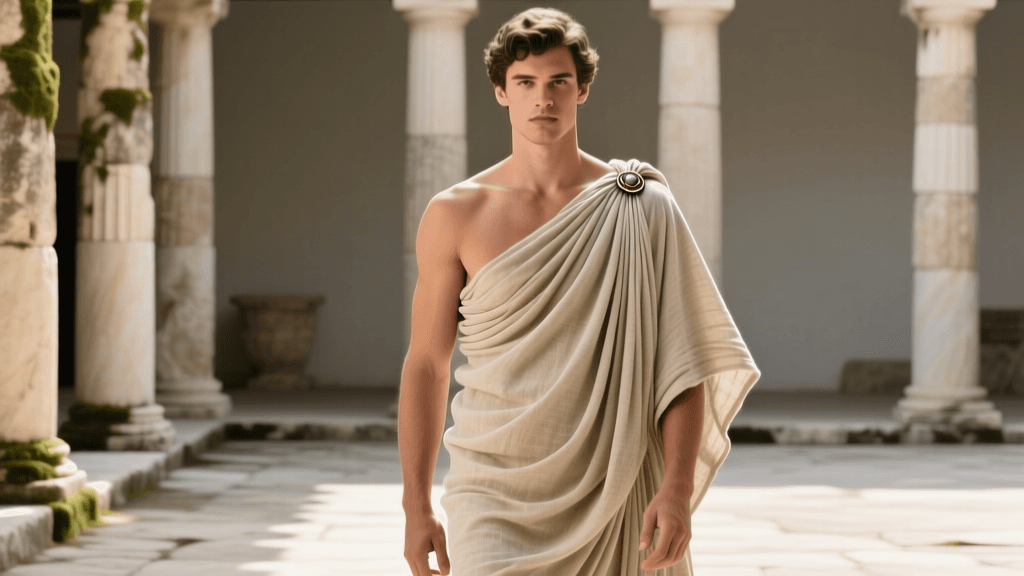
The toga was not a simple half-circle, as is often mistakenly taught in elementary history classes. By the Imperial period, the toga was a massive, elliptical piece of woolen cloth measuring up to 6 meters (20 feet) in length and 2.5 meters (8 feet) in width. Draping a toga was a two-person job, requiring a specialized slave known as a vestipicus to arrange the intricate folds.
The key components of the toga drape include:
- The Balteus: A thick band of folded fabric that crosses the chest diagonally, acting almost like a structural sling to support the massive weight of the wool.
- The Sinus: A deep, curved pocket of fabric that drapes over the right hip and thigh, which could be pulled up over the head during religious ceremonies or used to carry small items.
- The Umbo: A decorative, knob-like fold of fabric pulled from the lower edge and draped over the left shoulder, adding visual weight and securing the back drape.
The Stola: The Garment of the Roman Matron
While citizen men wore the toga, respectable Roman women wore the stola over a basic tunica. The stola was a long, sleeveless dress suspended from the shoulders by small straps or fibulae, characterized by a deep V-neckline and an instita (a decorative flounce or border) at the hem. In 2026, modern textile artisans have found that using a heavily weighted, high-twist linen or a fine merino wool blend provides the most historically accurate drape for the stola, allowing the institia to flare beautifully at the ankles without excessive ironing.
2026 Fabric Sourcing and Authenticity Matrix
Choosing the correct textile is the single most important factor in achieving a historically accurate drape. Modern synthetic blends will cling, bunch, and fail to hold the structured folds required for a toga or the crisp overfold of a Doric chiton. Below is a comparative matrix for sourcing fabrics in the current 2026 market.
| Fabric Type | Historical Accuracy | Drape & Structure | 2026 Avg. Cost (Per Yard) | Best Used For |
|---|---|---|---|---|
| Medium-Weight European Flax Linen | High | Crisp folds, moderate flow | $28 - $45 | Ionic Chiton, Women's Stola |
| Heavyweight Wool Melton | Very High | Excellent structure, heavy drape | $55 - $80 | Roman Toga, Winter Peplos |
| Lightweight Bamboo/Linen Blend | Low (Modern Substitute) | Fluid, soft, lacks memory | $18 - $25 | Theater, Summer Festivals |
| Raw Peace Silk (Ahimsa) | Moderate (Elite only) | Luminous, highly fluid | $60 - $95 | Bridal Revivals, High-End Ionic |
Accessorizing the Classical Look
No classical garment is complete without the appropriate accessories, which served both functional and aesthetic purposes. In 2026, the market for historically accurate replicas has expanded significantly, allowing enthusiasts to avoid cheap, mass-produced costume jewelry in favor of museum-quality reproductions.
Fibulae and Pins
The fibula was the ancient equivalent of the safety pin, but it was also a major status symbol. For a Doric chiton, opt for a large, bow-shaped or tortoise-shaped bronze fibula. For the Ionic chiton, use a series of smaller, matching pins along the shoulder seam. Ensure that the pin mechanisms are functional and sharp enough to pierce multiple layers of heavy linen or wool without bending.
Footwear: Sandals and Calcei
Greek and Roman footwear was distinctly different. The Greeks favored the chiton (sandal) with leather straps wrapping around the ankle, often leaving the toes exposed. The Romans, particularly in formal or civic settings, wore the calceus, a fully enclosed leather shoe that covered the entire foot and was tied with intricate lacing. For modern outdoor festivals, many reenactors opt for custom-molded leather sandals with reinforced rubber soles, blending ancient aesthetics with 2026 podiatric comfort.
Common Mistakes in Modern Reconstructions
Even with the best intentions, modern reconstructions often fall victim to contemporary tailoring biases. The most frequent error is over-sewing. Many modern sewists will stitch the side seams of a chiton or sew the shoulder folds permanently to make the garment easier to put on. This completely destroys the historical integrity of the clothing. The beauty and authenticity of the chiton and toga lie in their impermanence; they were put on fresh every morning, draped anew, and adjusted throughout the day. By sewing the folds, you lose the dynamic movement and the ability to adjust the garment for different weather conditions or physical activities.
Another common mistake is underestimating the weight of the fabric. A toga made from lightweight cotton or modern polyester will look like a bedsheet wrapped haphazardly around the body. The Roman toga required the heavy, fulled wool of antiquity to hold the deep, sculptural folds of the sinus and umbo. If authentic heavy wool is too hot for summer events, consider using a densely woven, heavyweight linen that has been pre-washed to soften its drape while maintaining its structural integrity.
Contemporary Revival: Festivals and Theater
As we move through 2026, the intersection of sustainable fashion and historical reenactment has brought classical garments into a new light. European heritage festivals, particularly those in Italy and Greece, are increasingly demanding high levels of historical accuracy from participants, moving away from the 'Hollywood' versions of antiquity. Furthermore, the Metropolitan Museum of Art's extensive archives on Greek dress continue to inspire modern avant-garde designers, who are integrating the zero-waste, draped methodologies of the chiton into contemporary sustainable fashion lines.
'The genius of ancient Mediterranean dress was not in the cutting of the cloth, but in the mastery of its arrangement upon the human form. To wear a chiton is to engage in a daily, living sculpture.' — Dr. Elena Rostova, Textile Historian, 2026 European Heritage Symposium.
Conclusion
Mastering the Doric chiton and the Roman toga requires patience, an understanding of textile physics, and a willingness to step away from modern sartorial conveniences. By sourcing the correct weight of linen or wool, meticulously executing the apoptygma and sinus folds, and accessorizing with authentic bronze hardware, you can achieve a classical silhouette that is both historically rigorous and visually stunning. Whether you are preparing for a major European heritage festival, a theatrical production, or simply exploring the zero-waste roots of European folk dress, the timeless elegance of antiquity's draped garments remains as powerful in 2026 as it was two millennia ago.