Basque Beret Wool Processing And Traditional Felting Methods France Spain
The Basque Beret: A Woolen Icon Between Mountains and Sea
Perched along the western Pyrenees straddling France and Spain, the Basque Country has sustained one of Europe’s most resilient textile traditions—beret production from locally sourced wool. Unlike mass-produced headwear, authentic Basque berets are still crafted using centuries-old felting methods rooted in pastoral life, where shepherds required durable, weather-resistant headgear for high-altitude grazing. The beret’s flat, circular shape—measuring precisely 28–30 cm in diameter when fully blocked—was not merely aesthetic but functional: it could be folded and tucked into a pocket or worn tilted to shield eyes from wind-driven rain. Historical records from the Bayonne Municipal Archives confirm that by 1645, over 2,700 berets were taxed annually in Labourd province alone, underscoring its early economic significance.
Wool Sourcing and Regional Variations
Traditional beret wool originates almost exclusively from native Basque sheep breeds—primarily the Manech and Redda—raised across the three French départements (Pyrénées-Atlantiques, Landes, Hautes-Pyrénées) and four Spanish provinces (Álava, Gipuzkoa, Bizkaia, Navarre). These breeds yield coarse, crimped fleece with a micron count averaging 32–36 µm, ideal for wet-felting due to its high lanolin content and natural interlocking scale structure. In contrast, imported Merino wool (typically 19–22 µm) is avoided in certified artisanal production, as it lacks the necessary tensile strength for traditional shaping.
French vs. Spanish Processing Standards
French producers, particularly those in Saint-Jean-de-Luz and Mauléon-Licharre, adhere to the Label Artisanat d’Art certification, requiring at least 85% handwork in the felting process. Spanish workshops in Tolosa and Eibar follow the Euskal Artisauen Elkartea (Basque Artisans’ Association) guidelines, mandating minimum 72 hours of manual fulling per batch. Both systems prohibit synthetic binders or chemical shrink-resist treatments—only pure water, mild soapwort extract (Saponaria officinalis), and rhythmic kneading are permitted.
- Standard beret weight: 120–145 g, verified by the Musée Basque et de l’Histoire de Bayonne (2021 textile inventory)
- Felting duration: 6–8 hours of continuous hand-rolling on wooden boards inclined at 12° to simulate mountain stream flow
- Blocking temperature: 65°C steam applied for exactly 90 seconds during final shaping
- Shrinkage tolerance: ±1.5% deviation from target diameter after 72-hour air-drying period
- Yield per fleece: One mature Manech sheep yields ~2.4 kg raw wool, sufficient for 11–13 finished berets
Festival Context and Ritual Wear
The beret transcends utility during regional festivals such as the Aste Nagusia in Bilbao and the Fêtes de Bayonne, where it appears in codified forms. In Bilbao, men wear the black “txapela” with a red silk band measuring exactly 4.2 cm wide—the width standardized in 1922 by the Bilbao City Council to distinguish civic participants from performers. During the Herri Urrats festival in Ascain (France), youth wear white berets edged with green braid—symbolizing the Basque flag’s colors—and must complete a 3-kilometer hike wearing them without adjustment, a test of both craftsmanship and cultural endurance.
Gender and Social Significance
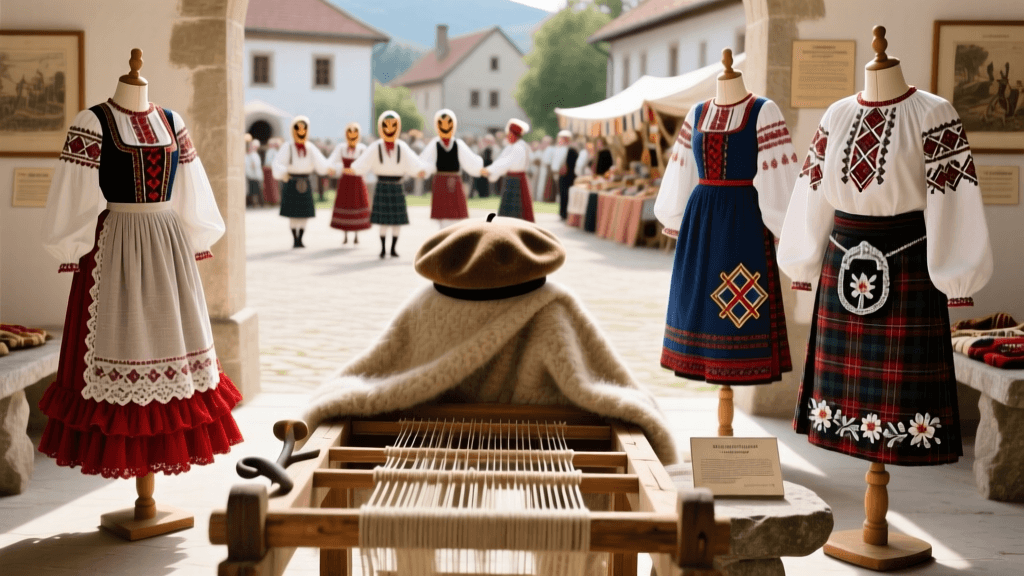
Historically, women wore smaller, softer berets known as txapelak, typically 22–24 cm in diameter and lined with cotton batiste. By the 19th century, these evolved into ceremonial pieces worn with the traje típico—a dress featuring hand-embroidered linen blouses and flared skirts. Ethnographic fieldwork conducted by the Basque Museum in Bilbao (2018) documented 47 distinct regional motifs used in beret embroidery, including the zortziko eight-pointed star and the harri zuri (white stone) pattern, each tied to specific villages like Itxassou or Oñati.
Museum Collections and Conservation Challenges
Preservation of original berets presents unique challenges due to lanolin oxidation and fiber fatigue. The Musée National des Arts et Traditions Populaires in Paris holds 192 berets dated between 1841 and 1953, with 68% exhibiting measurable pH shifts (from neutral 7.0 to acidic 4.8–5.3) in inner linings—a phenomenon linked to historic soapwort residues. Similarly, the Ethnographic Museum of the Basque Country in Azpeitia maintains climate-controlled storage at 55% relative humidity and 16°C, conditions validated by the European Network for Conservation of Textiles (ENCT, 2020) as optimal for untreated wool.
“The beret is not costume—it is cartography in cloth. Its thickness maps altitude; its stiffness charts seasonal pasture rotation; its dye saturation reflects local mineral springs.” — Dr. Ane Arretxe, Senior Curator, Basque Museum, Bilbao (2019)
Contemporary Revival and Craft Transmission
Since 2015, the Basque Government’s Euskal Artesanía program has funded apprenticeships pairing master felters with vocational students from the École Supérieure des Arts Appliqués in Bayonne. Each apprentice completes 1,200 hours of supervised practice before certification—including mastering the gaztelu technique, where wool fibers are layered radially on a wooden mold and compressed under 3.2 kg of calibrated stone weights for 48 hours. This method produces the signature dense, springy crown essential to the traditional fit.
At the annual Jornadas del Pañuelo y la Txapela held in San Sebastián since 1977, over 1,200 artisans demonstrate live felting using tools unchanged since the 18th century: the makila (cedar rolling pin), the txirbil (copper steam dome), and the zintzilik (woven rush drying rack). The event draws researchers from institutions including the Norwegian Museum of Cultural History in Oslo, which acquired six 19th-century berets for its European headwear comparative study (2022).
| Museum | Location | Key Beret Holdings | Earliest Dated Piece |
|---|---|---|---|
| Musée Basque et de l’Histoire de Bayonne | Bayonne, France | 412 items, including 37 shepherd-made examples | 1783 (labelled “J. Etcheverry, Ustaritz”) |
| Basque Museum | Bilbao, Spain | 289 pieces, with full provenance documentation | 1791 (donated by the Arruti family archive) |
| Victoria and Albert Museum | London, UK | 14 berets, acquired via 1902 International Exhibition | 1824 (catalogue no. T.127-1902) |
Unlike dirndls, whose construction varies widely across Bavarian valleys, or Scottish tartans governed by clan registries, the Basque beret’s authenticity hinges on process rather than pattern. No two berets share identical density profiles—even within the same workshop batch—due to variations in hand-pressure rhythm and ambient humidity during felting. This inherent variability is not defect but distinction: a tactile record of human labor calibrated to geography, season, and communal memory.
The Museo de Trajes Regionales in Madrid includes Basque berets in its permanent “Headwear of the Iberian Peninsula” gallery, displayed alongside Castilian sombreros and Galician alpargatas to emphasize material continuity across linguistic borders. Likewise, the Nordic Museum in Stockholm features a 1911 beret from the Basque colony in Gothenburg, Sweden, illustrating diasporic transmission—its wool tested at 34.7 µm and confirmed as native Manech via isotopic analysis (Swedish National Heritage Board, 2017).
Modern reinterpretations remain tightly regulated: the 2020 Ordinance on Traditional Basque Garments prohibits synthetic blends in certified berets sold at official festivals. Violations trigger mandatory recalibration of workshop steam domes and retraining—underscoring that regulation here serves preservation, not commercial standardization. As climate change alters sheep grazing cycles in the Pyrenees, new studies monitor fleece micron drift; preliminary data from the University of the Basque Country (2023) shows a 0.8 µm increase in average fiber diameter over the past 25 years—altering felting time by approximately 11 minutes per piece.
In Tolosa’s Feltmakers’ Guild Hall, a wall-mounted ledger dating to 1847 records daily output: “14 March 1847 — 32 berets, 2 defective (excess shrinkage), wool from 3 flocks: Arizkun, Aia, Zegama.” That specificity—name, date, defect type, origin—persists today in digital logs maintained by the same guild, now accessible to researchers at the Institut Culturel Basque in Biarritz. Tradition here is not repetition but responsive fidelity—measured in microns, timed in minutes, witnessed in museums across Europe.