Ancient Chiton & Roman Stola: 2026 Reenactment Sewing Guide
The Resurgence of Classical Garments in 2026
The fascination with classical antiquity continues to shape historical reenactment, theater, and cultural festivals in 2026. Whether you are preparing for a major classical theater production, participating in a Hellenic revival festival, or simply studying ancient European folk dress, mastering the construction and draping of the chiton and the Roman stola is essential. Unlike tailored modern clothing, these garments rely entirely on the art of draping, belting, and pinning rectangular pieces of fabric. This comprehensive guide will walk you through the historical nuances, modern fabric sourcing, and practical draping techniques required to recreate these iconic garments today.
Doric vs. Ionic Chiton: Understanding the Foundations
The chiton was the foundational garment of ancient Greece, evolving into two primary forms: the Doric and the Ionic. According to the Metropolitan Museum of Art's Heilbrunn Timeline of Art History, the Doric chiton (often referred to as a peplos when worn by women) was typically crafted from heavier woolen fabrics, featuring an apoptygma (overfold) at the upper edge. It was pinned at the shoulders using large, sturdy fibulae.
Conversely, the Ionic chiton, popularized during the 6th century BCE, utilized lighter, wider linen fabrics. It was sewn or pinned along the upper arms to create continuous sleeves, eliminating the need for the heavy overfold. For 2026 reenactors, understanding this distinction is crucial for achieving the correct silhouette. A Doric peplos requires a dense, medium-weight wool (around 250-300 GSM) to hold the structured overfold, while an Ionic chiton demands a highly breathable, semi-sheer linen (120-150 GSM) that cascades elegantly when belted.
The Roman Stola: Markers of Matronly Virtue
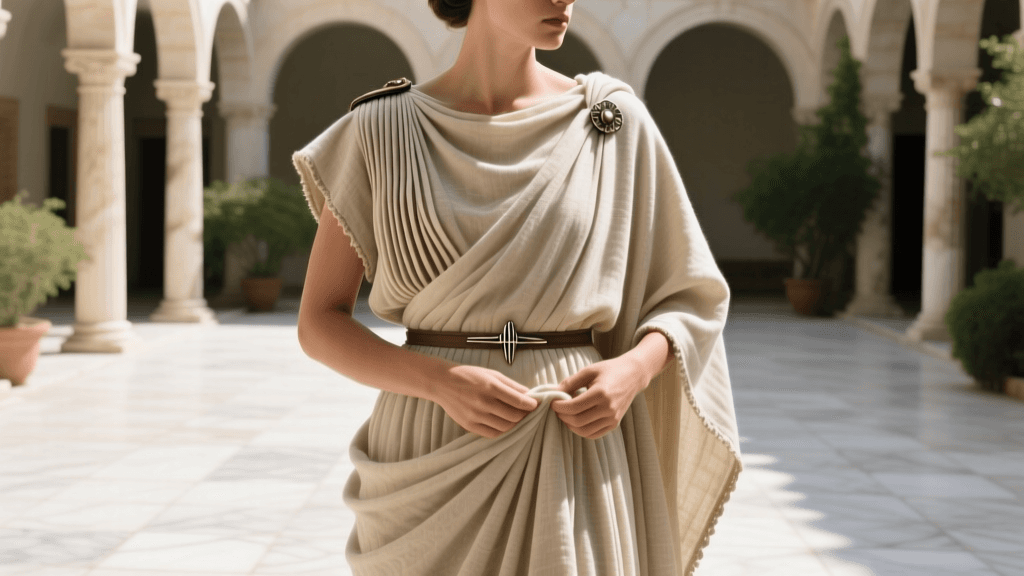
Transitioning from Greece to Rome, the stola emerged as the defining garment of the respectable Roman matron. Worn over a base tunic (tunica interior), the stola was a long, sleeveless or short-sleeved dress suspended by shoulder straps or brooches. The most critical identifying feature of the stola was the instita—a decorative band sewn to the lower hem, which signaled the wearer's social status and modesty.
As noted by the World History Encyclopedia, the stola was strictly reserved for female citizens, serving as a visual marker of virtue and legal standing. In modern 2026 reproductions, the stola is often paired with the palla, a large rectangular shawl draped over the head and shoulders when outdoors. To achieve an authentic drape, the stola should be cut significantly longer than the wearer's height, allowing the fabric to blouse generously over the high waist belt (zona).
Comparison Chart: Ancient Mediterranean Garments
| Garment | Primary Fabric | Fastening Method | Historical Era | Best 2026 Use Case |
|---|---|---|---|---|
| Doric Chiton (Peplos) | Heavy Wool | Shoulder Fibulae | Archaic/Classical Greece | Outdoor autumn reenactments, structured theater costumes |
| Ionic Chiton | Fine Linen | Sleeve pins, belt | Classical/Hellenistic Greece | Summer festivals, indoor events, layered draping |
| Roman Stola | Linen or Silk | Shoulder straps, belts | Roman Republic/Empire | Matron portrayals, formal historical exhibitions |
| Palla | Wool/Linen Blend | Draping, no pins | Roman Empire | Outdoor modesty layers, head covering |
Sourcing Authentic Textiles and Natural Dyes in 2026
Sourcing historically accurate textiles has become significantly easier in 2026, thanks to a boom in artisanal weaving and natural dyeing cooperatives across Europe and the Mediterranean. When selecting fabric, avoid modern synthetic blends; polyester will not drape, absorb natural dyes, or breathe like natural fibers. Look for 'half-bleached' or 'unbleached' linen for base Ionic chitons, and seek out naturally dyed wools for Doric peploi and Roman stolas.
Madder root (for reds, pinks, and terracottas) and woad or indigo (for blues) remain the most historically accurate colorants. Several European heritage mills now offer custom-width weaves, which is vital because ancient looms produced fabric in specific widths that dictated the drape. If you cannot find period-accurate loom widths, purchase standard 150cm wide linen but ensure the grainline is perfectly straight before cutting to prevent twisting during the draping process.
Fastenings and Hardware: The Importance of the Fibula
The hardware of ancient dress is just as important as the textile. The fibula (brooch) was not merely decorative; it was a structural necessity. For a heavy Doric peplos, you must use penannular or omega-style fibulae made of bronze or brass, capable of supporting the weight of the woolen overfold without tearing the fabric.
In 2026, several specialized historical jewelry artisans offer cast-bronze replicas based on museum artifacts. Avoid cheap, stamped-metal costume jewelry found at generic festival stalls, as the pins are often too weak and will snap under the tension of the draped fabric. Additionally, the kolpos (blousing effect) is achieved by pulling the fabric up and over a simple woven wool or leather cord belt, which should be tied securely but comfortably to allow for movement.
Step-by-Step Draping Guide: The Ionic Chiton
Draping an Ionic chiton requires precision and a bit of patience. Follow these steps for a historically accurate silhouette:
- Step 1: Measure the Width. Measure your wingspan from elbow to elbow with arms outstretched. This is the width of your Ionic chiton fabric.
- Step 2: Measure the Length. Measure from your shoulder to the floor, adding 40 cm to allow for the kolpos (blousing). This is your length.
- Step 3: Hemming. Hem all four edges of the rectangular fabric with a tight, rolled hem to prevent fraying while maintaining a lightweight drape.
- Step 4: Wrapping. Fold the fabric in half widthwise, wrapping it around your body with the open edges on one side (typically the left).
- Step 5: Pinning the Sleeves. Starting at the closed corner, pin the top edges together at intervals of 5 to 7 cm along the upper arms to form the sleeves. Leave a gap in the center for the head.
- Step 6: Belting. Tie a woven cord belt around your natural waist.
- Step 7: Blousing. Pull the fabric up and over the belt evenly around your entire body to create the bloused kolpos, adjusting the hem so it grazes the ankles.
Draping the Roman Palla
The Roman palla was a masterclass in versatile draping. Unlike the Greek himation, which was often wrapped tightly, the palla could be draped over the head, across the chest, or even used to support the arms. To drape the palla in the traditional style popular in the 1st century CE, cast the right end over the left shoulder, bring the bulk of the fabric across the back, wrap it under the right arm, and throw the remaining end over the left shoulder or across the head. The weight of a 200 GSM wool-linen blend should hold it in place, though a hidden bone or wooden pin can be used at the shoulder for active outdoor events in 2026.
Maintaining and Storing Natural Fibers
Caring for historically accurate garments in 2026 means abandoning modern washing machines and harsh detergents. Woolen Doric chitons and heavy stolas should be spot-cleaned or hand-washed in cool water with lanolin-rich soap to preserve the natural oils that make the wool water-resistant and durable. Linen Ionic chitons can be hand-washed but should be line-dried in the shade to prevent the fibers from becoming brittle and stiff. Store these garments folded with cedar blocks to deter moths, avoiding wire hangers which will distort the natural fibers and stretch the shoulder points where the fibulae sit.
Conclusion
Mastering the ancient chiton and Roman stola requires a shift in mindset from modern pattern-making to the fluid, architectural art of draping. By respecting the historical properties of wool and linen, utilizing proper bronze fibulae, and understanding the social context of garments like the stola's instita, modern enthusiasts can bring classical antiquity to life with striking accuracy. As the historical reenactment and heritage community continues to prioritize authenticity in 2026, these foundational skills ensure your garments are not just costumes, but accurate, living reflections of ancient European material culture.