DIY Hanfu Guide: Sewing Patterns and Fabric Selection
Introduction to DIY Hanfu Sewing
The global resurgence of traditional Chinese clothing, known as Hanfu, has inspired a vibrant community of makers, historians, and fashion enthusiasts to take up needle and thread. Unlike modern Western fashion, which relies heavily on complex darts, princess seams, and tailored armholes to contour the body, traditional Hanfu is rooted in the philosophy of flat-cutting. This approach respects the natural drape of the fabric and the integrity of the textile, creating garments that are forgiving, comfortable, and deeply symbolic. For the DIY sewist, creating your own Hanfu is not just a sewing project; it is an immersion into centuries of Asian sartorial traditions.
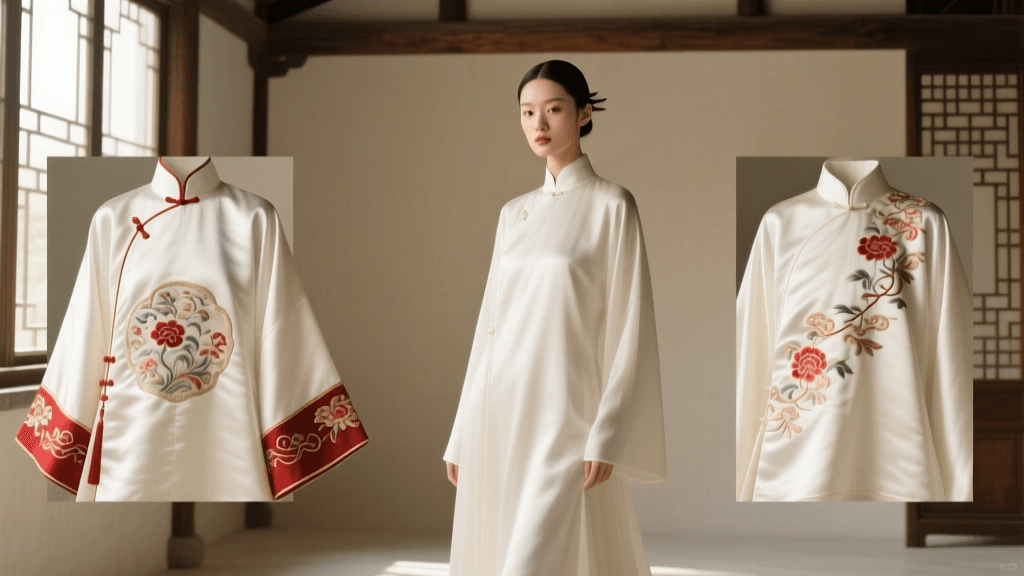
Whether you are aiming to recreate a flowing Song Dynasty Beizi (open-front coat) or a structured Ming Dynasty Aoqun (jacket and skirt ensemble), mastering the foundational patterns and selecting the appropriate textiles are your first steps. This guide focuses on the most iconic and recognizable Hanfu silhouette: the Jiaoling Youren (cross-collared upper garment) paired with a traditional pleated skirt, providing you with the actionable knowledge needed to draft, cut, and sew your own authentic garments.
The Philosophy of Flat-Cutting and Zero Waste
Before taking your fabric shears to your textile, it is crucial to understand the structural philosophy of historical Chinese dress. Traditional garments were constructed using a 'T-shaped' flat pattern. The sleeves were not set into an armhole; rather, they were cut as a continuous extension of the bodice shoulder. This method minimized fabric waste—an important consideration in eras where hand-woven silk and ramie were highly valuable commodities. When studying historical construction, institutions like the Victoria and Albert Museum's Asian collections showcase how flat-cutting techniques allowed for versatile layering and zero-waste pattern drafting, a concept that resonates deeply with today's sustainable fashion movements.
Because the garment is cut flat, the fit is achieved not through tailoring to the body's curves, but through the way the garment is wrapped, tied, and layered. This makes DIY Hanfu incredibly accessible for beginners who might feel intimidated by the precise fitting requirements of Western historical costuming.
Essential Measurements for Hanfu
Because Hanfu is cut on the flat and relies on wrapping, you need fewer measurements than a Western sloper requires. However, accuracy in the following areas is vital for achieving the correct historical proportions:
- Center Back to Wrist (Sleeve Length): Measure from the prominent bone at the base of your neck (C7 vertebra), across your shoulder, and down to your wrist bone. In traditional Hanfu, sleeves often extend past the hands, but a standard measurement to the wrist is ideal for everyday practice wear.
- Bust/Chest Circumference: Measure around the fullest part of your chest. You will add significant ease (usually 4 to 6 inches) to this measurement to allow for the cross-collar overlap and comfortable movement.
- Back Width: Measure across your back from shoulder tip to shoulder tip. This dictates where the sleeve seam will drop if you are using narrower fabric widths.
- Garment Length: Measure from the base of the neck down to your desired hemline. For a standard Ru (top) worn with a skirt, this usually falls at the high hip or natural waist.
Drafting the Jiaoling Youren (Cross-Collar Top)
The Jiaoling Youren is the quintessential Hanfu top, characterized by its cross-collar and lack of buttons. The most critical cultural rule to remember when drafting and sewing this garment is the direction of the collar: the left lapel must always cross over the right lapel. In traditional Chinese culture, crossing the right over the left (Zuoren) is strictly reserved for dressing the deceased or certain historical ethnic minorities. Wearing it incorrectly is considered a major faux pas in the Hanfu community.
Step-by-Step Drafting Instructions
Begin by folding your fabric in half, then in half again, to create a quadrant. This allows you to cut the main bodice and sleeves simultaneously, ensuring perfect symmetry.
- The Neckline: Cut a shallow curve at the top inner corner for the back neck. For the front neck, cut a deeper, more pronounced curve or a straight diagonal line that will form the base of your cross-collar.
- The Bodice Width: From the center fold, measure out one-quarter of your total bust measurement plus 2 inches of ease. Draw a straight line down to your desired hem length.
- The Sleeves: From the shoulder line, extend the fabric outward to your 'Center Back to Wrist' measurement. Traditional Hanfu sleeves can be narrow (Zhaixiu) or exceptionally wide and voluminous (Guangxiu or Pipa sleeves). For a beginner, a straight, slightly tapered sleeve is the easiest to draft and sew.
- The Front Overlap: The front panels must be wide enough to wrap around your torso. Extend the front panel horizontally by at least 8 to 12 inches past the center front line to ensure a secure, modest overlap when tied.
Fabric Selection: Tradition Meets Practicality
The soul of any Hanfu lies in its textile. According to the Metropolitan Museum of Art's Heilbrunn Timeline of Art History, silk production has been a cornerstone of Chinese material culture for millennia, dictating not only fashion but global trade routes. However, modern DIY sewists have a variety of options ranging from historically accurate silks to practical modern substitutes.
The importance of these traditional textiles is globally recognized; in fact, UNESCO inscribed Sericulture and Silk Craftsmanship of China on the Representative List of the Intangible Cultural Heritage of Humanity, highlighting the profound cultural weight of choosing authentic materials.
Hanfu Fabric Comparison Chart
| Fabric Type | Drape & Weight | Breathability | Cost per Yard | Historical Accuracy | Best Use Case |
|---|---|---|---|---|---|
| Mulberry Silk (Charmeuse/Crepe) | Fluid, Medium | High | $25 - $60 | Excellent | Formal wear, Ming/Song Dynasty tops |
| Ramie / Linen | Crisp, Structured | Very High | $12 - $25 | Excellent | Summer wear, everyday historical dress |
| Cotton Voile / Lawn | Soft, Light | High | $8 - $15 | Good (Substitute) | Beginner practice, inner layers (Zhongyi) |
| Polyester Chiffon | Flowy, Extremely Light | Low | $4 - $10 | Poor | Budget outer layers, fantasy Hanfu |
| Silk Brocade / Jacquard | Heavy, Stiff | Medium | $30 - $80 | Excellent | Winter jackets, Mamianqun (horse-face skirts) |
Fabric Preparation and Pre-Washing
Natural fibers like silk, linen, and ramie are prone to shrinkage. Before cutting your pattern, you must pre-wash your fabric. For silk, hand-wash in cool water with a pH-neutral detergent or a splash of white vinegar to preserve the fiber's luster. For linen and ramie, machine wash on a gentle cycle and tumble dry low to get the maximum shrinkage out of the way before your shears touch the cloth.
Sewing Techniques for an Authentic Finish
Because traditional Hanfu garments were often unlined or lined with delicate silks, raw edges were rarely left exposed. The interior finishing of your DIY Hanfu is just as important as the exterior appearance.
Mastering the Seams
Avoid standard overlocked or serged edges if you want a historically accurate finish. Instead, utilize French seams or flat-felled seams. A flat-felled seam is particularly robust and historically appropriate for the side seams and sleeve seams of heavier garments like cotton or linen Ruqun. It encloses the raw edges completely, providing a clean, tailored look on both the inside and outside of the garment.
Constructing the Cross-Collar
The collar is often the most intimidating part of Hanfu construction. The collar band is typically cut as a long, continuous strip of fabric on the straight grain (or slightly on the bias for better curve negotiation around the neck).
- Cut the collar strip roughly 3 to 4 inches wide, and long enough to reach from the side seam of the left front panel, around the back of the neck, and down to the side seam of the right front panel.
- Fold the strip in half lengthwise and press it with an iron.
- Sandwich the raw edge of the garment's neckline between the folded collar strip. Pin meticulously, especially at the center back and the sharp angles of the front crossover.
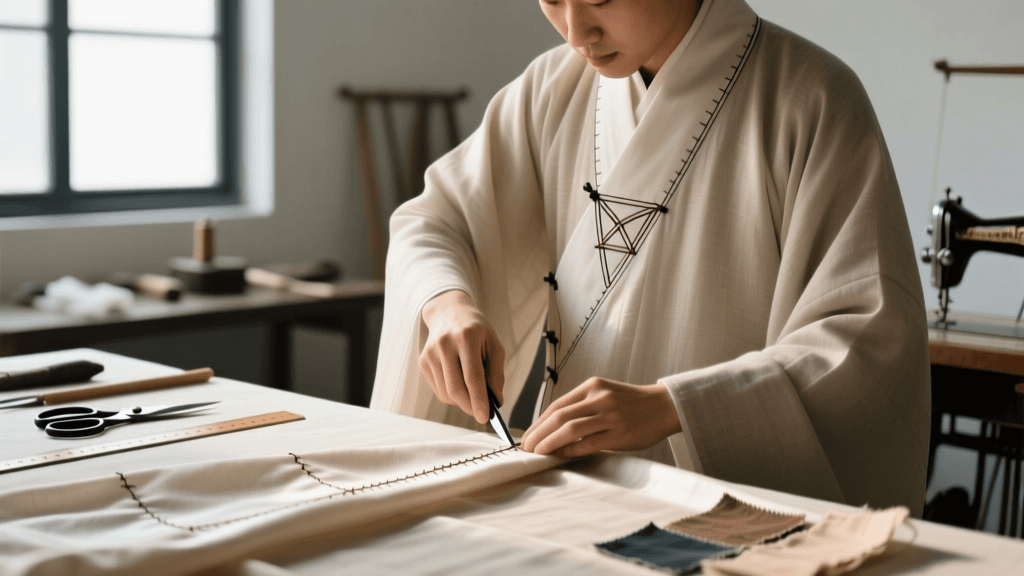
- Stitch slowly, pivoting at the corners. Once attached, the collar should stand up slightly at the back of the neck and lay flat against the collarbones as it crosses the chest.
Hems and Ties
Hanfu does not use buttons, zippers, or hooks for closure. Instead, it relies on fabric ties (Jieying). Cut long, narrow strips of fabric, fold them in half, and stitch them into tubes. Turn them right side out using a loop turner. Attach these ties to the inside and outside of the side seams and the collar edges to secure the garment. For the hems, a simple double-fold hem of 1/2 inch is standard, stitched by hand with a blind hem stitch for an invisible, professional finish.
Conclusion
Sewing your own Hanfu is a deeply rewarding endeavor that bridges the gap between historical appreciation and modern craftsmanship. By understanding the flat-cutting philosophy, respecting the cultural significance of the left-over-right collar, and thoughtfully selecting your textiles, you can create garments that are not only beautiful but culturally resonant. Whether you choose the crisp breathability of summer ramie or the luxurious drape of mulberry silk, your DIY Hanfu journey is a testament to the enduring legacy of Asian textile traditions.