DIY Hanfu Guide: Patterns, Fabric Selection and Sewing
Introduction to DIY Hanfu Construction
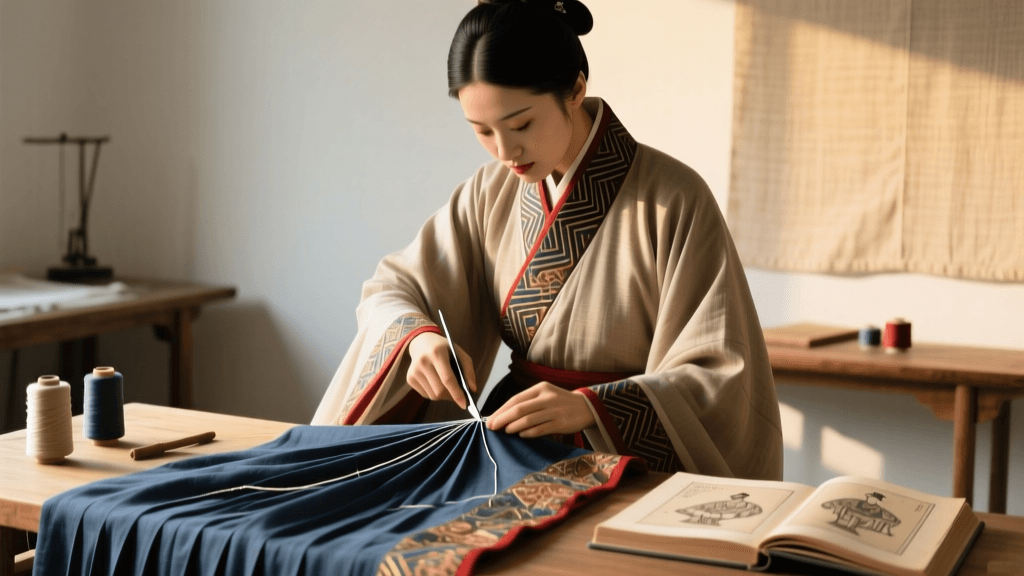
The global resurgence of traditional Chinese clothing, commonly known as the Hanfu movement, has inspired thousands of enthusiasts to not only wear these beautiful garments but to create them from scratch. Sewing your own Hanfu is a deeply rewarding endeavor that connects you to centuries of textile history, craftsmanship, and cultural philosophy. Unlike modern fast fashion, constructing a traditional Hanfu requires an understanding of historical flat-pattern cutting, fabric drape, and the symbolic rules of garment assembly. Whether you are aiming to recreate a flowing Wei-Jin era robe or a structured Ming Dynasty Mamianqun (horse-face skirt), mastering the fundamentals of DIY Hanfu patterns and fabric selection is your first step toward sartorial authenticity.
The Philosophy of Traditional Hanfu Patterns
To successfully sew a Hanfu, one must first unlearn the conventions of Western tailoring. Modern Western clothing relies on three-dimensional pattern drafting, utilizing darts, curved seams, and shoulder slopes to hug the contours of the body. In stark contrast, traditional Chinese garment construction is rooted in a philosophy known as Pingmian Caijian, or flat-pattern cutting. This two-dimensional approach treats the fabric as a continuous, unbroken canvas that respects the natural drape and flow of the textile.
In a traditional Hanfu pattern, the front and back bodices are often cut as a single continuous piece of fabric without a shoulder seam, or with a straight shoulder seam that drops naturally over the arm. Sleeves are attached at a sharp right angle to the bodice, creating the iconic wide, flowing silhouette when the arms are raised. Another non-negotiable rule in Hanfu construction is the Youren principle, which dictates that the left side of the garment must cross over the right side, securing on the wearer's right side. Historically, crossing right-over-left was reserved exclusively for the deceased, making the correct orientation of your pattern pieces a vital aspect of cultural respect and historical accuracy.
Selecting the Right Fabric for Your Hanfu
The success of a DIY Hanfu project hinges almost entirely on fabric selection. Because flat-pattern cutting relies on gravity and the natural weight of the textile to create the garment's shape, choosing a fabric with the wrong drape can result in a stiff, boxy silhouette rather than an elegant, flowing one. Historically, silk was the premier choice for Chinese textiles. According to the Metropolitan Museum of Art, the mastery of silk production and sericulture in ancient China not only defined the region's economy but also dictated the fluid, luxurious aesthetics of its traditional dress.
When selecting fabric, you must consider the season, the specific dynasty you are emulating, and your budget. Below is a comprehensive comparison chart to help you choose the best material for your project.
| Fabric Type | Drape Quality | Breathability | Best Season | Est. Cost per Yard | Best Used For |
|---|---|---|---|---|---|
| Mulberry Silk (Crepe/Charmeuse) | Exceptional, fluid | High | Spring / Summer | $30 - $80+ | Outer robes, premium Ruqun tops |
| Habotai Silk | Light, airy | Very High | Summer | $15 - $25 | Linings, lightweight inner layers |
| Rayon / Viscose | Heavy, fluid | Moderate | Spring / Autumn | $8 - $15 | Budget-friendly skirts, flowing sleeves |
| Linen | Stiff, structured | Very High | Summer | $12 - $25 | Everyday wear, Song Dynasty Beizi |
| Cotton Sateen | Moderate, soft | High | All Seasons | $10 - $20 | Structured skirts, beginner practice |
| Brocade / Jacquard | Heavy, rigid | Low | Winter | $20 - $60 | Ming Dynasty Mamianqun, outer jackets |
Essential Tools and Measurements
Before cutting into your carefully selected fabric, ensure you have the proper tools. Because Hanfu patterns consist of long, straight lines and large rectangular panels, a rotary cutter, a large self-healing mat, and pattern weights are vastly superior to traditional fabric shears and pins. You will also need a French curve ruler for drafting the slight neckline scoops and a flexible measuring tape.
Taking accurate measurements is crucial. Unlike Western garments that require precise bust and waist darts, Hanfu relies on generous ease. You will need to record the following:
- Bust/Chest: Measure around the fullest part, then add 4 to 6 inches for ease and overlapping layers.
- Waist: Measure your natural waist for skirt placement, though many Hanfu skirts sit higher on the ribcage.
- Shoulder Width: Measure from the edge of one shoulder to the other, though traditional drop-shoulder patterns will extend far beyond this point.
- Arm Length: Measure from the base of the neck, over the shoulder, and down to the wrist or desired sleeve length (historical sleeves often cover the hands).
- Skirt Length: Measure from your desired waistline down to the ankle or floor.
Step-by-Step Guide to Sewing a Basic Jiaoling Ruqun
The Jiaoling Ruqun (cross-collar top and skirt) is the most iconic and foundational Hanfu silhouette, worn across multiple dynasties. Here is a streamlined guide to constructing your own. For a standard set, expect to purchase between 4 to 6 yards of fabric, depending on your height and sleeve width.
Step 1: Fabric Preparation
Natural fibers, particularly silk and linen, are prone to shrinking. Pre-wash your fabric according to its care instructions and press it completely flat. Understanding the delicate nature of natural fibers is key; as noted in resources detailing sericulture and silk processing, the protein structure of silk requires gentle handling, cool water, and mild pH-neutral detergents to maintain its tensile strength and luster.
Step 2: Cutting the Bodice (Shan)
Lay your fabric flat and fold it to create a center-front and center-back line. Cut the main bodice as a large rectangle that spans your shoulder width plus the desired sleeve length. Cut a straight line down the center front to create the opening for the cross-collar. Leave a generous seam allowance of at least 5/8 inch.
Step 3: Constructing the Cross Collar
The collar is the most complex part of the Jiaoling top. Cut two long, bias-grain or straight-grain strips of fabric, depending on the specific dynasty's style you are replicating. Attach the inner collar strip first, sewing it to the raw edge of the center front cut, then fold it inward and slip-stitch it down. Repeat with the outer collar strip, ensuring it lies perfectly flat against the neckline and extends down to the side seam tie.
Step 4: Assembling the Skirt (Qun)
A basic Hanfu skirt is constructed from multiple rectangular panels pleated together. Cut 4 to 6 rectangular panels of fabric. Hem the bottom and top edges. Create deep knife pleats or box pleats along the top edge until the waist measurement matches your own. Attach a wide waistband, leaving long fabric ties on either end to wrap around the body.
Step 5: Finishing and Binding
Historically, raw edges were not serged. Instead, they were enclosed using narrow fabric binding or flat-felled seams. Use a lightweight silk or cotton bias tape to bind the interior seams of the sleeves and side slits for a clean, historically accurate finish.
Sourcing Patterns and Finding Inspiration
While drafting your own patterns from scratch using historical proportions is the ultimate goal for advanced sewists, beginners should rely on established community patterns. Independent creators on platforms like Etsy and specialized Taobao shops offer printable PDF patterns graded for modern sizing while maintaining historical accuracy. When studying historical garments for inspiration, digital archives are invaluable. Institutions like the Victoria and Albert Museum provide high-resolution images of extant Asian textiles and garments, allowing DIY sewists to study seam placements, pleating techniques, and fabric weaves in meticulous detail.
Common Beginner Mistakes to Avoid
As you embark on your Hanfu sewing journey, be mindful of a few common pitfalls. First, never skip the fabric pre-washing step; a shrinking skirt after your first wear can ruin hours of precise pleating. Second, pay close attention to the grainline. Cutting the bodice off-grain will cause the garment to twist uncomfortably on the body, defeating the purpose of flat-pattern comfort. Finally, avoid using modern interfacing in the collars unless you are making a heavily structured winter jacket. Historical Hanfu collars achieved their shape through multiple layers of fabric and precise stitching, not stiff modern fusibles.
Conclusion
Sewing your own Hanfu is a beautiful intersection of history, art, and personal expression. By respecting the traditional flat-pattern cutting methods, carefully selecting fabrics that honor the garment's drape, and paying attention to historical details like the Youren closure, you do more than just make a piece of clothing. You participate in the living continuation of Asian textile traditions, crafting a garment that moves, breathes, and flows exactly as it was intended to centuries ago.