Authentic Dirndls & Romanian IE: 2026 Buyer's Guide
The 2026 Renaissance of European Folk Dress
As we move through 2026, the European traditional garment market has experienced a profound renaissance. Driven by new EU Geographical Indication protections for heritage textiles and a widespread rejection of fast-fashion 'costumes,' collectors, cultural enthusiasts, and everyday wearers are seeking authentic, historically accurate folk dress. Two of the most iconic and highly sought-after garments in the European folk dress canon are the Bavarian Dirndl and the Romanian IE (traditional blouse). While they originate from vastly different cultural landscapes—the Alpine valleys of Central Europe and the Carpathian regions of Eastern Europe—both garments share a commitment to intricate craftsmanship, natural fibers, and deep regional symbolism.
This comprehensive 2026 sourcing guide will walk you through the anatomy, regional variations, and current market pricing for authentic Dirndls and Romanian IEs. Whether you are investing in a bespoke Alpine bodice or hunting for a vintage hand-loomed hemp blouse, this guide provides the actionable measurements, material tests, and artisan pricing you need to navigate the modern heritage market.
The Bavarian Dirndl: Anatomy and Regional Variations
The Dirndl is often misunderstood outside of Germany and Austria as a mere festival costume. In reality, the authentic Tracht is a highly structured, historically significant garment that varies deeply by municipality. In 2026, the most respected ateliers in Munich and Salzburg are returning to pre-1950s tailoring techniques, favoring heavy linens, boiled wools, and hand-blocked silk brocades.
Anatomy of an Authentic Dirndl
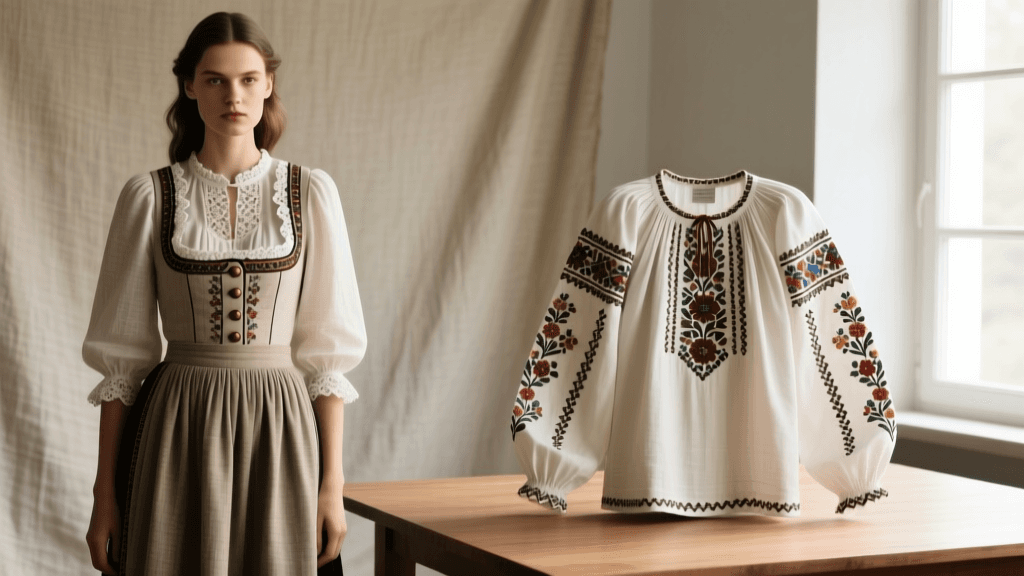
A true Dirndl consists of four distinct components, each of which can be sourced separately or tailored as a cohesive set:
- The Mieder (Bodice): The structural core of the dress. Authentic 2026 bodices feature internal boning (often spiral steel or heavy synthetic whalebone) and are lined with sturdy cotton drill. They fasten with hook-and-eye closures, decorative buttons, or a traditional silk ribbon lacing.
- The Bluse (Blouse): Worn underneath, traditionally made of crisp white cotton or linen. The neckline varies from modest square cuts to deeper heart shapes, often finished with delicate bobbin lace (Klöppelspitze).
- The Rock (Skirt): A fully gathered or knife-pleated skirt attached to a separate waistband. The length is a critical marker of authenticity; traditional skirts fall to the 'Maßkrug' (beer mug) height, roughly 60 to 70 cm from the waist, covering the knee.
- The Schürze (Apron): The most expressive element. Woven silk, hand-printed cotton, or embroidered linen aprons are tied at the front. The placement of the bow (Schleife) traditionally signals the wearer's relationship status: left for single, right for married/taken, center for virgins (historically), and back for widows or waitresses.
Regional Styles: Miesbacher vs. Werdenfelser
When sourcing from high-end Bavarian tailors in 2026, you will encounter distinct regional styles. The Miesbacher Tracht is characterized by a dark, heavily structured bodice, often black or deep navy, paired with a brightly colored silk apron and elaborate silver chain jewelry (Charivari). The Werdenfelser Tracht, originating near Garmisch-Partenkirchen, favors lighter, more pastoral colors, featuring floral brocade bodices and softer, less rigid tailoring, making it a popular choice for summer weddings and alpine church festivals.
Actionable Advice: Measuring for a Custom Bodice
If you are commissioning a bespoke Dirndl from a European tailor in 2026, precise measurements are non-negotiable. Expect to pay between €450 and €950 for a custom Mieder. Provide your tailor with the following:
- Underbust: Measured snugly directly beneath the breast tissue.
- Overbust: Measured across the fullest part of the bust.
- Natural Waist: Measured at the narrowest point of the torso, usually just above the navel.
- Back Width: Measured across the shoulder blades from armpit to armpit.
- Torso Length: From the base of the neck to the natural waist.
The Romanian IE: Decoding the Traditional Blouse
The Romanian IE (pronounced 'ee-yeh') is a masterpiece of Eastern European textile art. Recognized globally for its complex geometric and floral embroidery, the IE is deeply tied to the agrarian calendar and regional identity. According to the National Museum of the Romanian Peasant, the traditional blouse is not merely clothing but a protective talisman, with specific motifs designed to ward off evil spirits and ensure a bountiful harvest.
The Architecture of the IE
Unlike the tailored Dirndl, the IE is constructed from rectangular panels of hand-loomed fabric (traditionally hemp, linen, or cotton) joined by intricate embroidery seams. The embellishment follows a strict, sacred geometry divided into specific zones:
- Altita (The Epaulette): The most densely embroidered section, located on the upper shoulder. It historically represented the heavens and the cosmos, featuring complex star and sun motifs.
- Incret (The Gather): A horizontal band of embroidery just below the Altita, acting as a visual and structural transition to the sleeve.
- Rauri (The Rivers): Vertical bands of embroidery flowing down the sleeve from the Incret to the cuff. The number of 'rivers' (usually three, five, or seven) often indicated the wearer's age, wealth, or specific village.
- Piept (The Chest): The front panel, often featuring a vertical column of geometric patterns or stylized floral motifs representing the tree of life.
Sourcing Authentic IEs in 2026
The market for Romanian blouses in 2026 is split between antique collectors and modern artisan supporters. Antique IEs (pre-1940s), woven from thick hemp and dyed with natural madder root or indigo, are highly prized. At European ethnographic auctions, a pristine antique IE from the Muscel or Olt regions can fetch between €600 and €1,200. However, a vibrant movement of contemporary artisans in regions like Vrancea and Neamț are hand-stitching new blouses using traditional looms and natural dyes. These modern heritage pieces typically cost between €250 and €450, providing vital income to rural crafting cooperatives.
2026 Sourcing Guide: Authentic Artisans vs. Fast Fashion
As demand for European folk dress has surged, so has the proliferation of mass-produced imitations. When sourcing your garments, use the following comparison chart to ensure you are investing in authentic cultural heritage rather than synthetic costumes.
| Feature | Authentic Heritage Garment (2026) | Mass-Market 'Costume' Imitation |
|---|---|---|
| Primary Materials | 100% Linen, Hemp, Boiled Wool, Silk Brocade | Polyester blends, cheap synthetic satin, nylon lace |
| Embroidery | Hand-stitched or specialized artisan machine-work using cotton/silk floss | Computerized machine embroidery using shiny rayon/poly thread |
| Dirndl Skirt | Deep, heavy pleats; falls below the knee; hidden pockets | Short, flimsy gathers; above the knee; no structural weight |
| IE Construction | Rectangular loom panels joined by embroidered seams (Altitza) | Standard modern sleeve patterns with printed or glued-on motifs |
| 2026 Price Range | €250 - €1,200+ (depending on antique status and bespoke tailoring) | €30 - €80 (fast fashion retailers and festival pop-ups) |
The Burn Test: Verifying Natural Fibers
When buying vintage or artisan pieces at European flea markets or online estates, always request a thread sample to perform a burn test. Authentic hemp, linen, and cotton will burn quickly, smell like burning paper or leaves, and leave a fine, crumbly gray ash. Authentic wool or silk will curl away from the flame, smell like burning hair, and leave a crushable black bead. If the thread melts into a hard, plastic-like bead and emits a chemical odor, the garment contains synthetic fibers and is not a true heritage piece.
Accessories and Footwear: Completing the Ensemble
A folk dress is incomplete without its traditional accessories. In 2026, sourcing authentic footwear and jewelry is just as critical as the garments themselves.
Bavarian Accessories
For the Dirndl, the Charivari is an essential piece of jewelry. Originally a hunting trophy chain worn by men, it was adopted by women as a decorative silver chain adorned with coins, animal teeth (or modern silver casts), and gemstones. A genuine silver Charivari from a Bavarian silversmith will cost between €150 and €350. Footwear should consist of traditional Haferlschuhe (Alpine lace-up shoes) or modest, low-heeled leather pumps. Avoid plastic buckles or overly modern stiletto heels, which break the historical silhouette.
Romanian Accessories
The IE is traditionally paired with a Fota (a heavy, woven wool wrap skirt) or a Catrinta (a narrower, intricately striped woven apron). Sourcing authentic hand-woven wool skirts from Romanian cooperatives costs roughly €120 to €200. For footwear, traditional Opinci (leather peasant shoes tied with long laces around the calf) are experiencing a massive revival in 2026. Custom leather Opinci, molded to your feet by traditional cobblers in Transylvania, can be ordered online for approximately €90 to €140.
Care and Preservation of Heritage Textiles
Investing in European folk dress requires a commitment to proper textile conservation. The Metropolitan Museum of Art's Textile Conservation Department emphasizes that natural fibers are highly susceptible to light damage, moisture, and pest infestation.
- Washing: Never machine wash an authentic IE or a silk-brocade Dirndl apron. Hand wash cotton and linen IEs in cool water with a pH-neutral textile detergent. For heavy wool Dirndl skirts, rely exclusively on professional dry cleaners who specialize in heritage garments.
- Drying: Never wring out embroidered panels. Roll the garment in a clean, dry cotton towel to press out excess moisture, then lay it flat on a drying rack away from direct sunlight to prevent the natural dyes from fading.
- Storage: Store your garments in a cool, dark, and dry environment. Wrap antique IEs and silk Dirndl aprons in acid-free, unbuffered tissue paper to prevent the fibers from becoming brittle. Never hang heavy, antique hemp blouses on wire hangers, as the weight of the wet or heavy fabric will distort the shoulder seams; instead, store them flat in archival textile boxes.
Conclusion
The year 2026 marks a pivotal moment for European folk dress. As consumers become more educated and demand transparency, the market is rightfully rewarding the master tailors of Bavaria and the village artisans of Romania. By understanding the structural anatomy of the Dirndl, decoding the sacred embroidery of the Romanian IE, and utilizing strict material verification methods, you can build a collection that honors the profound history of European textile traditions. For further research into regional customs and historical contexts, the Bavarian Tourism Board offers excellent resources on Alpine heritage, ensuring your journey into traditional European dress is both authentic and deeply respectful of its origins.