Chinese Fashion History Research: 2026 Digital Reconstruction Tools
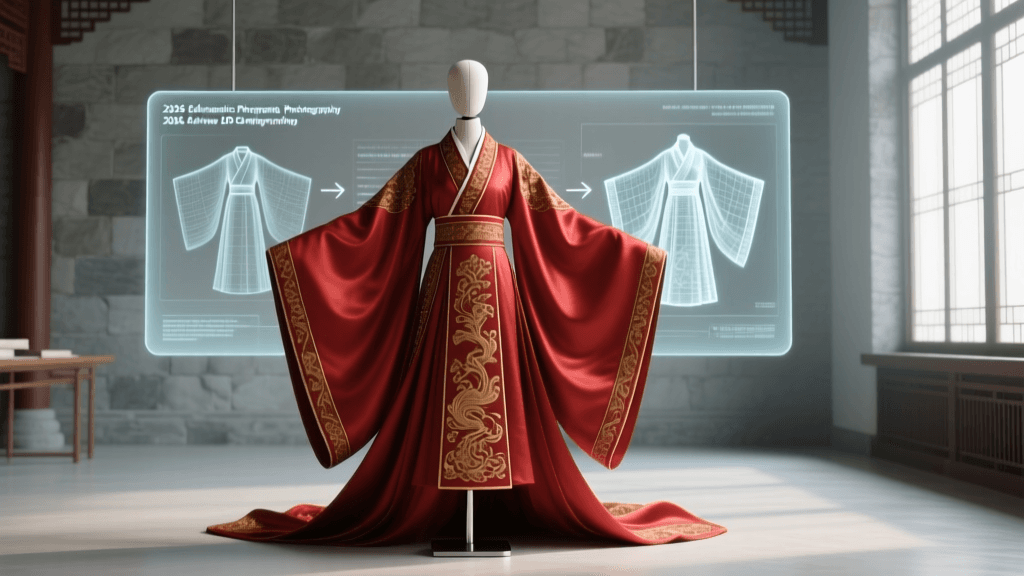
The Evolution of Chinese Fashion History Education in 2026
The landscape of Chinese fashion history education has undergone a radical transformation by 2026. Moving far beyond the traditional reliance on two-dimensional sketches, static museum archives, and textual analysis, contemporary academic research now integrates advanced digital reconstruction, artificial intelligence, and physics-based fabric drape analysis. Leading institutions such as Donghua University in Shanghai and the Beijing Institute of Fashion Technology (BIFT) have completely overhauled their graduate curricula to reflect this shift. Today's fashion historians and textile conservationists are trained not just as archivists, but as digital archaeologists. This evolution is driven by a dual demand: the academic necessity to preserve fragile, excavated Silk Road textiles in high-fidelity virtual environments, and the booming commercial interest in the Xin Zhongshi (new Chinese style) movement, which requires rigorous historical accuracy for modern apparel design.
According to the Metropolitan Museum of Art's Heilbrunn Timeline of Art History, the study of Chinese textiles requires an understanding of complex loom technologies and historical garment construction that flat pattern-making simply cannot convey. In 2026, universities address this by mandating 3D digital prototyping as a core competency for all fashion history graduate students, ensuring that the structural integrity and kinetic drape of ancient garments are fully understood before any physical reproduction is attempted.
The Digital Paradigm Shift: 3D Draping and Physics Engines
In the 2026 academic semester, courses dedicated to historical garment construction rely heavily on enterprise-grade 3D fashion design software. Programs like CLO 3D and Marvelous Designer are utilized not merely for modern apparel drafting, but as historical simulation engines. Researchers input specific physical properties of ancient textiles—such as the bending stiffness, shear modulus, and weight of historical Song dynasty kesi (silk tapestry) or Tang dynasty damask—to observe how these fabrics would have draped on the human body centuries ago.
This physics-based approach has resolved long-standing academic debates regarding the volume and layering of Hanfu and historical court dress. For example, digital drape analysis has proven that certain stiff, heavily brocaded Silk Road textiles required specific undergarment structures to achieve the silhouettes depicted in Tang dynasty murals. By simulating gravity and fabric friction in a virtual environment, students can test hypotheses about historical tailoring techniques, such as the use of hidden gussets or specific pleating methods, without risking damage to priceless physical artifacts.
AI-Assisted Textile Analysis and Pattern Reconstruction
One of the most significant breakthroughs in 2026 academic research is the application of artificial intelligence in reconstructing damaged textile patterns. Excavated garments, particularly those recovered from arid tombs along the ancient trade routes documented by the UNESCO Silk Road Programme, are often fragmented, faded, or structurally compromised. Modern academic labs now employ machine learning algorithms trained on thousands of intact historical textile fragments to predict and reconstruct missing motifs.
When a student analyzes a fragmented piece of Tang dynasty weft-faced compound twill, AI pattern recognition tools can extrapolate the original warp and weft intersections, generating a complete, mathematically accurate weave file. This digital file can then be sent to computerized Jacquard looms to recreate the exact textile for physical study. This synergy between ancient weaving techniques and 2026 AI modeling has dramatically accelerated the pace of textile conservation research, allowing scholars to visualize the vibrant, polychromatic reality of ancient Chinese fashion that time and oxidation have stripped away.
Academic Curriculum Comparison: Traditional vs. 2026 Digital Methodologies
The integration of these technologies has fundamentally altered the structure of fashion history degree programs. Below is a comparison of how core research methodologies have evolved from traditional approaches to the current 2026 digital standard.
| Research Domain | Traditional Methodology (Pre-2020) | 2026 Digital Academic Methodology |
|---|---|---|
| Garment Structure | Flat pattern drafting from 2D photographs and paintings. | 3D volumetric scanning of extant garments and physics-based virtual draping. |
| Textile Analysis | Microscopic visual inspection and manual thread counting. | AI-assisted weave extrapolation and digital Jacquard simulation. |
| Color & Dye Study | Visual estimation and basic chemical spot testing. | Non-invasive multispectral imaging paired with digital color-space mapping. |
| Historical Context | Literature review of ancient texts and court records. | Cross-referencing texts with 3D virtual reality museum archives and global trade databases. |
Case Study: Reconstructing the Tang Dynasty Banbi (Half-Sleeve)
To understand the practical application of these 2026 tools, consider the standard graduate case study: the reconstruction of the Tang dynasty Banbi (a short-sleeved jacket worn by both men and women). Historically, the Banbi was a staple of the cosmopolitan Silk Road wardrobe, reflecting a blend of Central Asian and indigenous Chinese tailoring. The Victoria and Albert Museum's Asian Collections highlights the importance of such cross-cultural garments in understanding historical trade and fashion exchange.
In a 2026 university lab, the reconstruction process begins with the 3D scanning of a fragile, extant Banbi using structured light scanners (such as the Artec Eva, a staple in modern conservation labs costing approximately $15,000). The resulting point cloud is converted into a precise digital mesh. Students then use digital pattern-making software to reverse-engineer the 2D cutting lines, paying strict attention to the historical fabric width limitations. Ancient looms typically produced fabric widths of around 18 to 22 inches, dictating the placement of seams and the use of triangular side gores to achieve the necessary hem circumference.
Once the 2D patterns are extracted, they are imported into a 3D physics engine. Students apply digital material presets that mimic the specific weight and drape of historical silk gauze or brocade. They then run kinetic simulations, placing the virtual garment on an anatomically accurate, historically proportioned avatar. This allows researchers to observe the garment in motion, analyzing how the wide sleeves and crossed collars behave during walking or seated court rituals, providing insights into the ergonomic and social functions of the clothing that static displays cannot offer.
The Xin Zhongshi Connection: From Academia to the Runway
The rigorous academic research conducted in these 2026 digital labs does not remain confined to university servers. It directly fuels the Xin Zhongshi (new Chinese style) movement, which has dominated both domestic and international design weeks this year. Modern consumers and high-fashion houses are no longer satisfied with superficial, costume-like appropriations of historical dress; they demand structural authenticity, authentic textile weaves, and accurate silhouettes.
Academic researchers frequently collaborate with commercial design houses, providing them with open-source digital pattern libraries and verified textile simulation files. When a contemporary brand designs a 2026 Xin Zhongshi collection inspired by the Song dynasty, they utilize the exact digital drape parameters and AI-reconstructed motifs generated by university researchers. This pipeline ensures that the commercial market elevates traditional Chinese garments with profound historical respect, bridging the gap between ancient heritage and modern, wearable luxury.
Essential Tools for the 2026 Fashion Historian
For students and independent researchers entering the field of Chinese fashion history today, mastering a specific suite of digital tools is mandatory. The standard academic toolkit in 2026 includes:
- 3D Fashion Simulation Software: Enterprise licenses for CLO 3D or Browzwear, specifically utilizing their advanced material physics engines to simulate historical silk, hemp, and ramie.
- Multispectral Imaging Hardware: Portable spectral cameras used to identify historical organic dyes (such as madder, indigo, and safflower) without touching the fragile artifact.
- AI Pattern Extrapolation Models: Custom-trained machine learning algorithms, often hosted on university servers, designed specifically to recognize and complete traditional Chinese auspicious motifs and structural weaves.
- Structured Light 3D Scanners: High-resolution, non-contact scanning devices essential for archiving the exact volumetric dimensions of museum-held garments.
Conclusion
The year 2026 marks a definitive turning point in Chinese fashion history education. By embracing 3D digital reconstruction, AI textile analysis, and physics-based drape simulation, academic institutions are preserving the intricate legacy of Asian traditional garments with unprecedented accuracy. This technological renaissance not only safeguards the material culture of the Silk Road and ancient dynasties for future generations but also provides the foundational authenticity required to propel the Xin Zhongshi movement into the future of global fashion.