Vintage Kimono Auctions 2026: Appraisal & Bidding Guide
The Evolution of the Secondhand Kimono Market in 2026
As we navigate the global fashion landscape in 2026, the circular economy has firmly cemented the vintage kimono as both a wearable art form and a highly liquid alternative asset. The secondhand market for traditional Japanese garments has evolved far beyond dusty antique shops in Kyoto. Today, international collectors, sustainable fashion advocates, and textile historians converge on digital auction platforms, driving unprecedented demand for authenticated, high-quality silk garments. Understanding how to accurately appraise value and strategically bid in this fast-paced digital environment is essential for both novice enthusiasts and seasoned archivists.
The 2026 market is characterized by a surge in demand for mid-century Showa-era textiles, particularly those featuring rare regional dyeing techniques that are no longer practiced. Furthermore, the integration of AI-assisted condition reporting by major Japanese proxy bidding services has leveled the playing field, allowing overseas buyers to assess microscopic fabric flaws before placing a bid. However, technology cannot replace a deep, foundational knowledge of textile provenance, weave structures, and formal hierarchy.
Core Metrics for Kimono Value Appraisal
Accurately appraising a vintage kimono requires a systematic evaluation of its material composition, structural formality, and physical condition. Unlike Western vintage clothing, where brand labels often dictate price, the value of a kimono is intrinsically tied to its artisan techniques and ceremonial utility.
Fabric and Weave: Ori vs. Some
The primary dichotomy in kimono appraisal is the distinction between ori (woven patterns) and some (dyed patterns). Woven textiles, such as the highly prized Oshima Tsumugi from Amami Oshima, derive their value from the staggering complexity of the kasuri (ikat) tie-dyeing process applied to individual silk threads before weaving. In 2026, a fully aligned, mud-dyed Oshima Tsumugi kimono commands premium auction prices due to the near-extinction of traditional hand-binding artisans. Conversely, some garments like Kaga Yuzen rely on hand-painted, resist-dyed pictorial motifs. Appraisers must look for the subtle color gradations (bokashi) and the intentional inclusion of 'insect-eaten' leaf motifs that authenticate genuine Kaga Yuzen versus mass-produced stenciled imitations.
Formality and the Kamon (Family Crests)
The presence, number, and application method of kamon (family crests) serve as the ultimate indicator of a garment's formality and, consequently, its baseline auction value. A garment bearing five crests (itsutsumon) is reserved for the highest ceremonial occasions. The method of crest application also matters: crests woven into the fabric are considered less formal than those meticulously resist-dyed into the silk, leaving a pristine white crest against a colored background. When appraising a Kurotomesode (black crested kimono), the clarity, symmetry, and dyeing technique of these five crests can shift the estimated value by hundreds of dollars.
Condition Mapping and Flaw Identification
Condition is the most volatile variable in secondhand auctions. Collectors must familiarize themselves with Japanese auction terminology regarding flaws. Yake refers to sun fading or water-ring discoloration, often found along the shoulders or hem. Shimi denotes age spots or organic staining, while tsugi indicates historical mending or patching. In 2026, while minor shimi on the inner lining (ura) is largely forgiven by collectors, any yake on the primary exterior panels significantly depresses the realized auction price unless the piece is exceptionally rare.
2026 Auction Pricing Trends by Garment Type
To provide actionable intelligence for collectors, we have compiled the average starting bids and realized collector prices across major Japanese proxy auction houses as of early 2026. These figures assume garments are in very good to excellent condition, crafted from pure silk (shouken), and include standard auction premiums.
| Garment Type | Formality Level | 2026 Avg. Starting Bid (USD) | 2026 Realized Collector Price (USD) | Key Appraisal Factor |
|---|---|---|---|---|
| Kurotomesode | Highest (Formal) | $150 | $800 - $2,500+ | Kamon clarity, Yuzen dyed hem continuity |
| Furisode | High (Unmarried) | $120 | $600 - $1,800 | Sleeve length, metallic thread (kinran) integration |
| Edo Komon | Semi-Formal | $80 | $300 - $900 | Micro-stencil precision, silk crepe (chirimen) quality |
| Oshima Tsumugi | Informal / Craft | $250 | $1,200 - $4,500 | Mud-dyeing authenticity, kasuri pattern alignment |
| Maru Obi | Accessory (Formal) | $90 | $400 - $1,500 | Weight, continuous Nishijin-ori brocade weaving |
Navigating Japanese Online Auction Platforms
The epicenter of the secondhand kimono trade remains Yahoo! Auctions Japan, supplemented by specialized vintage storefronts on Rakuten. Because these platforms generally restrict direct international bidding, collectors in 2026 rely heavily on advanced proxy bidding services like Buyee, Neokyo, and ZenMarket. These platforms have recently introduced consolidated shipping algorithms and high-resolution macro-photography requests, allowing buyers to inspect the ji (ground fabric) for microscopic stress tears before committing.
Essential Japanese Search Terminology
Success in these auctions requires bypassing English translations and searching directly in Japanese. Mastering the following keywords is non-negotiable for serious appraisers:
- 正絹 (Shouken): 100% Pure Silk. Always verify this; synthetic blends (polyester) dominate the lower-tier auction brackets and hold zero archival value.
- 未使用 (Mishyou): Unused / Deadstock. Often indicates a garment that was gifted but never worn. These command a 30-50% premium.
- 難あり (Ari) / 難有 (Ari): Flawed / Damaged. Use this to filter out garments requiring expensive restoration, unless you are specifically seeking project pieces.
- 身丈 (Mitake): Back length. Crucial for determining if the garment can be worn by the buyer or if it must be relegated to a display piece.
- 裄丈 (Yukitake): The measurement from the center back seam to the wrist. Because vintage kimono were tailored to specific individuals, finding a yukitake that matches modern, taller demographics is rare and highly valued.
Provenance: Shoken and Rakkan
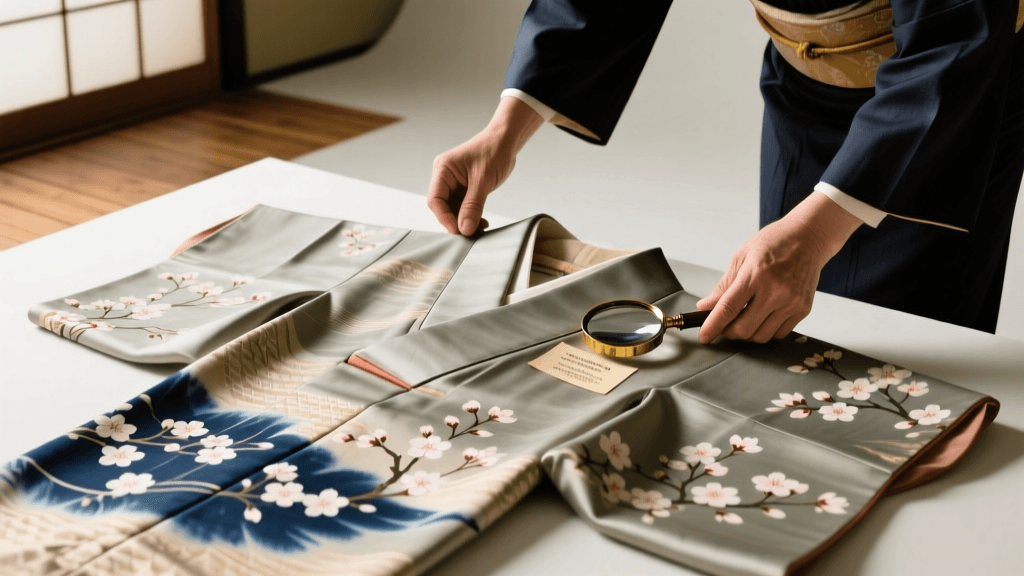
When appraising high-end vintage kimono, provenance documentation can exponentially increase the auction ceiling. A shoken is a paper certificate of authenticity, often included with the garment in a dedicated wooden box (tatou). The shoken details the artisan, the specific dyeing technique, and the date of creation. Furthermore, collectors should request photos of the inner lining near the left underarm. Here, master artisans often stamp their rakkan (signature seal) in red ink. As noted by the Metropolitan Museum of Art's Heilbrunn Timeline, the evolution of the kimono and its intricate structural components provides vital clues to its period and origin; the presence of a verifiable rakkan bridges the gap between a beautiful garment and a documented piece of textile history.
Strategic Bidding for the Modern Collector
The psychology of auction bidding in 2026 requires discipline. The most common mistake novice buyers make is engaging in early bidding wars, which artificially inflates the algorithmic visibility of the listing and attracts more competitors. The optimal strategy is 'sniping'—placing your maximum proxy bid within the final three minutes of the auction. This prevents emotional counter-bidding and secures the garment at the lowest possible increment above the previous bidder's maximum.
Furthermore, collectors must factor in the hidden costs of post-auction preservation. A vintage kimono purchased in 2026 will almost certainly require maruarai (traditional Japanese dry cleaning involving complete disassembly and re-stitching) if it shows signs of organic staining or lingering odors. Sourcing authentic maruarai services outside of Japan can cost between $150 and $300 USD per garment. Therefore, your maximum auction bid must always be calculated as: Total Budget - (Proxy Fees + International Shipping + Estimated Restoration Costs).
Archival Preservation vs. Upcycling
Finally, the 2026 market is distinctly bifurcated between archival preservation and creative upcycling. Garments with severe yake or structural tearing that render them unwearable are frequently purchased by designers for upcycling into haori jackets, tote bags, or framed textile art. However, for the traditionalist collector, maintaining the structural integrity of the shitate (tailoring) is paramount. Understanding the historical weight of these garments is crucial for accurate appraisal. For broader context on Asian textile preservation and regional variations, the Victoria and Albert Museum's Asia Collections provides invaluable baseline references for identifying period-specific motifs and dyeing techniques, ensuring that your 2026 auction acquisitions are both culturally respectful and financially sound.
By mastering the nuances of silk grading, understanding the strict hierarchy of formality, and employing disciplined bidding strategies, collectors can successfully navigate the vibrant 2026 vintage kimono market, preserving these masterpieces of Asian tradition for generations to come.