2026 Silk Road Finds: Decoding Sogdian Samite Textile Weaves

The Enduring Legacy of Silk Road Textile Exchanges
The Silk Road was never merely a conduit for spices, precious metals, and jade; it was the ultimate ancient superhighway for textile innovation and cross-cultural design exchange. As we navigate the landscape of Asian traditional garments in 2026, a profound renaissance in archaeological textile analysis is reshaping our understanding of ancient weaving techniques. Recent 2026 breakthroughs in non-invasive spectroscopic analysis and AI-driven pattern reconstruction have allowed researchers and contemporary designers to decode the complex structures of Sogdian silks unearthed from the Taklamakan Desert. These findings are not just academic triumphs; they are actively fueling the Xin Zhongshi (New Chinese Style) movement, bridging a millennium of history with cutting-edge 2026 fashion.
2026 Breakthroughs in Non-Invasive Textile Archaeology
For decades, the fragile nature of excavated silks from sites like the Astana cemetery in Turpan and the tomb of the Yingpan Man meant that physical handling was strictly limited. However, 2026 has ushered in a new era of portable X-ray fluorescence (pXRF) and macro-photogrammetry. According to the UNESCO Silk Roads Programme, these non-invasive methodologies now allow conservators to map the exact chemical composition of ancient dyes—such as madder root reds and indigo blues—without extracting a single fiber.
Furthermore, AI-assisted structural mapping has enabled textile historians to virtually "unroll" and reconstruct fragmented weft-faced compound twills, known historically as samite. This specific weave structure, introduced to China by Sogdian merchants from Central Asia and Persia during the Tang Dynasty, represented a massive technological leap. By analyzing the thread count and twist direction of surviving 7th-century fragments, 2026 digital looms can now replicate the exact tension and drape of these ancient masterpieces, offering unprecedented accuracy for modern reproductions.
The Architecture of Samite: Warp vs. Weft
To truly appreciate the magnitude of the Silk Road textile exchange, one must understand the structural revolution that Sogdian samite brought to Chinese weavers. Prior to these exchanges, Han dynasty silks were predominantly warp-faced, meaning the longitudinal threads dictated the pattern and color. The introduction of weft-faced compound twill flipped this paradigm, allowing for vastly more complex, curvilinear, and vibrant designs.
| Feature | Han Warp-Faced Silk | Sogdian Samite (Weft-Faced) |
|---|---|---|
| Dominant Element | Warp threads (longitudinal) | Weft threads (transverse) |
| Visual Effect | Longitudinal ribbing, subtle sheen | Smooth, tapestry-like surface, high opacity |
| Pattern Complexity | Geometric, linear, cloud motifs | Curvilinear, pearl roundels, confronting beasts |
| Loom Technology | Traditional multi-harness drawloom | Modified drawloom with extra weft harnesses |
| Historical Origin | Indigenous Chinese innovation | Persian/Central Asian import via Silk Road |
This structural shift allowed for the iconic "pearl roundel" motifs—circles of pearl-like dots enclosing confronting ducks, boars, or lions—which became the defining aesthetic of the Silk Road. As detailed by the Metropolitan Museum of Art's Heilbrunn Timeline of Art History, these motifs were highly prized by the Sasanian Empire and subsequently adapted by Tang dynasty weavers who merged the foreign weft-faced technique with native Chinese silk quality.
The Xin Zhongshi Renaissance: Bringing Archaeological Silks to 2026 Fashion
The Xin Zhongshi (New Chinese Style) movement of 2026 has moved far beyond simple mandarin collars and basic brocade. Today’s avant-garde designers are acting as wearable historians, utilizing 2026 AI-reconstructed patterns to weave authentic Sogdian samite replicas on modern digital jacquard looms in Hangzhou and Suzhou. The integration of these heavy, structured textiles into contemporary streetwear and haute couture represents a sophisticated dialogue between ancient globalization and modern identity.
For collectors and fashion enthusiasts looking to invest in these garments, the 2026 market offers highly accurate replicas. However, true samite is a heavy, densely woven fabric. When evaluating a Xin Zhongshi piece claiming to utilize traditional Silk Road weaves, look for a fabric weight between 22 and 30 momme. Authentic replicas will feature a distinct tapestry-like hand-feel, with the weft threads completely concealing the warp, resulting in a matte-to-semi-lustrous finish that drapes with architectural stiffness rather than fluid fluidity.
Sourcing Authentic Samite Replicas in 2026
With the surge in demand for historically accurate textiles, the market has seen an influx of both premium replicas and cheap, printed imitations. To ensure you are acquiring genuine woven samite rather than a digitally printed satin, buyers must apply a few critical inspection techniques:
- The Reverse-Side Test: Turn the fabric over. In true weft-faced compound twill, the back of the fabric will show a negative or inverted color pattern of the front, with distinct floating threads. Printed fabrics will show a faint, blurred version of the front image, while standard brocades will show a messy, unstructured web of carrier threads.
- The Motif Check: Seek out historically accurate Sogdian motifs. The Victoria and Albert Museum's Asian Collections highlight the prevalence of the "confronting animals within a pearl roundel" as a primary marker of Sogdian influence. If the fabric features standard Ming-dynasty dragons or Qing-dynasty bats, it is not a Silk Road samite replica.
- Price Benchmarking: In 2026, authentic digital jacquard samite woven with 100% mulberry silk warp and spun silk or metallic weft threads commands a premium. Expect to pay between $120 and $350 USD per yard for museum-grade reproductions from specialized ateliers in Zhejiang province.
Archival Storage and Maintenance for Heavy Weaves
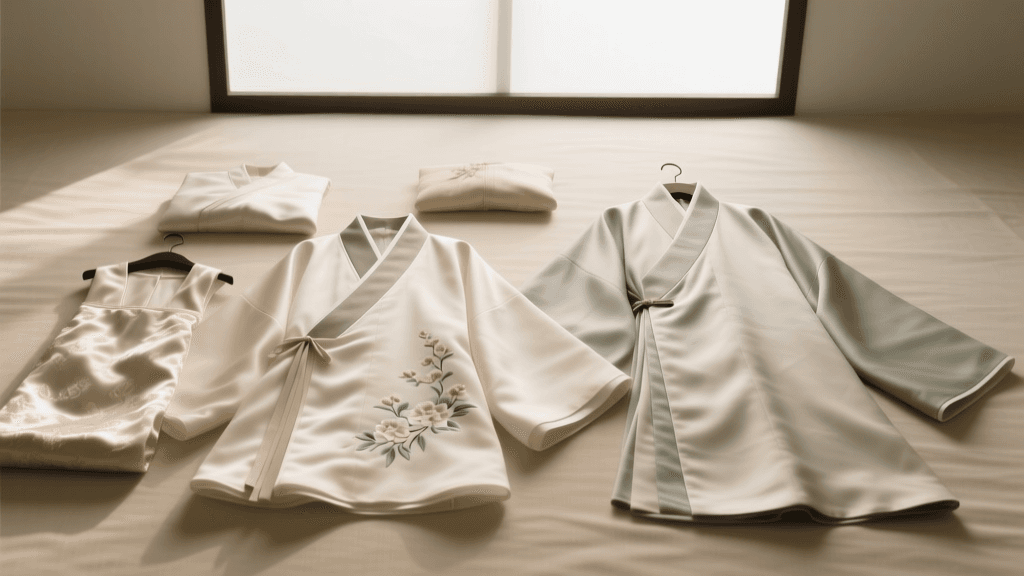
Because samite and weft-faced compound twills are exceptionally dense and heavy, they are uniquely susceptible to gravity-induced distortion and weft-slippage. Storing a heavy Xin Zhongshi samite jacket or a raw yardage of replica Silk Road silk requires a departure from standard silk care. The weight of the transverse threads can cause the fabric to pull apart at the fold lines over time if not properly supported.
2026 Conservation Checklist for Collectors
To maintain the structural integrity of your Silk Road replica textiles, implement the following archival storage protocols:
- Never Hang Heavy Samite: The sheer weight of a 30-momme weft-faced textile will stretch the warp threads if hung on a hanger, leading to irreversible shoulder distortion. Always store heavy silk garments flat.
- Use Blueboard Archival Boxes: Invest in museum-grade, acid-free Blueboard boxes. These provide a rigid, pH-neutral environment that prevents the acidic degradation of both natural silk fibers and any metallic threads used in the weft.
- Unbuffered Acid-Free Tissue: When folding the garment, pad every fold line with unbuffered acid-free tissue paper to create gentle, rolling curves rather than sharp creases. Sharp creases in heavy twill weaves will eventually snap the warp threads.
- Climate and Light Control: Maintain a strict relative humidity (RH) of 45% to 55%. Fluctuations in humidity cause the silk fibers to expand and contract, which can lead to weft-slippage in complex compound twills. Keep the textiles in total darkness, as UV exposure rapidly degrades the protein structure of silk.
- Pest Management: Utilize natural cedar blocks or archival-grade lavender sachets placed in the corners of the storage box. Never allow the botanical pest deterrents to touch the silk directly, as the natural oils can stain the weft threads.
Conclusion: Weaving the Past into the Future
The 2026 archaeological and technological breakthroughs surrounding Silk Road textiles have done more than just fill gaps in academic literature; they have resurrected lost technologies for a new generation. By decoding the intricate weft-faced structures of Sogdian samite, contemporary weavers and Xin Zhongshi designers are ensuring that the vibrant, cross-cultural dialogue of the ancient Silk Road continues to be worn, studied, and celebrated today. Whether you are a textile conservator, a fashion historian, or a collector of avant-garde Asian traditions, understanding the architecture of these ancient weaves is the key to unlocking the true value of Silk Road heritage in the modern era.