Decoding Kimono in Ukiyo-e Woodblock Prints: A Collector Guide
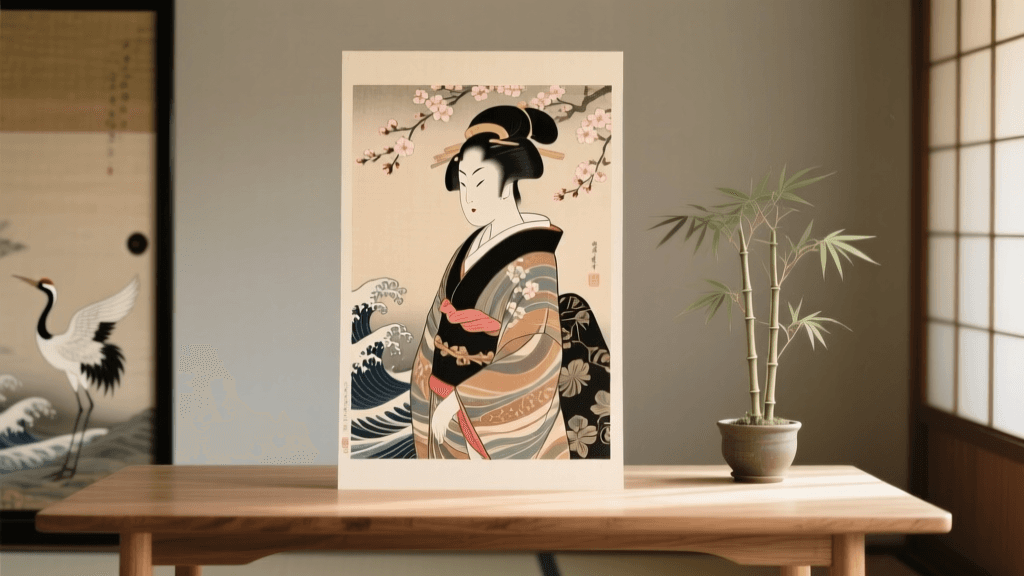
The Floating World Woven in Ink and Silk
Ukiyo-e, translating to 'pictures of the floating world,' represents one of the most vibrant and culturally significant epochs in Japanese art history. Flourishing primarily during the Edo period (1603–1867), these woodblock prints served as the fashion magazines, celebrity tabloids, and travel brochures of their time. At the heart of the ukiyo-e aesthetic is the kimono. Far more than mere clothing, the garments depicted in these prints were complex visual codes that communicated the wearer's social status, wealth, season, and even their poetic inclinations. According to the Metropolitan Museum of Art's Heilbrunn Timeline of Art History, the 'floating world' was deeply tied to the newly affluent merchant class (chonin), who used extravagant textiles to bypass strict sumptuary laws imposed by the Tokugawa shogunate.
For modern collectors, art historians, and textile enthusiasts, understanding the sartorial language of ukiyo-e is essential. The woodblock carvers of the Edo period were master technicians who developed ingenious methods to replicate the intricate textures of shibori (tie-dyeing), yuzen (resist-dyeing), and gold-leaf embroidery using only flat blocks of cherry wood and water-based pigments. This guide will decode the kimono in Japanese woodblock prints, offering actionable advice for identifying styles, understanding historical context, and building a museum-quality collection.
Reading the Garment: Identifying Kimono Types in Prints
To accurately date and contextualize an ukiyo-e print, one must first identify the specific type of garment being worn. While Western audiences often use 'kimono' as a catch-all term, the prints depict highly specific variations of the T-shaped robe.
- Kosode: The foundational garment of the Edo period, characterized by small, narrow sleeve openings. In early ukiyo-e (1670s–1720s), the kosode features massive, bold patterns that span the entire back and shoulders, often ignoring the seam lines.
- Furisode: Identified by its long, swinging sleeves (often measuring 18 to 36 inches in length). In ukiyo-e, furisode are almost exclusively worn by unmarried young women or courtesans. The deep sleeves allowed for dramatic drapery and were used by artists like Kitagawa Utamaro to frame the subject's face or conceal subtle emotional gestures.
- Uchikake: A heavily padded, unbelted outer robe worn by high-ranking courtesans (oiran) and brides. In prints, the uchikake is distinguished by its thick, trailing hem (fukikaeshi) that pools on the floor, often decorated with auspicious motifs like cranes, pines, or mythical beasts.
- Yukata: A lightweight, unlined cotton robe worn after bathing or during summer festivals. Ukiyo-e artists depicted yukata with indigo-blue and white patterns, utilizing the negative space of the paper to represent the white resist-dyed cotton.
Motifs, Dyes, and the Hidden Language of Seasonality
Japanese traditional dress is governed by strict rules of seasonality, and ukiyo-e artists were meticulous in their representation of these rules. A woman depicted wearing a garment adorned with plum blossoms and pine boughs (shochikubai) indicates a New Year or late winter setting, while maple leaves and chrysanthemums firmly place the scene in autumn.
Collectors must also pay close attention to the pigments used to represent specific dyes. The most notorious of these is beni, a delicate pinkish-red dye derived from the safflower. In ukiyo-e prints, beni was highly fugitive and prone to rapid fading when exposed to light. When examining a print, a faded, yellowish-brown hue on a garment that was originally meant to be vibrant red is a telltale sign of age and light exposure. Conversely, aizome (indigo) was incredibly stable. Prints featuring deep blue kimono collars or hemlines often retain their striking color centuries later. The Art Institute of Chicago's Ukiyo-e collection provides excellent high-resolution examples of how indigo pigments have survived compared to the delicate safflower reds.
Master Artists and Their Signature Textile Styles
Different ukiyo-e masters approached the depiction of textiles with unique stylistic signatures. Studying these nuances can aid in authenticating unsigned prints or attributing works to specific studios.
| Artist | Active Period | Signature Kimono Style | Key Motif Focus |
|---|---|---|---|
| Hishikawa Moronobu | 1670s–1690s | Early Kosode, Monochrome sumizuri-e | Large-scale floral, courtly references, bold graphic blocks |
| Suzuki Harunobu | 1760s–1770s | Slender, multi-layered, delicate drapery | Delicate botanicals, poetry motifs, subtle color gradients (bokashi) |
| Kitagawa Utamaro | 1780s–1800s | Opulent, wide-sleeved, sheer fabrics | Complex Yuzen patterns, mica backgrounds, intricate obi knots |
| Utagawa Kuniyoshi | 1820s–1850s | Bold, dramatic, heavily patterned | Warrior motifs, mythical creatures, tattoo-like skin and textile blends |
Utamaro, for instance, was famous for his depictions of sheer summer fabrics (ro or sha). He achieved this effect by printing the skin tone first, then overlaying a very faint, diluted grey or blue pattern, creating an optical illusion of transparency that was revolutionary for the 1790s.
Practical Guide to Collecting Ukiyo-e Prints
Entering the ukiyo-e market requires a keen eye for condition, an understanding of print states, and a realistic budget. The standard size for most mature Edo-period prints is oban, measuring approximately 15.5 x 10.5 inches (39 x 26 cm).
Pricing Tiers and Market Value
- Entry-Level ($150 – $400): Late 19th-century Meiji period prints, actor portraits (yakusha-e) by lesser-known Utagawa school students, or prints with noticeable condition issues such as trimmed margins, center folds, or heavy fading.
- Mid-Tier ($800 – $2,500): Well-preserved Edo-period landscapes by Hiroshige, bijin-ga (pictures of beautiful women) by Utamaro's students, and Kuniyoshi warrior prints with strong color retention and intact censor seals.
- Museum-Grade ($5,000 – $50,000+): First-edition (shozuri) prints by Hokusai, Harunobu, or Sharaku. These feature pristine margins, sharp keyblock lines, and original, unfaded pigments. The Museum of Fine Arts Boston, which holds the world's premier collection of Japanese prints, sets the benchmark for what constitutes museum-grade condition.
Condition Report Checklist for Collectors
Before purchasing an ukiyo-e print featuring intricate kimono patterns, always request a detailed condition report and examine the following:
- Trimming (Margins): Early collectors often trimmed prints to fit standard Western frames, cutting off the publisher's cartouche, censor seals, and crucially, the outer edges of the kimono patterns. A print with full, untrimmed margins commands a 30-50% premium.
- Wormholes and Repairs: Look for tiny, irregular holes caused by bookworms. Professional Japanese conservators use toning (painting the repair paper to match the original), but amateur repairs will look flat and disrupt the flow of the textile pattern.
- Color Bleed: Turn the print over (if possible) or ask for a photo of the verso. Heavy bleed-through of dark indigo or red pigments indicates that the print was likely re-colored or touched up in the 20th century to deceive buyers.
- Censor Seals (Kiwame): Located often near the hem of the kimono or the edge of the background, these seals dictate the exact month and year of publication. Missing seals indicate trimming.
Archival Framing and Care for Textile-Heavy Prints
Because ukiyo-e prints rely heavily on the depiction of delicate garments and fugitive dyes, improper framing can destroy the artwork in a matter of months. The safflower red (beni) and organic yellow (ki) dyes used to render kimono patterns are exceptionally sensitive to ultraviolet light.
Actionable Framing Advice:
- Glazing: Never use standard glass. Invest in Optium Museum Acrylic, which provides 99% UV protection and is anti-static. Expect to pay between $150 and $250 per sheet for custom-cut Optium, but it is non-negotiable for preserving Edo-period pigments.
- Mounting: Do not use dry-mounting, adhesives, or pressure-sensitive tapes. The print should be secured using Japanese kozo paper hinges and wheat starch paste, allowing the washi paper to expand and contract with humidity changes.
- Matting: Use 100% cotton rag, acid-free mat board. The window of the mat should be cut to reveal the full oban dimensions, ensuring no part of the kimono's hem or the artist's signature is hidden.
- Environment: Hang the framed print in a room with a relative humidity of 45-55%. Avoid exterior walls where temperature fluctuations can cause the washi paper to warp, which will visually distort the geometric patterns of the depicted kimono.
By learning to read the folds, dyes, and motifs of the garments in ukiyo-e, collectors unlock a deeper narrative of Japanese history. The kimono in these prints is not merely a costume; it is the very canvas upon which the artisans of the floating world painted their genius.