Decoding Kimono Fabrics: Nishijin-ori & Yuzen Dyeing Guide
The Foundation of Japanese Elegance: Silk and the Tanmono
The traditional Japanese kimono is far more than a mere garment; it is a wearable canvas that reflects centuries of aesthetic philosophy, seasonal awareness, and masterful craftsmanship. At the heart of this sartorial tradition lies the fabric itself. While cotton, hemp, and wool are used for casual or regional wear, silk (kinu) remains the undisputed pinnacle of formal Japanese dress. Understanding kimono craftsmanship requires an intimate knowledge of how these textiles are woven, dyed, and structured.
Unlike Western tailoring, which relies on cutting fabric into curved shapes to fit the human form, the kimono is constructed from a single, standardized bolt of fabric known as a tanmono. A standard tanmono measures exactly 36 centimeters (approximately 14.1 inches) in width and 12.5 meters (about 41 feet) in length. This geometric, zero-waste approach dictates the straight-line construction of the kimono. Because the fabric is rarely cut, the artistry is entirely concentrated on the surface design and the weave of the silk itself. According to the Victoria and Albert Museum, the evolution of these surface techniques transformed the kimono from a simple undergarment (kosode) into a highly codified system of social and artistic expression.
Nishijin-ori: The Pinnacle of Japanese Brocade Weaving
When discussing luxury kimono fabrics, Nishijin-ori (Nishijin brocade) stands at the absolute apex. Originating in the Nishijin district of Kyoto, this weaving tradition dates back over 1,200 years, though it was solidified following the Onin War (1467–1477) when displaced weavers returned to the capital and brought advanced Chinese weaving techniques with them. Today, the Nishijin Textile Center remains a vital hub for preserving these intricate methods.
Nishijin-ori is characterized by its complex, multi-layered patterns woven directly into the fabric, often utilizing dyed silk threads combined with metallic elements. The creation of a single Nishijin obi (sash) can involve over twenty distinct specialized steps, from the initial design drafting and thread dyeing to the final weaving on specialized Jacquard looms or traditional hand-drawn sorabiki looms.
The Anatomy of a Nishijin Obi
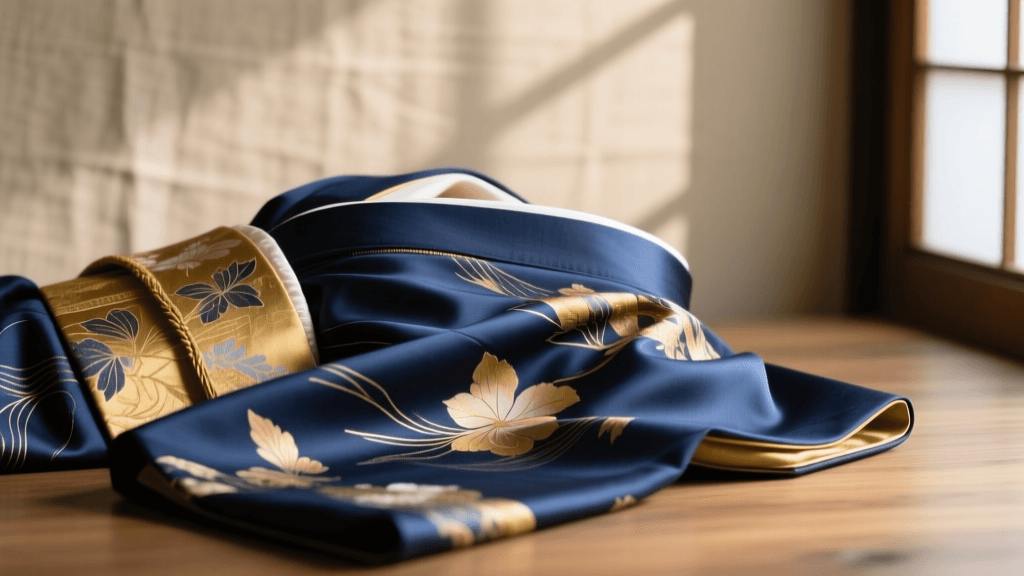
The most common application of Nishijin-ori in modern formal wear is the fukuro obi (pouch sash), worn with formal kimono such as the furisode or tomesode. Authentic Nishijin weaving frequently incorporates hikibaku, threads wrapped in ultra-thin sheets of pure gold or silver leaf.
Actionable Advice for Buyers: When examining a vintage or new Nishijin obi, run your fingernail gently over the gold threads. Authentic hikibaku will feel slightly raised and textured, catching the light at varying angles due to the hand-woven tension. Printed imitations or mass-produced synthetic alternatives will feel entirely flat and uniform. Furthermore, inspect the reverse side of the fabric; true Nishijin brocade will show a distinct, albeit neater, mirror image of the pattern, whereas printed fabrics will show only a faint shadow of the ink.
Yuzen Dyeing: Painting with Resist Paste
While Nishijin-ori relies on the interlacing of pre-dyed threads, Yuzen dyeing allows artisans to paint directly onto the silk with breathtaking, pictorial freedom. Developed in the late 17th century by Miyazaki Yuzensai, this technique revolutionized kimono fashion. During the Edo period, strict sumptuary laws restricted the common merchant class from wearing luxurious fabrics or overtly flashy colors. Yuzen dyeing bypassed these laws by treating the silk as a painter's canvas, allowing for subtle, exquisite designs that technically adhered to the letter of the law while subverting its spirit.
The Yuzen process is staggeringly meticulous. It begins with sketching the design on the silk using aobana (spiderwort) extract, a natural dye that completely disappears when washed in water. Next, artisans apply itome-nori, a waterproof rice paste resist, along the sketched lines. This paste acts as a barrier, preventing adjacent colors from bleeding into one another when the silk is hand-painted using fine brushes. After coloring, the fabric is steamed to set the dyes, washed in cold running water to remove the rice paste, and finally finished with gold leaf or embroidery.
Kyo-Yuzen vs. Kaga-Yuzen
There are two primary regional styles of Yuzen dyeing, each with distinct aesthetic signatures:
- Kyo-Yuzen (Kyoto): Known for its vibrant, diverse color palette, elaborate use of gold leaf (surihaku), and intricate embroidery. The designs often feature stylized, idealized nature motifs and courtly elegance.
- Kaga-Yuzen (Kanazawa): Characterized by a strict adherence to the Kaga Gosai (five signature colors: indigo, crimson, ochre, moss green, and deep purple). Kaga-Yuzen favors realistic, botanical illustrations and employs a technique called bokashi (gradation), where colors fade softly from the edges of a motif toward the center, often leaving intentional 'insect-eaten' holes in painted leaves for rustic realism.
Comparing Traditional Kimono Fabric Techniques
Understanding the practical differences between weaving and dyeing techniques is crucial for collectors, practitioners, and enthusiasts. The table below outlines the core characteristics of major kimono fabric types.
| Technique | Primary Method | Formality Level | Estimated Base Cost (USD) | Weight & Drape |
|---|---|---|---|---|
| Nishijin-ori | Complex brocade weaving with metallic threads | High (Obi only) | $4,000 - $15,000+ | Heavy, stiff, highly structured |
| Kyo-Yuzen | Resist-dyeing, gold leaf, embroidery | Highest (Furisode, Tomesode) | $3,500 - $20,000+ | Medium, fluid, luxurious drape |
| Kaga-Yuzen | Resist-dyeing, bokashi gradation, no gold | High to Highest (Houmongi, Tomesode) | $5,000 - $25,000+ | Medium, fluid, elegant drape |
| Shibori | Intricate tie-dyeing and binding resist | Medium to High (Tsumugi, Houmongi) | $1,500 - $8,000 | Textured, lightweight, matte finish |
A Buyer's Guide to Authentic Kimono Fabrics
Purchasing an authentic, handcrafted kimono or obi is a significant investment. Whether you are buying a bespoke piece or sourcing vintage textiles, specific markers of authenticity and practical considerations must guide your decisions.
Verifying Authenticity and Understanding Costs
Authentic Nishijin-ori textiles are accompanied by a Nishijin Ori Shomei (certification label), a holographic or stamped paper tag issued by the Nishijin Textile Industrial Association. This label guarantees that the fabric was woven in the designated Kyoto district using approved traditional methods. Similarly, high-end Yuzen pieces often bear the stamp or signature of the master dyer on the inner lining or the bottom hem.
Cost and Timing: Commissioning a bespoke, hand-painted Kyo-Yuzen furisode requires a lead time of 6 to 9 months. Artisans must account for the humidity-sensitive rice paste application, which is notoriously difficult during Kyoto's humid rainy season (tsuyu) in June and July. Therefore, orders should be placed well in advance of the spring coming-of-age (Seijin-no-Hi) or wedding seasons. Expect to invest between $4,000 and $12,000 USD for a master-crafted Nishijin fukuro obi, and upwards of $8,000 USD for a fully bespoke Kaga-Yuzen kimono.
For vintage buyers, the Metropolitan Museum of Art's Heilbrunn Timeline of Art History notes that the condition of the silk's protein structure is paramount. Vintage silks from the early Showa period (1920s-1940s) may suffer from 'shattering' (dry rot) if stored improperly. Always test the tensile strength of vintage silk by gently pinching the fabric; if it feels brittle or emits a fine dust, the structural integrity is compromised, regardless of the beauty of the dye.
Caring for Woven and Dyed Silks
The longevity of a kimono depends entirely on its maintenance. Traditional silk kimono should never be washed in water, nor should they be taken to standard Western dry cleaners, as the harsh chemicals (like perc) can strip the silk of its natural sericin proteins and dissolve the metallic adhesives used in Nishijin-ori.
Instead, kimono must be cleaned by specialized Japanese cleaners known as shikkai. These artisans use gentle, specialized solvents and can perform arai-hari—the traditional process of entirely taking the kimono apart, washing the flat tanmono panels, stretching them on wooden boards (shinshi) to dry, and re-sewing the garment. For storage, keep your silk garments wrapped in acid-free tatou-shi (traditional Japanese paper) inside a paulownia wood (kiri) chest. Paulownia wood naturally regulates humidity and repels insects, ensuring that the masterful craftsmanship of Nishijin weavers and Yuzen dyers survives for generations to come.