Decoding Hanfu Garments in Traditional Chinese Scroll Art
The Canvas of History: Reading Garments in Chinese Art
For centuries, traditional Chinese scroll paintings have served as far more than mere aesthetic masterpieces; they are vital historical archives. For modern historians, textile conservators, and the thriving Hanfu revival movement, these ink-and-pigment scrolls provide crucial blueprints of historical dress. Before the advent of photography, court painters and literati artists meticulously documented the sartorial realities of their eras. By analyzing brushstrokes, color layering, and the depiction of fabric drape, researchers can decode the structural engineering, textile weights, and social hierarchies embedded in traditional Chinese clothing.
Translating two-dimensional art into three-dimensional, wearable garments requires a keen understanding of historical context, artistic license, and textile physics. According to The Metropolitan Museum of Art's Heilbrunn Timeline of Art History, the Tang dynasty was a period of immense cosmopolitan exchange, heavily reflected in the flowing, multi-layered garments depicted in court art. Understanding how to read these visual cues is essential for anyone looking to accurately reproduce historical Hanfu or study the evolution of Asian fashion traditions.
Key Masterpieces and Their Sartorial Secrets
To accurately reconstruct historical garments, one must study the definitive masterpieces of Chinese art history. Each dynasty favored different silhouettes, fabric weights, and structural tailoring, all of which are immortalized in specific scrolls.
Tang Dynasty: Court Ladies Adorning Their Hair with Flowers
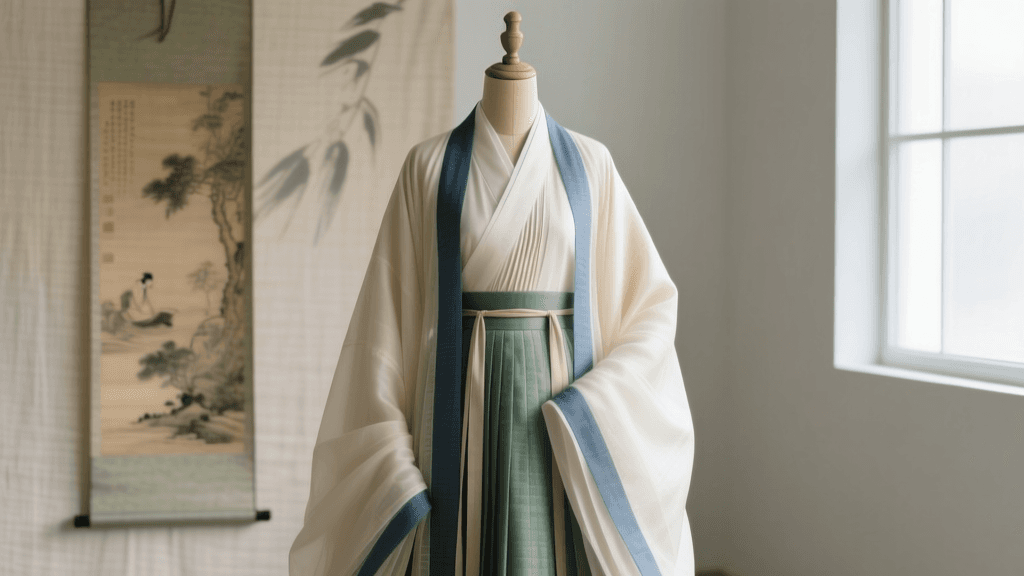
Attributed to Zhou Fang, this 8th-century masterpiece is the ultimate reference for Tang Dynasty court fashion. The painting illustrates women wearing the 'Qixiong Ruqun' (chest-high skirt) and the 'Pibo' (draped silk shawl). The genius of Zhou Fang lies in his depiction of translucency. By using faint, layered washes of pigment over the outlines of the undergarments, he visually communicates the use of 'sha' (silk gauze) and 'luo' (leno-weave silk). For modern makers, this scroll confirms that Tang outer layers were exceptionally lightweight, designed to float and catch the wind, contrasting with the heavier, structured brocades of the under-layers.
Five Dynasties Period: Night Revels of Han Xizai
Painted by Gu Hongzhong, this horizontal scroll offers a voyeuristic glimpse into the private life of a court official. The garment details here are remarkably precise, showcasing the 'Banbi' (half-sleeve jacket) and complex color-blocking techniques. The brushwork highlights the stiffness of silk twill and early satin weaves, which hold sharp creases and structured collars. The scroll also provides invaluable evidence of how garments were layered for indoor leisure versus formal outdoor entertaining, noting the subtle shifts in collar crossings and waist tie placements.
Song Dynasty: Along the River During the Qingming Festival
Zhang Zeduan's sprawling 12th-century panorama is a treasure trove of commoner and merchant-class clothing. Unlike the idealized court ladies of the Tang, this scroll captures the practical, everyday 'Beizi' (outer coat) and 'Ru' (jacket) worn by the working class. The garments are depicted with narrower sleeves, higher hems, and visible side-slits for mobility. The brushwork suggests the use of ramie, hemp, and heavier linens, which drape with more rigidity and display distinct, angular fold lines rather than the fluid ripples of silk.
Garment Elements Across Dynastic Scrolls
| Painting Title | Dynasty | Key Garment Featured | Recommended Modern Fabric Weight | Structural Insight from Art |
|---|---|---|---|---|
| Court Ladies Adorning Their Hair | Tang | Qixiong Ruqun & Pibo | 8-12 momme Silk Gauze | High waistband requires stiff buckram backing to support heavy skirts without buckling. |
| Night Revels of Han Xizai | Five Dynasties | Banbi & Layered Ru | 16-19 momme Silk Twill | Layering requires precise shoulder grading and 2cm seam allowances to prevent bulk. |
| Along the River During Qingming | Song | Beizi & Practical Ru | 12-16 momme Linen or Ramie | Straight cut with 15cm side slits; requires flat-felled seams for durability and clean lines. |
Actionable Guide: Translating 2D Scrolls into 3D Hanfu
For historical costume makers, theater wardrobes, and Hanfu enthusiasts, moving from a digital scroll to a physical garment requires a systematic approach. Here is a practical methodology for analyzing and replicating scroll-based designs.
Step 1: Sourcing and Analyzing High-Resolution Archives
Do not rely on compressed thumbnails. Utilize open-access museum databases to zoom in on the micro-details of brushwork. The Cleveland Museum of Art's Chinese Painting collection and the Smithsonian National Museum of Asian Art offer ultra-high-resolution downloads. Zoom in at 400% magnification to study the hemlines. Look for the 'double-line' technique used by painters to indicate the thickness of a hem or the presence of a fabric border (lan).
Step 2: Calculating Proportions and Yardage
Traditional Chinese portraiture often utilizes a specific head-to-body ratio, typically 1:6 or 1:6.5 for adult figures. By measuring the painted figure's head height and comparing it to the garment's length, you can calculate historical proportions. For example, if a painted skirt measures 4.5 head-lengths, and your model's head is 22cm, the skirt should be drafted to approximately 99cm in length. When calculating yardage for a Tang-style Pibo shawl, scrolls indicate the fabric wraps around the elbows and trails behind the wrists; plan for a minimum of 3.5 meters of 110cm-wide silk chiffon to achieve this drape accurately.
Step 3: Material Sourcing and Budgeting
Replicating the exact drape seen in ink washes requires specific textile investments.
- Tang Dynasty Silks: Source 8-momme to 10-momme silk gauze (luo) or crepe (sha). Expect to pay between $25 and $45 per yard from specialized heritage textile suppliers.
- Song Dynasty Structured Coats: Opt for 14-momme raw silk (noil) or high-quality linen-ramie blends. These cost roughly $15 to $22 per yard and provide the architectural stiffness seen in Song literati paintings.
- Internal Structuring: Paintings rarely show the underpinnings, but gravity dictates their use. Budget $5 to $8 per yard for cotton twill tape or sew-in buckram to stabilize the chest-high waistbands of Qixiong skirts, ensuring they sit flush against the body as depicted in court art.
Step 4: Decoding Color and Motif Placement
Scroll paintings utilize mineral pigments like azurite and malachite, which sit heavily on the paper, mimicking the way metallic threads and thick brocades sit on fabric. When a painter uses heavy, opaque white pigment (lead white) for a collar, it indicates a layered, padded, or heavily embroidered edge. Modern makers should replicate this by using 15mm wide bias binding with a layer of cotton batting inside the collar edge to achieve the same rigid, pristine neckline seen in Five Dynasties portraiture.
Where to Study Authentic Scroll Art Online
To deepen your research, bypass secondary blogs and go directly to primary digital archives. The following institutions offer robust, searchable databases specifically optimized for textile and costume researchers:
- The Palace Museum Digital Archive (Beijing): Offers extensive zoomable scans of Ming and Qing court portraits, essential for studying the evolution of the 'Mamianqun' (horse-face skirt) and structured 'Aoqun' jackets.
- Harvard Art Museums Collections: Their digital portal allows users to filter specifically by 'textile patterns' within Chinese paintings, isolating scrolls that heavily feature woven brocade motifs.
- The National Museum of China (Virtual Exhibitions): Frequently hosts digital walkthroughs that pair surviving textile artifacts with the contemporary scroll paintings that depict them, providing a 2D-to-3D cross-reference.
Conclusion
Traditional Chinese scroll paintings are not merely static reflections of the past; they are dynamic, instructional manuals for the art of historical dress. By learning to read the subtle language of brushstrokes, fabric drape, and structural tailoring, modern enthusiasts and historians can bridge the gap between ancient artistry and contemporary reconstruction. Whether you are drafting a pattern for a Song Dynasty Beizi or sourcing the perfect lightweight silk for a Tang Pibo, the masterpieces of Chinese art remain the most authoritative, beautiful, and enduring guides to the legacy of Hanfu.