Reviving Da Hua Lou Drawlooms For Song Brocade In 2026
The Renaissance of the Da Hua Lou in 2026
The year 2026 marks a pivotal moment in the evolution of the Xin Zhongshi (New Chinese Style) movement. No longer satisfied with superficial digital prints or mass-produced synthetic blends, contemporary designers and heritage enthusiasts are demanding structural and material authenticity. At the heart of this renaissance is the Da Hua Lou, the traditional Chinese drawloom. This massive, intricate wooden apparatus is the only tool capable of producing genuine Song Jin (Song Brocade) with the correct structural integrity, drape, and historical accuracy. As global fashion weeks in 2026 increasingly spotlight heritage craftsmanship, understanding the mechanics, sourcing, and maintenance of drawloom-woven textiles has become essential for serious collectors, designers, and cultural preservationists.
Understanding the Mechanics of the Ancient Drawloom
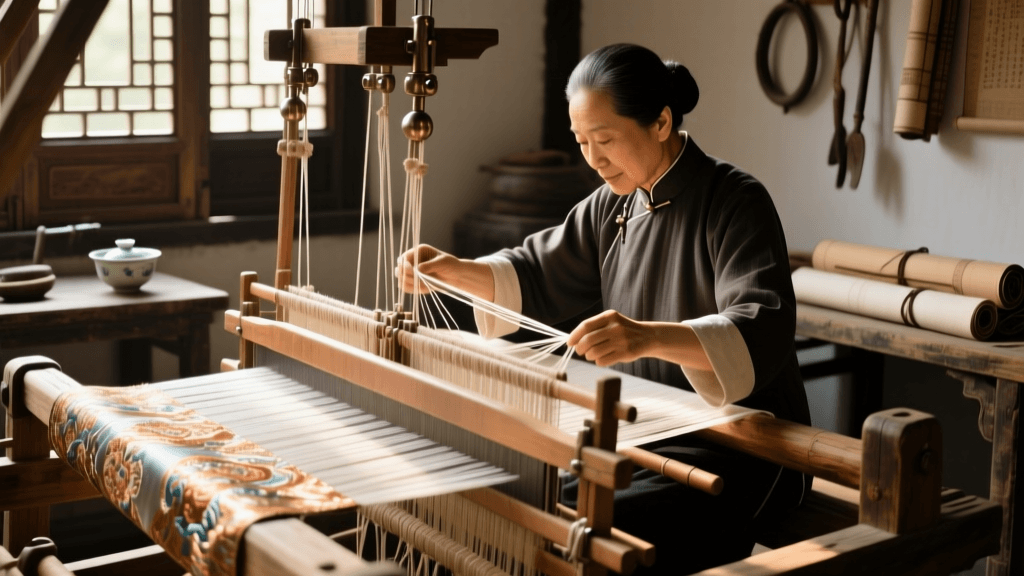
To appreciate the value of drawloom textiles, one must first understand the sheer scale and complexity of the Da Hua Lou. Unlike standard treadle looms, the traditional drawloom is a towering structure, often measuring over five meters in length and three meters in height. It requires a highly synchronized two-person operation. The primary weaver (zhuji) sits at the front, managing the shuttles and beating the weft threads into place. High above, perched on the loom's upper frame, sits the drawboy or puller (huaxiang), who manually lifts specific bundles of warp threads according to the pattern requirements.
Before the invention of the Jacquard punch card system in the West, Chinese weavers utilized a sophisticated system of knotted cords known as jie ben. These knot cords act as an ancient form of binary programming, dictating exactly which warp threads are raised for every single pass of the shuttle. In 2026, while some modernized heritage workshops have integrated digital assistive tools to track pattern sequences, the most prestigious ateliers in Suzhou and Hangzhou still rely entirely on hand-tied jie ben and human drawboys to maintain the subtle tension variations that give authentic Song brocade its signature soft luster and breathable drape.
Song Brocade: The Jewel of Traditional Loom Weaving
Song Jin, or Song Brocade, originated during the Song Dynasty (960–1279 CE) and is celebrated for its understated elegance, complex geometric frameworks, and delicate floral motifs. Unlike the heavier, more opulent Shu brocade or the vibrant Yun brocade, Song brocade is characterized by its flat, warp-faced structure and soft hand-feel, making it exceptionally well-suited for modern, tailored Xin Zhongshi garments. The weaving process relies on multiple sets of warp threads—a ground warp and a binding warp—interlaced with colorful weft threads to create a fabric that is both durable and remarkably fluid.
The historical continuity of this craft is a testament to Chinese sericulture and textile engineering. As documented by The Metropolitan Museum of Art's Heilbrunn Timeline of Art History, the evolution of Chinese silk weaving from early geometric patterns to the complex pictorial and floral brocades of the Song and Ming dynasties represents one of the most significant technological and artistic achievements in global textile history. Today, preserving these specific weaving structures is vital for maintaining the cultural DNA of traditional Asian garments.
Sourcing and Commissioning Drawloom Textiles in 2026
For designers and private clients looking to commission authentic Da Hua Lou textiles in 2026, the process requires patience, a substantial budget, and a deep understanding of the supply chain. The epicenter of this craft remains Suzhou, specifically the heritage cooperatives operating near the Zhenhu embroidery and weaving districts.
Material Selection and Costs
The foundation of any premium Song brocade is 6A-grade raw mulberry silk. As of early 2026, the global market price for top-tier 6A raw silk has stabilized at approximately 520 RMB ($72 USD) per kilogram. However, the true cost lies in the labor. Because a master weaver and drawboy can only produce about 5 to 10 centimeters of complex Song brocade per day, the labor cost is immense.
- Standard Geometric Patterns: 4,500 to 6,000 RMB ($620 to $830 USD) per meter.
- Custom/Complex Floral Motifs: 8,000 to 15,000 RMB ($1,100 to $2,080 USD) per meter, factoring in the weeks required to tie the new jie ben knot cords.
- Lead Time: Expect a minimum of 4 to 6 months from commission to delivery, as loom warping and pattern tying alone can take over a month.
When contracting an atelier, always request a physical sample of the warp tension and weft density. Authentic drawloom fabrics will exhibit a slight, organic irregularity in the selvedge and a distinct, soft acoustic rustle when handled, which synthetic or heavily sized machine-woven fabrics lack.
Comparison: Authentic Drawloom vs. Modern Jacquard Replication
While modern electronic Jacquard looms have advanced significantly by 2026, capable of mimicking the visual patterns of Song brocade, they fundamentally alter the structural physics of the fabric. Below is a detailed comparison to help buyers and designers make informed decisions.
| Feature | Da Hua Lou (Traditional Drawloom) | Electronic Jacquard Loom (2026 Standard) |
|---|---|---|
| Structural Drape | Exceptional; soft, fluid, conforms to body movement naturally. | Stiffer; high tension weaving results in a rigid hand-feel. |
| Pattern Complexity | Limited by physical knot cord memory; favors traditional geometry. | Virtually unlimited; can weave photorealistic digital prints. |
| Production Speed | 5 to 10 centimeters per day. | 15 to 25 meters per day. |
| Cost per Meter | $620 to $2,080 USD. | $40 to $120 USD. |
| Cultural Authenticity | Recognized as Intangible Cultural Heritage. | Commercial reproduction; lacks heritage designation. |
For high-end Xin Zhongshi couture and museum-grade archival pieces, the Da Hua Lou remains irreplaceable. The electronic Jacquard is best reserved for ready-to-wear diffusion lines where cost and speed are the primary drivers.
Caring for Heritage Loom-Woven Garments
Investing in authentic drawloom-woven silk requires rigorous maintenance protocols to preserve the fibers and the intricate warp-faced structures. In 2026, conservation standards for private collectors dictate strict environmental controls.
Storage and Environment
Silk is a protein fiber that is highly susceptible to hydrolysis and photodegradation. Garments must be stored in a climate-controlled environment with a relative humidity (RH) strictly maintained between 45% and 55%, and a stable temperature of 18°C to 20°C (64°F to 68°F). Never store Song brocade in plastic garment bags, which trap moisture and off-gas volatile organic compounds (VOCs) that yellow the silk. Instead, use unbleached, acid-free cotton muslin bags or wrap the garment in acid-free archival tissue paper.
Handling and Display
When displaying or wearing these garments, avoid wire or thin wooden hangers, which can distort the delicate warp threads at the shoulders. Use heavily padded, wide-shoulder hangers covered in washed cotton muslin. If the garment features heavy metallic weft threads (a common variation in ceremonial Song brocade), it must be stored flat in archival boxes to prevent the metal threads from pulling and tearing the silk ground warp over time.
The Future of Ancient Weaving
The dedication to preserving the Da Hua Lou is not merely an exercise in historical nostalgia; it is a vital component of global cultural sustainability. The intricate knowledge required to build, maintain, and operate these looms is recognized globally. As noted by the UNESCO Intangible Cultural Heritage list, the sericulture and silk craftsmanship of China encompass a profound body of traditional knowledge that binds communities and fosters a deep respect for the natural environment and ancestral ingenuity.
As we move through 2026, the integration of authentic drawloom textiles into contemporary wardrobes bridges the gap between ancient Asian traditions and modern sartorial expression. By understanding the mechanics, respecting the labor, and properly caring for these masterpieces, we ensure that the rhythmic clatter of the Da Hua Lou continues to echo into the future, weaving the past seamlessly into the fabric of tomorrow.