Da Hua Loom Yunjin Weaving: Ancient Techniques in 2026
The Legacy of the Da Hua Loom: A Masterpiece of Ancient Engineering
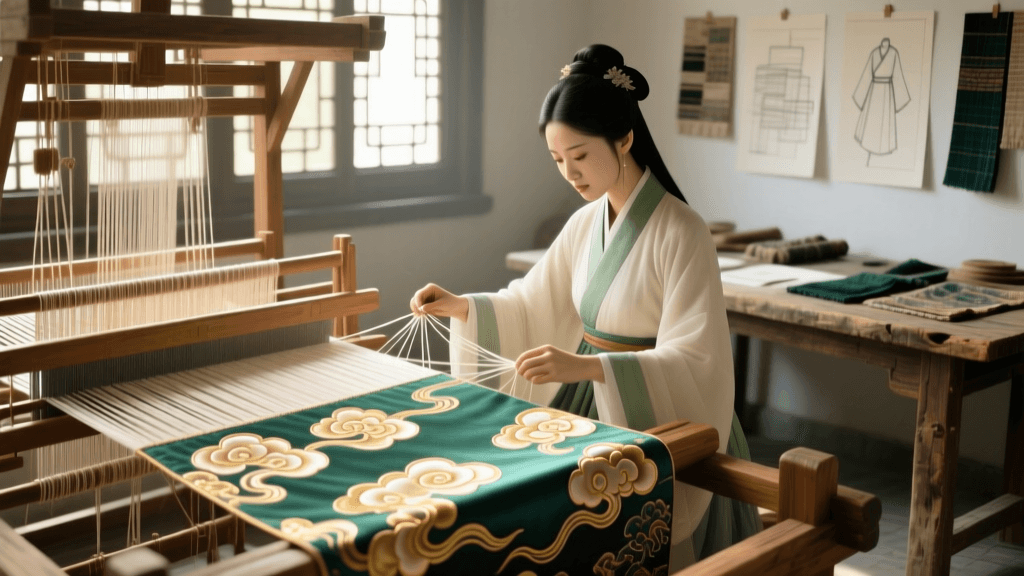
The Da Hua Loom, or Great Drawloom, stands as one of the most complex and magnificent mechanical achievements in the history of global textiles. Originating during the Ming and Qing dynasties, this colossal wooden structure was specifically designed to weave Yunjin, the legendary "cloud brocade" of Nanjing. As of 2026, the Da Hua Loom remains a vital, living artifact. Unlike mechanized Jacquard looms that mass-produce synthetic imitations, the traditional wooden drawloom is the only apparatus capable of executing the intricate, localized weft-brocading techniques required for authentic Yunjin. In an era where fast fashion dominates, the meticulous, painstaking art of hand-loomed Yunjin has experienced a profound renaissance, championed by a new generation of artisans, cultural preservationists, and high-fashion designers who recognize its unparalleled value.
Measuring approximately 5.6 meters in length, 1.4 meters in width, and 4 meters in height, the Da Hua Loom is a towering wooden monolith that requires a two-person team to operate. The weaver sits at the lower level, managing the shuttle and the heddles, while the "drawboy" (or puller) sits on the upper deck, manually pulling the complex pattern harnesses according to a coded sequence. This symbiotic relationship between the two operators is a dance of precision, memory, and physical endurance. According to the UNESCO Intangible Cultural Heritage registry, the Nanjing Yunjin brocade technique represents the absolute pinnacle of Chinese silk weaving, requiring immense physical coordination and generational knowledge.
The Anatomy of the Drawloom and the Binary Code of Silk
To understand the genius of the Da Hua Loom, one must examine its pattern harness system, known as the Jiaoben. Long before the invention of the punch cards used in early computing or the Jacquard loom in 19th-century France, Chinese weavers developed a binary coding system using knotted silk cords. Each cord represents a single warp thread. The pattern is programmed into the loom by tying these cords in a specific sequence, effectively creating a physical, three-dimensional software program.
The Metropolitan Museum of Art's Heilbrunn Timeline of Art History notes that Chinese silk weaving techniques fundamentally altered global trade routes and textile manufacturing paradigms. The drawloom's ability to store complex patterns in its harness allowed weavers to reproduce intricate, asymmetrical, and multi-colored motifs that were mathematically impossible on standard pedal looms. When the drawboy pulls a specific bundle of cords, it raises only the exact warp threads needed for that single pass of the weft, allowing for the insertion of localized, discontinuous supplementary wefts. This is what gives Yunjin its signature vibrant, cloud-like patterns that seem to float above the fabric's surface without repeating in a rigid grid.
2026 Innovations: Ergonomics, Sustainability, and Studio Upgrades
While the core mechanics of the Da Hua Loom remain unchanged, the studios of 2026 have introduced critical, non-invasive upgrades to support the artisans and modernize the material supply chain. The physical toll of operating a 4-meter-tall wooden loom for eight hours a day is immense. In 2026, the Nanjing Yunjin Research Institute, alongside independent heritage studios, has implemented several modern interventions:
- Ergonomic Seating and Support: Modern weavers now utilize custom-molded, lumbar-supporting seats with adjustable hydraulic lifts, allowing them to maintain the precise eye-level alignment required for thread counting without suffering from chronic back strain.
- Climate-Controlled Weaving Environments: Authentic silk warp threads are highly sensitive to humidity. In 2026, heritage studios utilize smart HVAC systems that maintain a strict 65% relative humidity and 22°C temperature, preventing the silk from snapping under the loom's high tension.
- LED Macro-Illumination: The upper deck, where the drawboy works with thousands of fine silk cords, is now equipped with adjustable, color-accurate LED macro-lighting, reducing eye fatigue and minimizing pattern-reading errors.
- Sustainable and Alternative Threads: While traditional Yunjin relies heavily on cultivated mulberry silk, gold leaf threads, and peacock feather yarns, 2026 has seen the introduction of lab-grown spider silk blends for the warp. These bio-engineered threads offer the same lustrous sheen and tensile strength as traditional silk but require a fraction of the water and land resources to produce.
Comparing Traditional and 2026 Modernized Studio Looms
The following table illustrates how contemporary heritage studios are balancing historical authenticity with modern artisan welfare in 2026.
| Feature | Historical Qing Dynasty Loom | 2026 Modernized Heritage Studio Loom |
|---|---|---|
| Frame Material | Aged Elm or Pine Wood | Kiln-dried Elm with hidden steel tension-braces |
| Pattern Harness (Jiaoben) | Hand-spun silk and hemp cords | High-tenacity bio-silk cords with UV-resistant coatings |
| Lighting | Natural sunlight (restricted weaving hours) | Full-spectrum, adjustable LED studio arrays |
| Weaver Seating | Wooden bench with straw cushion | Ergonomic mesh chair with hydraulic height adjustment |
| Warp Material | Standard Mulberry Silk | Mulberry Silk & Peace Silk (Ahimsa) blends |
| Daily Output | Approx. 2-3 centimeters | Approx. 4-5 centimeters (due to reduced fatigue) |
The Step-by-Step Weaving Process: Tongjing Duanshu
The creation of Yunjin on a Da Hua Loom is governed by a technique known as Tongjing Duanshu (continuous warp, discontinuous weft). This process is incredibly labor-intensive, which is why authentic Yunjin remains one of the most expensive textiles in the world. In 2026, a single meter of master-grade Zhuanghua Yunjin commands a market price between $1,500 and $3,000 USD, reflecting the sheer number of labor hours involved.
1. Warping and Threading
The process begins with preparing the warp. Thousands of silk threads are measured, aligned, and tensioned. These threads are then individually passed through the heddles (which control the foundational weave structure) and the reed (which beats the weft into place). This setup alone can take a team of three artisans over a week to complete for a single loom.
2. Programming the Harness
The master designer translates the desired motif into the Huaben (pattern book), a grid-based manuscript. The drawboy then ties the Jiaoben harness according to this grid. A single complex motif may require over 10,000 individual knots in the harness.
3. The Weaving Execution
The actual weaving is a synchronized effort. The drawboy, sitting atop the 4-meter frame, calls out the sequence and pulls the corresponding harness cords, lifting specific warp threads. The weaver, sitting below, passes the shuttle carrying the ground weft. For the intricate, multi-colored brocading, the weaver uses small, individual bobbins (sometimes dozens at a time) to insert localized supplementary wefts only where the pattern requires them. The weaver then uses the heavy wooden beater to pack the weft tightly against the previous row.
Understanding the Four Pillars of Yunjin
For collectors, curators, and designers sourcing textiles in 2026, it is crucial to understand the four primary categories of Yunjin brocade, each requiring slightly different loom configurations and weaving approaches:
- Zhuanghua (妆花): The most complex and prestigious category. It utilizes the localized, discontinuous weft technique, allowing for limitless color variations within a single motif. This is the only type of Yunjin that cannot be replicated by modern power looms.
- Kujin (库金): Translating to "Treasury Gold," this style heavily features genuine gold leaf wrapped around silk cores. It was historically reserved for imperial dragon robes and remains highly sought after by luxury fashion houses in 2026.
- Kujin (库锦): Similar to Kujin but focuses on intricate, repeating geometric and floral patterns using continuous supplementary wefts, making it slightly less labor-intensive than Zhuanghua.
- Shijin (十锦): A vibrant, multi-colored brocade that incorporates a wide variety of motifs, often used for high-end decorative furnishings and contemporary couture accents.
Sourcing, Authentication, and the 2026 Collector's Market
As the global appreciation for slow fashion and heritage crafts continues to surge in 2026, the market for authentic Yunjin has become highly competitive. However, this demand has also led to an influx of machine-made imitations masquerading as hand-loomed drawloom textiles. When sourcing Yunjin for private collections, museum archives, or bespoke fashion lines, buyers must exercise rigorous due diligence.
Authentic Da Hua Loom Yunjin will always exhibit slight, microscopic irregularities in the weft tension and the alignment of the gold threads. Machine-made Jacquard imitations, while visually similar from a distance, possess a rigid, pixelated uniformity and lack the three-dimensional depth created by the heavy wooden beater of the traditional loom. Furthermore, authentic Zhuanghua Yunjin will have loose, uncut threads on the reverse side of the fabric where the localized bobbins were turned back, whereas machine-made fabrics will show a continuous, locked stitch pattern on the back.
In 2026, the most reliable avenue for sourcing authentic yardage is directly through the certified master studios affiliated with the Nanjing Yunjin Museum or the official research institutes. These studios provide a blockchain-verified certificate of authenticity with every purchase, detailing the names of the weaver and drawboy, the exact hours spent on the piece, and the specific material composition of the threads used. This transparency not only protects the buyer's investment but ensures that the artisans are fairly compensated for their extraordinary dedication to preserving one of humanity's most breathtaking textile traditions.
Conclusion: The Enduring Pulse of the Drawloom
The Da Hua Loom is far more than a relic of antiquity; it is a dynamic, breathing instrument of cultural continuity. In 2026, the rhythmic clatter of the wooden beater and the melodic calls of the drawboys echoing through the studios of Nanjing serve as a powerful testament to the enduring appeal of human craftsmanship. By embracing sustainable materials, ergonomic innovations, and rigorous authentication standards, the modern guardians of Yunjin are ensuring that the cloud brocade will continue to captivate and inspire for centuries to come. Whether viewed through the lens of historical preservation, binary computing history, or high-end sustainable fashion, the ancient techniques of the Da Hua Loom remain as relevant and revolutionary today as they were during the height of the Ming Dynasty.