Astana Samite Silk Conservation: 2026 Museum Standards
Unearthing the Silk Road: The Astana Cemetery Legacy
The Astana Cemetery, located near Turpan in the Xinjiang region, remains one of the most vital archaeological sites for understanding Silk Road textile exchanges. Often referred to as the 'Underground Museum,' the arid climate of the Taklamakan Desert has miraculously preserved organic materials that would have otherwise perished. Among the most significant finds are the ancient samite silks—complex weft-faced compound twills that highlight the sophisticated technological and aesthetic exchanges between Sogdian merchants, Sassanian Persia, and Tang Dynasty China.
As we navigate the conservation landscape in 2026, the preservation of these fragile protein-based fibers requires a synthesis of advanced diagnostic technology and stringent environmental controls. For museum curators, private archivists, and textile conservators, understanding the specific vulnerabilities of Astana samite is paramount to ensuring these artifacts survive for future generations.
Multispectral Imaging and Dye Analysis in 2026
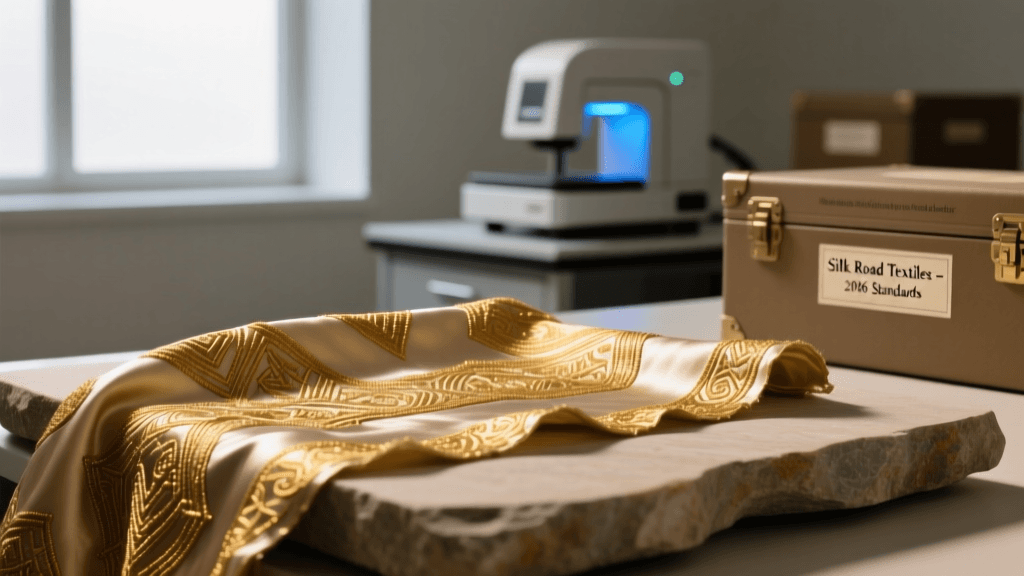
Historically, identifying the organic dyes used in ancient Silk Road textiles required destructive sampling—a practice that is now largely obsolete thanks to 2026 advancements in non-invasive diagnostics. Today, conservators rely heavily on portable multispectral imaging and Fiber Optic Reflectance Spectroscopy (FORS) to map dye distributions across fragile samite weaves without removing a single thread.
By cross-referencing spectral signatures with the CAMEO (Conservation and Art Materials Encyclopedia Online) database, researchers can accurately identify historical colorants such as madder root (Rubia tinctorum) for reds, weld (Reseda luteola) for yellows, and indigo for blues. This non-destructive approach not only preserves the structural integrity of the textile but also provides crucial data on historical trade routes, confirming the presence of imported dyes in local Turpan workshops.
2026 Archival Storage Protocols for Protein Fibers
Silk is a protein fiber, making it highly susceptible to hydrolysis, photo-oxidation, and biological deterioration. The 2026 guidelines established by the ICOM-CC (International Council of Museums - Committee for Conservation) emphasize a proactive, preventive approach to storage. For flat textiles like samite fragments, the primary goal is to eliminate mechanical stress and isolate the artifact from fluctuating microclimates.
Flat Storage and Interleaving Techniques
Never fold an ancient silk fragment. Folding creates permanent creases that weaken the yarn structure, leading to micro-fractures along the warp and weft. In 2026, the standard protocol involves supporting the textile on a rigid, custom-carved Ethafoam plank padded with polyester batting and covered in washed, unbleached cotton muslin. The textile is then interleaved with unbuffered, acid-free tissue paper. Buffered tissue (which contains calcium carbonate) must be strictly avoided, as the alkaline reserve can degrade protein fibers over time.
Microclimate Enclosures and Silica Gel Conditioning
For highly degraded samite fragments, creating a localized microclimate is essential. Conservators now utilize heat-sealed Marvelseal envelopes or custom acrylic vitrines conditioned with pre-hydrated silica gel. This ensures that the relative humidity (RH) surrounding the textile remains perfectly stable, independent of the broader gallery environment.
Environmental Parameters for Samite Preservation
Maintaining a strict environmental baseline is non-negotiable in modern textile conservation. The following table outlines the optimal 2026 environmental parameters for storing and displaying ancient Silk Road silks.
| Parameter | Optimal Range (Storage) | Optimal Range (Display) | Risk of Deviation |
|---|---|---|---|
| Temperature | 18°C - 20°C (64°F - 68°F) | 19°C - 21°C (66°F - 70°F) | Accelerated chemical degradation, embrittlement |
| Relative Humidity (RH) | 45% - 50% | 50% ± 5% | Mold growth (high RH), fiber snapping (low RH) |
| Visible Light (Lux) | 0 Lux (Complete Darkness) | Maximum 50 Lux | Irreversible photo-oxidation, dye fading |
| UV Radiation | 0 µW/lumen | < 10 µW/lumen | Severe protein chain scission |
Mounting and Display: Mitigating Gravity Stress
When exhibiting Astana silks, the physical forces of gravity pose a severe threat to the ancient yarns. The UNESCO Silk Roads Programme frequently highlights the fragility of excavated trade goods, making proper mounting a critical discipline.
In 2026, vertical hanging of fragile samite is strictly prohibited unless the textile is fully supported by a continuous fabric backing. Instead, conservators utilize slant boards angled at 30 to 45 degrees. This reduces the gravitational shear force on the warp threads while still allowing the public to appreciate the intricate Sogdian pearl roundels and facing-duck motifs. Furthermore, magnetic mounting systems using rare-earth neodymium magnets encased in protective silicone sleeves have replaced traditional stitching for securing lightweight fragments to their display backings, distributing tension evenly across the fabric's surface.
Handling Protocols and Personal Protective Equipment
Direct human contact with ancient silk introduces sebum, sweat, and microscopic salts that catalyze fiber degradation. In 2026, the universal standard for handling Astana textiles mandates the use of clean, powder-free nitrile gloves. While cotton gloves were historically preferred, modern conservation science recognizes that cotton can snag on brittle, friable yarns and does not provide an adequate moisture barrier. Nitrile offers superior tactile sensitivity while completely isolating the artifact from skin oils.
Furthermore, all handling must occur over a padded examination table lined with clean Tyvek. Conservators should utilize micro-spatulas and bamboo tweezers tipped with silicone tubing to manipulate fragile edges during mounting or photography. Limiting the duration of handling sessions to 90-minute intervals reduces the risk of accidental fatigue-induced mishaps.
Sourcing Archival Materials: 2026 Cost Guide
For institutions and private collectors budgeting for the preservation of Silk Road artifacts, understanding the current market for conservation-grade materials is vital. Below is a structured breakdown of essential supplies and their estimated 2026 costs:
- Unbuffered Acid-Free Tissue Paper (20 x 30 inches, 100 sheets): $45 - $55. Essential for interleaving and creating soft pillows for textile support.
- Ethafoam Planks (2 inches thick, 24 x 48 inches): $35 - $45 per plank. Used for carving custom, rigid support bases for flat storage.
- Marvelseal 360 Roll (48 inches wide, per linear yard): $18 - $22. An aluminized nylon barrier used to create moisture-proof microclimate envelopes.
- Conditioned Silica Gel Cassettes (Standard 40g): $25 - $30 each. Pre-hydrated to specific RH levels to maintain stable humidity inside vitrines.
- UV-Filtering Acrylic Sheets (Optium Museum Acrylic, 1/8 inch): $150 - $180 per square foot. Provides anti-static, UV-blocking protection for framed display.
Conclusion
The silk fragments unearthed from the Astana Cemetery are more than mere textiles; they are tangible records of a vibrant, interconnected ancient world. By adhering to 2026's rigorous conservation standards—leveraging non-invasive multispectral imaging, enforcing strict microclimate controls, and utilizing gravity-mitigating display mounts—we can ensure that the legacy of the Silk Road remains intact. Proper preservation is an ongoing commitment, requiring both substantial financial investment and a deep respect for the material science of ancient protein fibers.