14th-Century Cotehardie Reconstruction: 2026 Tailoring Guide
The Enduring Allure of the Cotehardie in 2026
As of 2026, the historical reenactment, living history, and Historical European Martial Arts (HEMA) communities have experienced a massive paradigm shift toward uncompromising archaeological accuracy. Gone are the days of synthetic blends and machine-serged seams. Today's dedicated artisans and historical tailors demand garments that mirror the exact drape, weight, and construction of surviving medieval artifacts. At the forefront of this movement is the cotehardie, the iconic fitted tunic of the 14th century that revolutionized European fashion. According to the Victoria and Albert Museum's medieval fashion archives, the transition from loose, draped garments to tailored, body-hugging silhouettes marks one of the most significant leaps in textile history. This comprehensive guide will walk you through the precise tailoring techniques, textile sourcing, and construction methods required to build an authentic 14th-century cotehardie in 2026.
Anatomy of the 14th-Century Silhouette
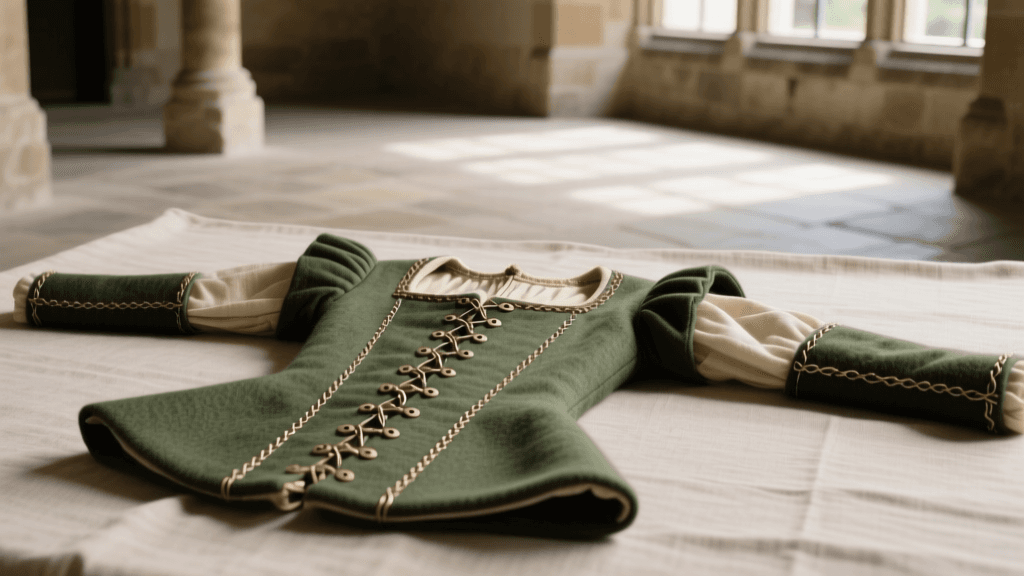
The cotehardie is defined by its close-fitting bodice, flared skirt, and distinct sleeve variations. Unlike earlier tunics that relied on belts to create shape, the cotehardie achieved its silhouette through complex pattern cutting, utilizing curved seams and strategically placed gores. For men, the garment typically fell to the mid-thigh or knee, while women's versions extended to the floor with a trained hem. The waistline was often emphasized without a horizontal waist seam in earlier iterations, relying instead on vertical paneling and side gores to contour the body. By the late 14th century, the introduction of the grande assiette sleeve and tightly spaced buttons transformed the cotehardie into a marvel of medieval engineering, allowing for unprecedented mobility while maintaining a sleek, aristocratic profile.
Sourcing Heritage Textiles: A 2026 Supplier Guide
The foundation of any historically accurate garment is the textile. Modern commercial wools are often heavily processed, fulled to a dense felt, and lack the drape of medieval broadcloth or worsteds. In 2026, specialized heritage weavers across Europe have stepped up to recreate historical weaves, such as diamond twills, herringbone, and tabby weaves, using period-appropriate yarn counts. When sourcing fabric for a cotehardie, you must look for 100% natural fibers—specifically, medium-to-heavy weight wools for the outer shell and high-quality, tightly woven linens for the lining and base layers.
| Supplier | Fabric Type | Weight (GSM) | Best Use | 2026 Price (per meter) |
|---|---|---|---|---|
| Whitchurch Silk Mill | Heritage Tabby Linen | 180 GSM | Base layers, linings | £28.00 |
| Wensleydale Woollens | Diamond Twill Wool | 350 GSM | Outer Cotehardie | £45.00 |
| Historiska Rum | Mörbylång Cast Wool | 420 GSM | Winter garments | £58.00 |
| Ulster Linens | Heavy Bleached Linen | 250 GSM | Structural interlining | £32.00 |
When ordering from these heritage mills in 2026, always request a 'burn test' certificate or a physical swatch to ensure the warp and weft threads are purely natural, as trace synthetic sizing agents can alter the way the fabric accepts natural dyes and reacts to hand-stitching.
Mastering the Grande Assiette Sleeve
The most complex and defining feature of the late 14th-century cotehardie is the grande assiette (great armhole) sleeve. Unlike modern set-in sleeves that restrict arm movement when raised, the grande assiette features an armhole that extends deep into the bodice, sometimes reaching the neckline or the side seams. This ingenious design creates a wide, gusset-like insertion that allows the wearer to lift their arms completely overhead without pulling the bodice up with it—a crucial feature for medieval combat, archery, and labor. To draft this in 2026, tailors use a specialized draping technique on a dress form, pinning the fabric directly to the body to map the exact pivot points of the shoulder joint. The sleeve cap is cut with a long, tapering point that inserts into the bodice, requiring meticulous basting and multiple fittings to ensure the fabric lies flat without unsightly puckering.
Historical Fastenings: The Button Revolution
The 14th century witnessed the explosion of the button as a functional fastener rather than mere decoration. A proper cotehardie requires dozens of tightly spaced buttons running from the neckline down to the hipline, and often down the forearms. According to the Metropolitan Museum of Art's Heilbrunn Timeline of Art History, the proliferation of buttons allowed for the radically fitted silhouettes that defined late medieval European dress. For historical accuracy, you have two primary options: cast metal buttons or cloth buttons. Cast pewter or bronze buttons, modeled after archaeological finds from the Thames River, are ideal for high-status portrayals. However, cloth buttons are incredibly authentic, cost-effective, and widely used. To make a cloth button, cut a perfect circle of your fashion fabric, run a gathering stitch around the edge, and stuff it tightly with scrap wool or linen thread before pulling it closed. The resulting sphere is then secured with a dense web of thread, creating a durable, period-accurate fastener. Buttonholes must be hand-stitched using a dense buttonhole stitch, spaced no more than 1.5 centimeters apart to prevent the bodice from gaping under tension.
Stitching Techniques and Edge Finishes
Machine sewing has no place in a high-end 2026 historical reconstruction. The structural seams of a cotehardie should be sewn using a backstitch with heavily waxed linen thread (typically 35/2 or 50/2 weight). The backstitch provides the necessary tensile strength to withstand the immense pulling force of a tightly fitted bodice. Once the main seams are assembled, the raw edges must be finished to prevent fraying. While modern tailors use sergers, medieval artisans folded the seam allowances together and secured them flat against the interior using a fine running stitch, or bound them in narrow strips of linen. For the visible edges—such as the neckline, hem, and cuffs—tablet weaving or fingerloop braiding was frequently applied. Fingerloop braiding, a technique experiencing a massive revival in 2026 crafting circles, produces a beautiful, rounded cord that can be sewn over the raw edges, providing both structural reinforcement and a vibrant pop of contrasting color.
Natural Dyes and Eco-Mordanting in 2026
The color of your cotehardie communicates your social status and regional origin. In 2026, the push for sustainable, eco-friendly historical crafting has led to a renaissance in natural dyeing. Artisans are moving away from harsh chemical mordants like chrome and are instead utilizing bio-mordants, such as symplocos (a plant-based aluminum source) and tannin-rich oak galls. Achieving the deep, saturated blues of woad or the rich reds of madder root requires patience and precise temperature control, but the resulting colors possess a depth and luminosity that synthetic dyes simply cannot replicate. A deep, madder-red cotehardie lined with saffron-yellow linen remains one of the most striking and historically validated combinations for a prosperous 14th-century merchant or minor noble portrayal.
Conclusion
Reconstructing a 14th-century cotehardie is a rigorous but deeply rewarding endeavor. By embracing the complex geometry of the grande assiette sleeve, sourcing authentic heritage textiles, and committing to the slow, deliberate pace of hand-stitching, modern makers can create garments that are not merely costumes, but living, breathing continuations of European textile heritage. As the standards for historical accuracy continue to rise in 2026, mastering these foundational medieval tailoring techniques ensures your work will stand the test of time, both on the reenactment field and in the annals of historical dressmaking.